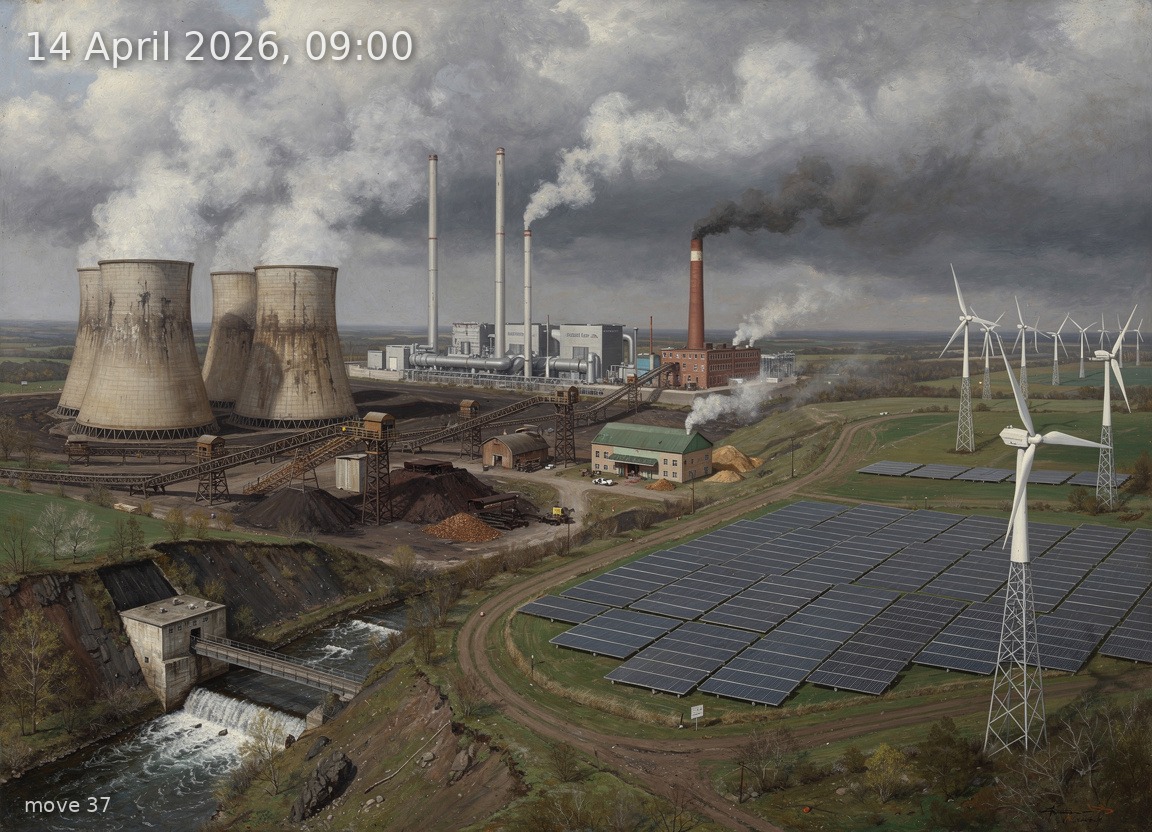
Solar leads at 12.1 GW under overcast skies; heavy coal and gas dispatch plus 15.9 GW net imports meet strong morning demand.
Back
Generation mix
Wind onshore 12%
Wind offshore 3%
Solar 25%
Biomass 9%
Hydro 3%
Natural gas 20%
Hard coal 8%
Brown coal 20%
52%
Renewable share
7.4 GW
Wind (on + offshore)
12.1 GW
Solar
49.4 GW
Total generation
-15.9 GW
Net import
144.3 €/MWh
Day-ahead price
8.3°C / 16 km/h
Temp / Wind speed
Open-Meteo, Kassel (51.3°N 9.5°E)
91.0% / 36.5 W/m²
Cloud cover / Radiation
323
gCO₂/kWh
Image prompt
Brown coal 9.7 GW dominates the left quarter as a cluster of massive hyperbolic cooling towers with thick white-grey steam plumes merging into the overcast sky, surrounded by conveyor belts carrying dark lignite; natural gas 10.0 GW fills the centre-left as a row of modern combined-cycle gas turbine plants with tall slender exhaust stacks venting thin heat shimmer; solar 12.1 GW stretches across the centre-right as vast fields of aluminium-framed crystalline silicon PV panels on rolling farmland, their surfaces reflecting only flat grey light under the heavy clouds; wind onshore 5.9 GW appears as a line of three-blade turbines with white lattice towers on gentle hills in the right portion, blades turning at moderate speed in the 16 km/h breeze; wind offshore 1.6 GW is suggested by a few distant turbines on a hazy horizon line at far right; hard coal 4.2 GW sits behind the brown coal as a smaller power station with a single large chimney emitting darker smoke; biomass 4.5 GW appears as a modest wood-fired plant with a green-roofed building and small stack near the centre; hydro 1.5 GW is represented by a small dam and penstock visible in a valley at far left. The sky is 91% overcast—a heavy, oppressive, nearly uniform blanket of grey stratocumulus pressing low, with only faint diffuse brightness indicating the sun's position at a mid-morning angle; direct sunlight is almost absent, consistent with 36.5 W/m² direct radiation. Vegetation is early spring: bare branches with first pale-green buds, brown-green grass, patches of lingering winter mud. The atmosphere feels dense and weighty, conveying the high electricity price through visual heaviness—muted tones, damp air, industrial haze blending with cloud base. The scene is rendered as a highly detailed oil painting in the tradition of 19th-century German Romantic landscape painters such as Caspar David Friedrich and Carl Blechen, with rich but subdued colour palette, visible textured brushwork, atmospheric perspective giving depth across the panoramic industrial-pastoral landscape, and meticulous engineering accuracy in every turbine nacelle, cooling tower curvature, PV panel frame, and smokestack detail. No text, no labels.