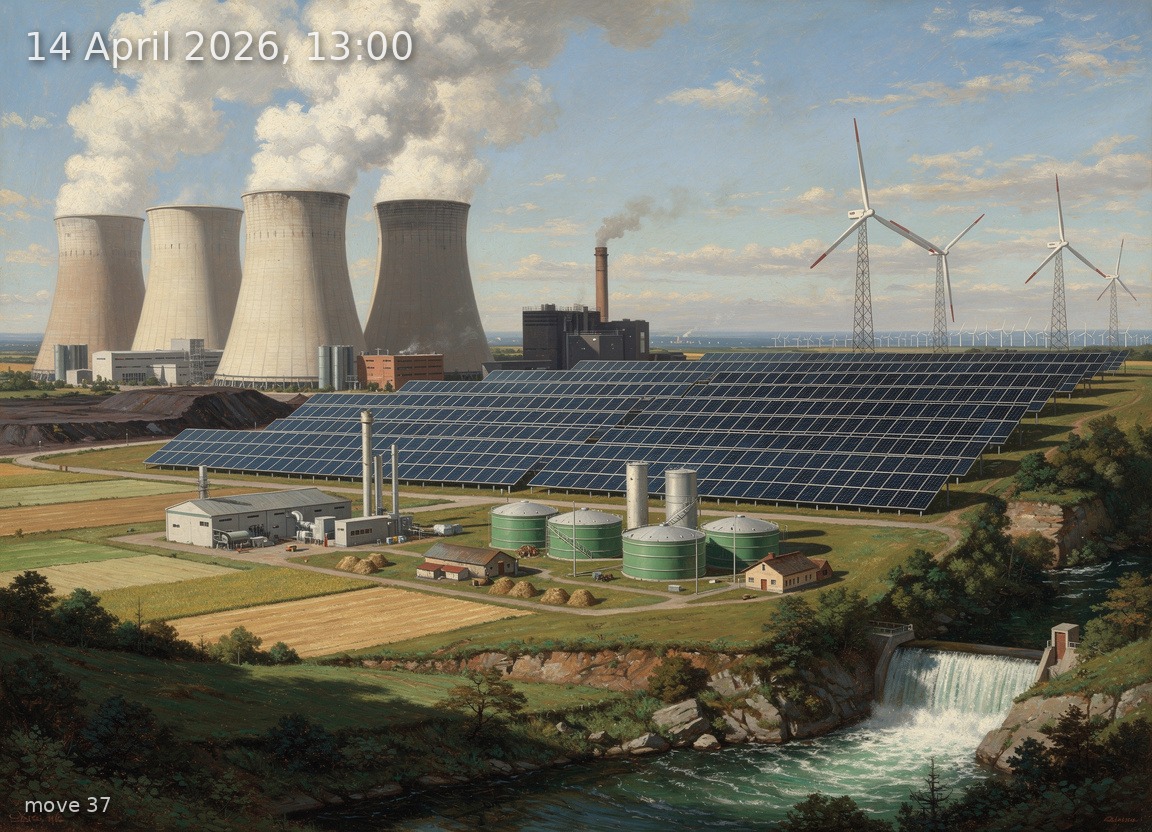
Solar leads at 25.7 GW with coal and gas backing; 7.2 GW net imports fill the gap at elevated prices.
Back
Generation mix
Wind onshore 10%
Wind offshore 2%
Solar 46%
Biomass 7%
Hydro 3%
Natural gas 12%
Hard coal 6%
Brown coal 14%
68%
Renewable share
6.8 GW
Wind (on + offshore)
25.7 GW
Solar
56.1 GW
Total generation
-7.2 GW
Net import
104.7 €/MWh
Day-ahead price
12.9°C / 14 km/h
Temp / Wind speed
Open-Meteo, Kassel (51.3°N 9.5°E)
56.0% / 437.5 W/m²
Cloud cover / Radiation
218
gCO₂/kWh
Image prompt
Solar 25.7 GW dominates the centre-right as vast rolling fields of crystalline silicon PV panels angled toward a high midday sun, their aluminium frames glinting, stretching across nearly half the canvas; brown coal 7.6 GW occupies the far left as a cluster of massive hyperbolic cooling towers trailing thick white steam plumes into the sky; natural gas 6.9 GW sits left-of-centre as compact combined-cycle gas turbine plants with slender exhaust stacks venting thin heat shimmer; hard coal 3.5 GW appears behind the lignite station as a smaller set of rectangular boiler buildings with a single squat chimney; wind onshore 5.8 GW spans the right horizon as a line of three-blade turbines on lattice towers turning slowly in a light breeze of 14 km/h; wind offshore 1.0 GW is visible as tiny distant turbines on the far-right horizon suggesting a coastline; biomass 4.1 GW appears as a mid-ground agricultural biogas facility with green cylindrical digesters and a modest stack; hydro 1.5 GW is rendered as a small dam and spillway nestled into a wooded hillside at far right. The sky is spring midday daylight with 56% cloud cover — patches of cumulus clouds drifting across a blue sky, direct sunlight breaking through in broad shafts, casting warm highlights and cool cloud shadows across the landscape. The atmosphere feels heavy and slightly oppressive, reflecting the high 104.7 EUR/MWh price — a subtle amber-tinged haze sits along the horizon, giving the air a dense, costly warmth. Vegetation is early spring: fresh pale-green buds on deciduous trees, bright grass beginning to grow, scattered wildflowers. Temperature around 13°C gives crisp light without summer haze. High-voltage transmission lines cross the scene, hinting at the 7.2 GW of imports flowing in. Painted in the style of a highly detailed 19th-century German Romantic oil painting — rich impasto brushwork, atmospheric depth with luminous skies reminiscent of Caspar David Friedrich crossed with industrial realism, meticulous engineering detail on every turbine nacelle, every PV cell grid line, every cooling tower's parabolic curve. No text, no labels.