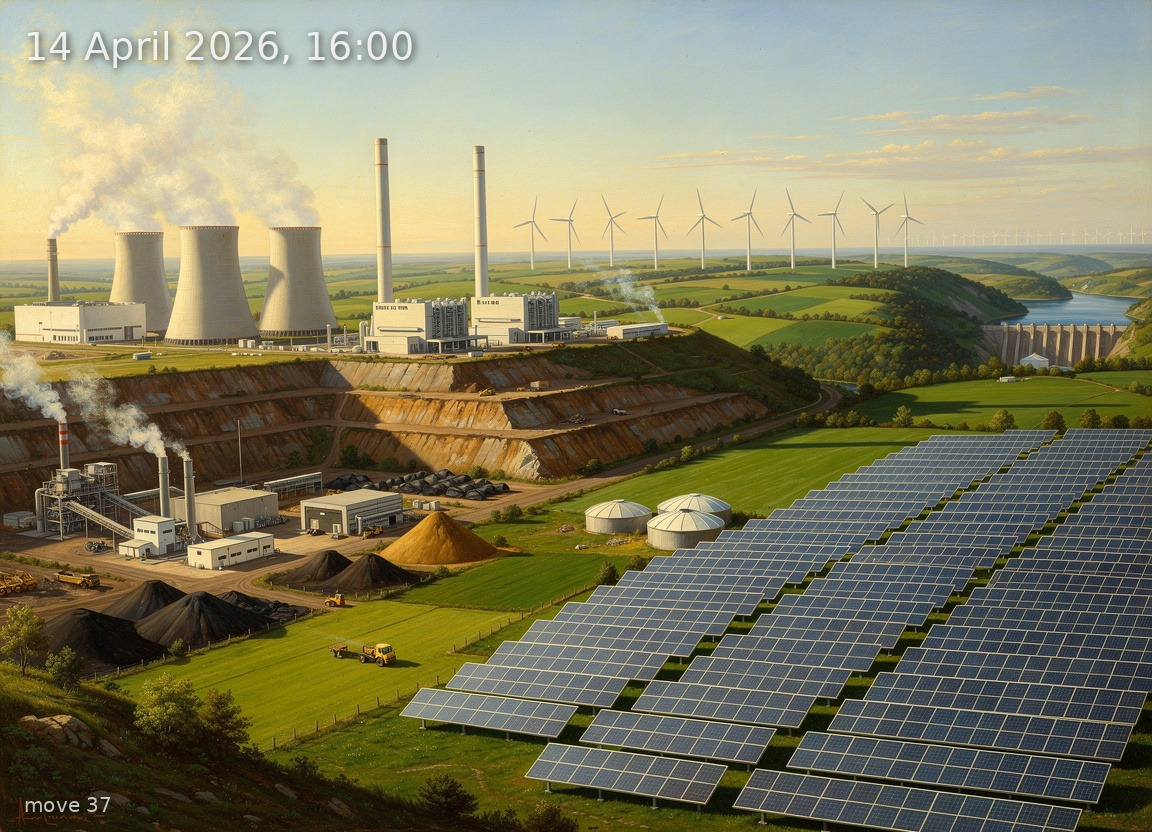
Strong solar at 17.1 GW and heavy coal and gas dispatch cannot meet 59.4 GW demand, requiring 12.8 GW net imports.
Back
Generation mix
Wind onshore 11%
Wind offshore 1%
Solar 37%
Biomass 9%
Hydro 3%
Natural gas 14%
Hard coal 9%
Brown coal 16%
61%
Renewable share
5.6 GW
Wind (on + offshore)
17.1 GW
Solar
46.6 GW
Total generation
-12.8 GW
Net import
121.7 €/MWh
Day-ahead price
14.3°C / 13 km/h
Temp / Wind speed
Open-Meteo, Kassel (51.3°N 9.5°E)
3.0% / 453.2 W/m²
Cloud cover / Radiation
268
gCO₂/kWh
Image prompt
Solar 17.1 GW dominates the right half of the scene as vast fields of aluminium-framed crystalline silicon photovoltaic panels stretching across rolling green spring farmland, glinting intensely under a brilliant late-afternoon sun at about 40 degrees elevation in a nearly cloudless pale-blue sky. Brown coal 7.6 GW occupies the left foreground as a massive lignite power station with three hyperbolic cooling towers releasing thick white steam plumes drifting slowly rightward, beside open-pit mining terraces. Natural gas 6.7 GW appears centre-left as two modern combined-cycle gas turbine plants with tall slim exhaust stacks and modest heat shimmer. Wind onshore 5.2 GW is rendered as a line of fifteen three-blade turbines on a low ridge in the centre-background, rotors turning slowly in the moderate breeze. Hard coal 4.0 GW sits far left as a rectangular boiler house with a single large smokestack trailing grey emissions. Biomass 4.1 GW appears as a cluster of smaller industrial buildings with woodchip storage domes near the coal station. Hydro 1.5 GW is suggested by a modest concrete dam and reservoir glimpsed in a valley at far right. Wind offshore 0.4 GW is hinted at by tiny turbine silhouettes on a hazy horizon line. The atmosphere feels warm but heavy and slightly oppressive despite the sunshine, with a faint yellowish industrial haze settling over the thermal plants — reflecting the high electricity price. Spring vegetation is fresh bright green, wildflowers dot meadow edges, temperature around 14°C gives a cool crispness to shadows. Full afternoon daylight with long golden tones beginning to develop. Highly detailed oil painting in the tradition of 19th-century German Romantic landscape painters — rich saturated colour, visible confident brushwork, deep atmospheric perspective — combined with meticulous engineering accuracy for every turbine nacelle, PV panel frame, cooling tower curvature, and exhaust stack. No text, no labels.