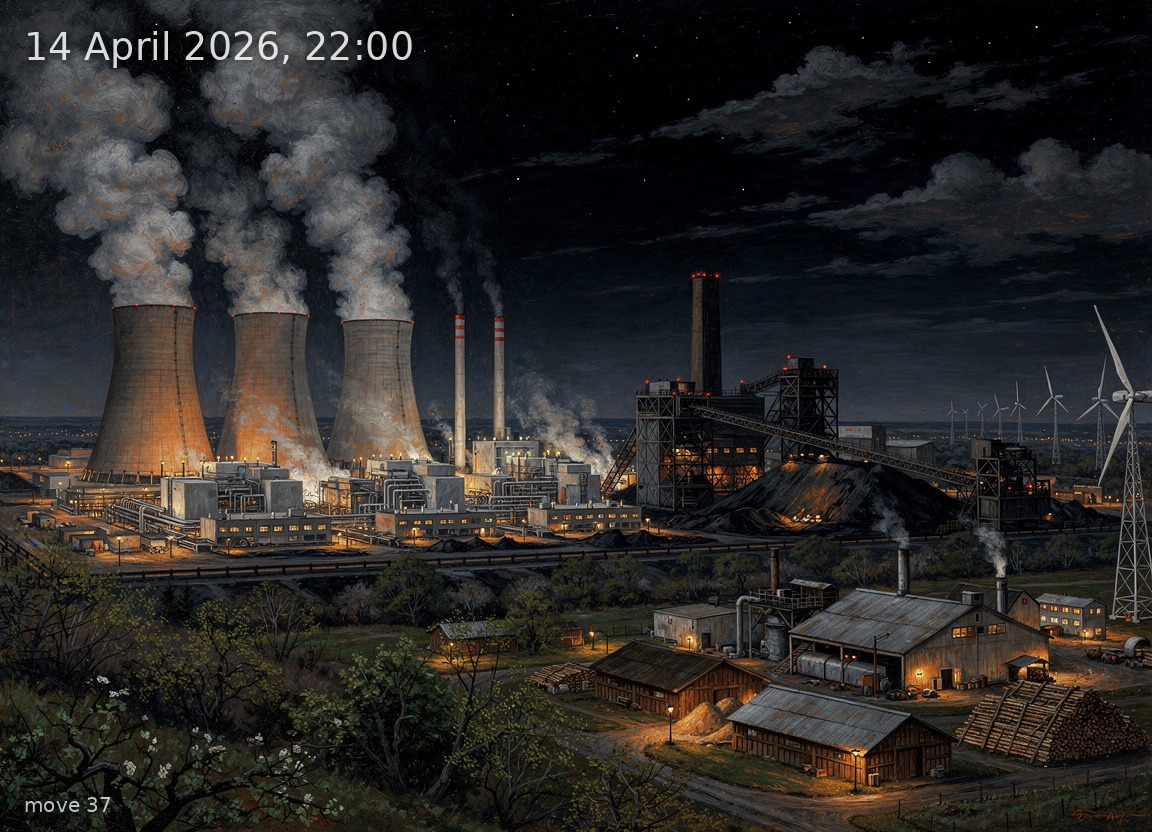
Brown coal, gas, and hard coal dominate nighttime generation as low wind and no solar force heavy net imports.
Back
Generation mix
Wind onshore 12%
Wind offshore 0%
Biomass 13%
Hydro 4%
Natural gas 32%
Hard coal 13%
Brown coal 26%
30%
Renewable share
4.4 GW
Wind (on + offshore)
0.0 GW
Solar
35.4 GW
Total generation
-18.5 GW
Net import
148.3 €/MWh
Day-ahead price
9.0°C / 4 km/h
Temp / Wind speed
Open-Meteo, Kassel (51.3°N 9.5°E)
11.0% / 0.0 W/m²
Cloud cover / Radiation
462
gCO₂/kWh
Image prompt
Brown coal 9.0 GW occupies the left third of the scene as a sprawling lignite complex with four massive hyperbolic cooling towers emitting thick white-grey steam plumes into the night sky; natural gas 11.4 GW fills the centre-left as a bank of compact CCGT power stations with tall single exhaust stacks releasing shimmering heat haze; hard coal 4.5 GW appears centre-right as a dark industrial plant with conveyors, a large chimney, and a glowing coal stockyard; biomass 4.6 GW is rendered as a cluster of smaller industrial facilities with timber-framed fuel stores and modest stacks; onshore wind 4.2 GW stands along the right edge as a sparse line of three-blade turbines on lattice towers, blades barely turning in the negligible breeze; hydro 1.6 GW appears as a small dam with water glinting faintly in the far background. The scene is set at 22:00 in April — fully dark, a deep black-navy sky with a few scattered stars visible through 11% cloud cover, no twilight or sky glow whatsoever. All illumination comes from sodium-orange streetlights, the amber glow of furnace mouths, lit control-room windows, and red aviation warning lights atop cooling towers and turbine nacelles. The atmosphere feels heavy and oppressive, reflecting the high electricity price — a thick industrial haze hangs low, diffusing the artificial light into murky haloes. Early spring vegetation is just visible in the foreground: bare-branched trees budding faintly, damp grass at 9°C. Style: highly detailed oil painting in the tradition of 19th-century German Romantic landscape painters — Caspar David Friedrich meets industrial sublime — rich dark palette of indigo, umber, ochre, and sulphurous orange, visible impasto brushwork, atmospheric depth receding into darkness, meticulous engineering detail on every turbine nacelle, cooling tower flute, and exhaust stack. No text, no labels.