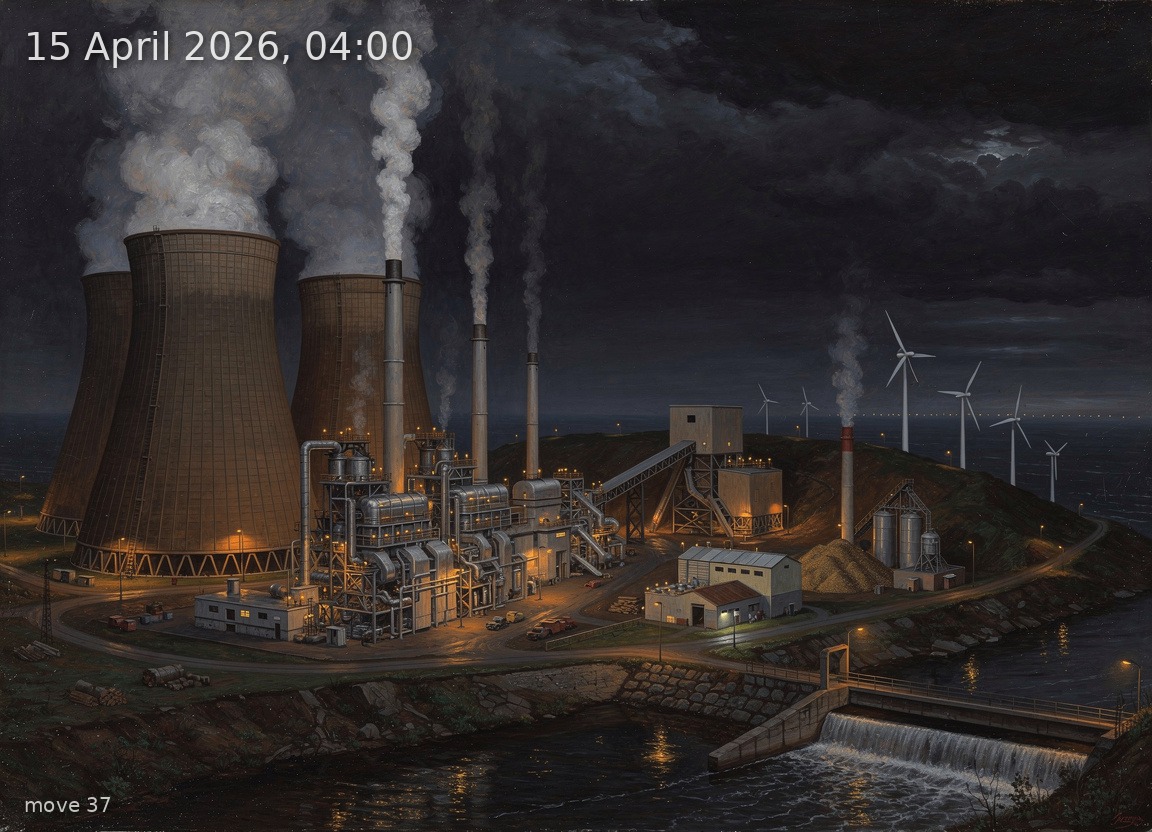
Brown coal and natural gas dominate overnight generation as low wind, no solar, and cold weather drive 11.8 GW net imports.
Back
Generation mix
Wind onshore 11%
Wind offshore 4%
Biomass 12%
Hydro 4%
Natural gas 28%
Hard coal 13%
Brown coal 28%
31%
Renewable share
5.3 GW
Wind (on + offshore)
0.0 GW
Solar
34.9 GW
Total generation
-11.8 GW
Net import
110.8 €/MWh
Day-ahead price
1.4°C / 4 km/h
Temp / Wind speed
Open-Meteo, Kassel (51.3°N 9.5°E)
100.0% / 0.0 W/m²
Cloud cover / Radiation
463
gCO₂/kWh
Image prompt
Brown coal 9.9 GW dominates the left third of the scene as a cluster of massive hyperbolic cooling towers with thick white-grey steam plumes rising into darkness; natural gas 9.7 GW fills the centre-left as a row of compact CCGT plants with tall single exhaust stacks emitting thin vapour trails, lit by orange sodium lamps; hard coal 4.4 GW appears centre-right as a smaller coal plant with conveyor belts and a single squat cooling tower; biomass 4.2 GW is rendered as a modest wood-chip-fed CHP facility with a gently smoking chimney at centre-right; wind onshore 4.0 GW stands as a sparse line of three-blade turbines on a low ridge in the right background, blades nearly still; wind offshore 1.3 GW is suggested by tiny distant turbines on a dark horizon line at far right; hydro 1.5 GW appears as a small concrete dam with spillway at the far right foreground edge. The time is 04:00 — a completely dark, starless night sky, deep black-navy, no twilight, no sky glow. Overcast cloud cover at 100% erases all stars. Temperature is near freezing: frost glints on bare early-spring branches, patches of frost on the ground, dormant brown grass with no green yet. Wind is almost absent — smoke and steam rise nearly vertically. The atmosphere feels heavy, oppressive, dense with unseen moisture, conveying the tension of high electricity prices. Sodium-orange industrial lighting bathes the power plants, casting long amber reflections on wet tarmac and puddles. In the far background, a faint silhouette of a German village with a few warm-lit windows. Highly detailed oil painting in the tradition of 19th-century German Romantic landscape painters — Caspar David Friedrich's brooding darkness meets industrial sublime — rich colour contrasts of deep indigo sky against warm amber industrial glow, visible thick brushwork, atmospheric depth and haze, meticulous engineering accuracy on turbine nacelles, cooling tower ribbing, CCGT exhaust geometries, conveyor structures. No text, no labels.