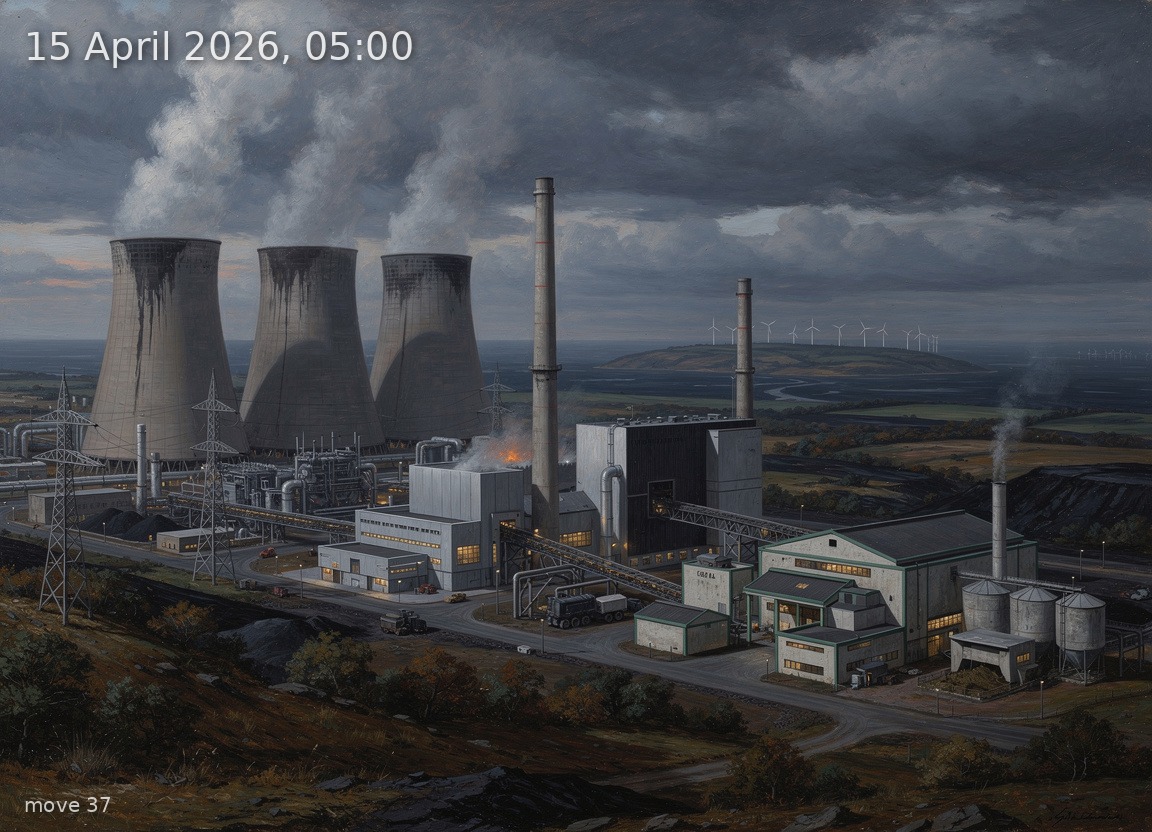
Brown coal, gas, and hard coal dominate a 35 GW domestic supply requiring 15 GW net imports under cold, calm, overcast pre-dawn conditions.
Back
Generation mix
Wind onshore 12%
Wind offshore 4%
Biomass 12%
Hydro 4%
Natural gas 27%
Hard coal 13%
Brown coal 28%
32%
Renewable share
5.5 GW
Wind (on + offshore)
0.0 GW
Solar
35.0 GW
Total generation
-15.0 GW
Net import
123.2 €/MWh
Day-ahead price
0.4°C / 4 km/h
Temp / Wind speed
Open-Meteo, Kassel (51.3°N 9.5°E)
100.0% / 0.0 W/m²
Cloud cover / Radiation
459
gCO₂/kWh
Image prompt
Brown coal 9.9 GW dominates the left third of the scene as a massive lignite power station complex with four hyperbolic cooling towers emitting thick white-grey steam plumes rising into the darkness; natural gas 9.6 GW fills the centre-left as a cluster of compact CCGT plants with tall single exhaust stacks, each venting thin heat shimmer and faint orange-lit exhaust; hard coal 4.4 GW appears centre-right as a coal-fired station with rectangular boiler houses, conveyor belts, and a pair of shorter concrete stacks trailing grey smoke; biomass 4.2 GW is rendered as a wood-chip-fuelled CHP plant with a modest green-trimmed building and a single stack with pale vapour, positioned right of centre; wind onshore 4.1 GW appears as a sparse row of tall three-blade turbines on low hills in the right background, rotors barely turning in negligible wind; wind offshore 1.5 GW is suggested by tiny turbine silhouettes on a distant dark sea horizon at far right; hydro 1.5 GW is depicted as a small run-of-river weir with a powerhouse at the bottom-right foreground edge. Time is 05:00 pre-dawn in central Germany mid-April: the sky is deep blue-grey with the faintest pale band on the eastern horizon, no direct sunlight, no stars visible through 100% overcast, freezing air at 0.4°C with frost on grass and bare early-spring trees with only the smallest leaf buds. The atmosphere is heavy and oppressive, reflecting a high electricity price — low dense clouds press down, industrial vapour merges with overcast, sodium-orange streetlights and amber facility lights cast pools of warm glow on wet roads and frost-covered ground. No solar panels anywhere. The overall composition is a highly detailed oil painting in the tradition of 19th-century German Romantic landscape painters — rich, dark colour palette of indigo, slate grey, amber, and ochre, visible confident brushwork, deep atmospheric perspective, meticulous engineering detail on every turbine nacelle, cooling tower, and exhaust stack, conveying the weight of an industrial nation drawing power before dawn. No text, no labels.