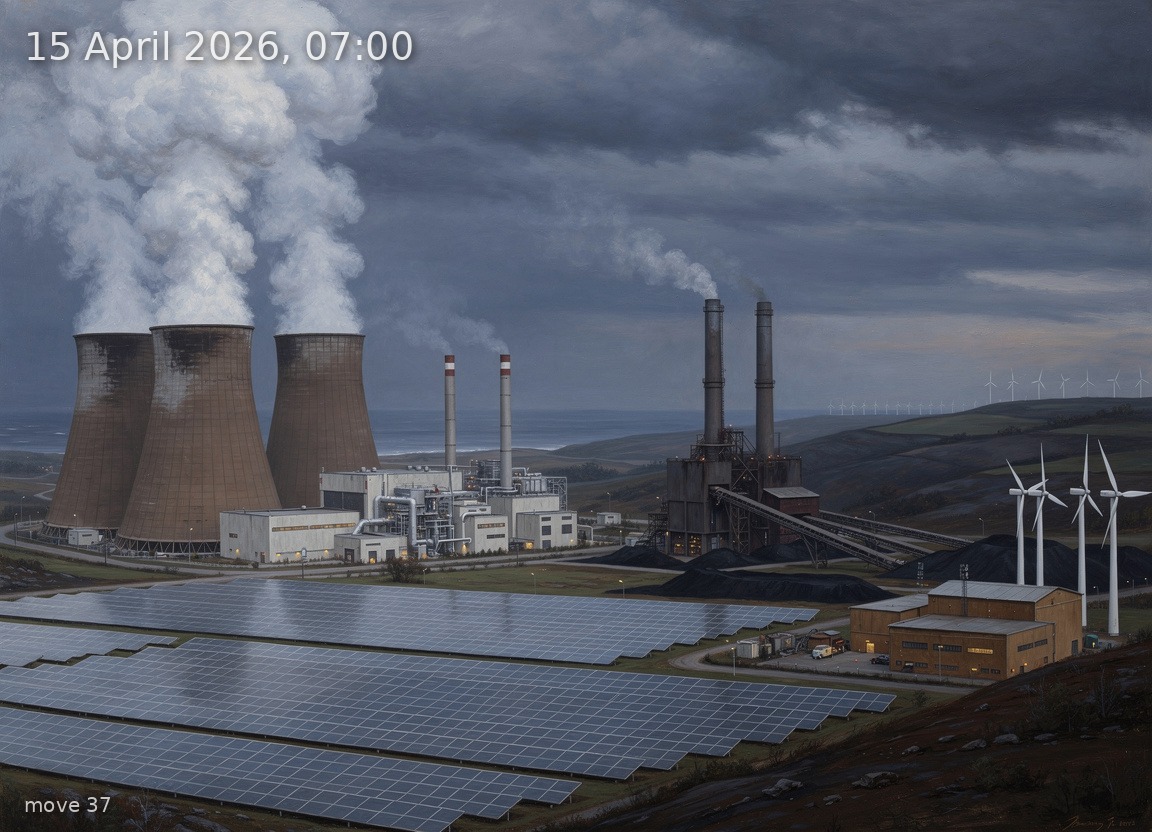
Gas and brown coal dominate as cold, windless overcast suppresses renewables, driving high prices and ~21.7 GW net imports.
Back
Generation mix
Wind onshore 10%
Wind offshore 4%
Solar 12%
Biomass 11%
Hydro 4%
Natural gas 25%
Hard coal 11%
Brown coal 24%
40%
Renewable share
5.6 GW
Wind (on + offshore)
4.7 GW
Solar
40.5 GW
Total generation
-21.6 GW
Net import
159.6 €/MWh
Day-ahead price
0.7°C / 4 km/h
Temp / Wind speed
Open-Meteo, Kassel (51.3°N 9.5°E)
100.0% / 0.0 W/m²
Cloud cover / Radiation
402
gCO₂/kWh
Image prompt
Brown coal 9.8 GW dominates the left third of the scene as a massive lignite power station with four hyperbolic cooling towers emitting thick white steam plumes into the heavy sky; natural gas 10.0 GW fills the centre-left as a cluster of compact CCGT plants with tall single exhaust stacks venting thin grey plumes; hard coal 4.5 GW appears centre-right as a dark industrial block with twin chimneys and coal conveyors; solar 4.7 GW is represented in the mid-ground as vast fields of aluminium-framed crystalline silicon PV panels reflecting only dull grey light under total overcast; wind onshore 4.1 GW appears as a modest row of three-blade turbines on gentle hills to the right, their rotors barely turning in negligible wind; wind offshore 1.5 GW is suggested by distant turbines on a grey horizon line at far right; biomass 4.4 GW is a medium-sized plant with a rounded wood-chip silo and modest steam stack in the right foreground; hydro 1.5 GW appears as a small concrete run-of-river dam with white water spilling, nestled in the far background valley. Time is early dawn at 07:00 in mid-April: the sky is a deep blue-grey pre-dawn wash with the faintest pale luminescence along the eastern horizon, no direct sun visible, no warm tones — only cold steel-blue light. The atmosphere is oppressive and heavy, reflecting the 159.6 EUR/MWh price: low dense stratiform clouds blanket the entire sky edge to edge with zero breaks, pressing down on the landscape. Temperature is near freezing at 0.7°C: patches of white frost cover bare fields and rooftops, early spring vegetation is sparse — leafless birch and alder trees with only the faintest green buds, brown dormant grass. Transmission towers and high-voltage lines recede into misty distance, suggesting the heavy import flows. Rendered as a highly detailed oil painting in the tradition of 19th-century German Romantic landscape masters — Caspar David Friedrich's atmospheric bleakness merged with meticulous industrial realism — rich layered colour in muted slate-blues, ash-greys, and cold ochres, visible impasto brushwork, deep atmospheric perspective with morning mist clinging to valleys, each power technology painted with correct engineering detail. No text, no labels.