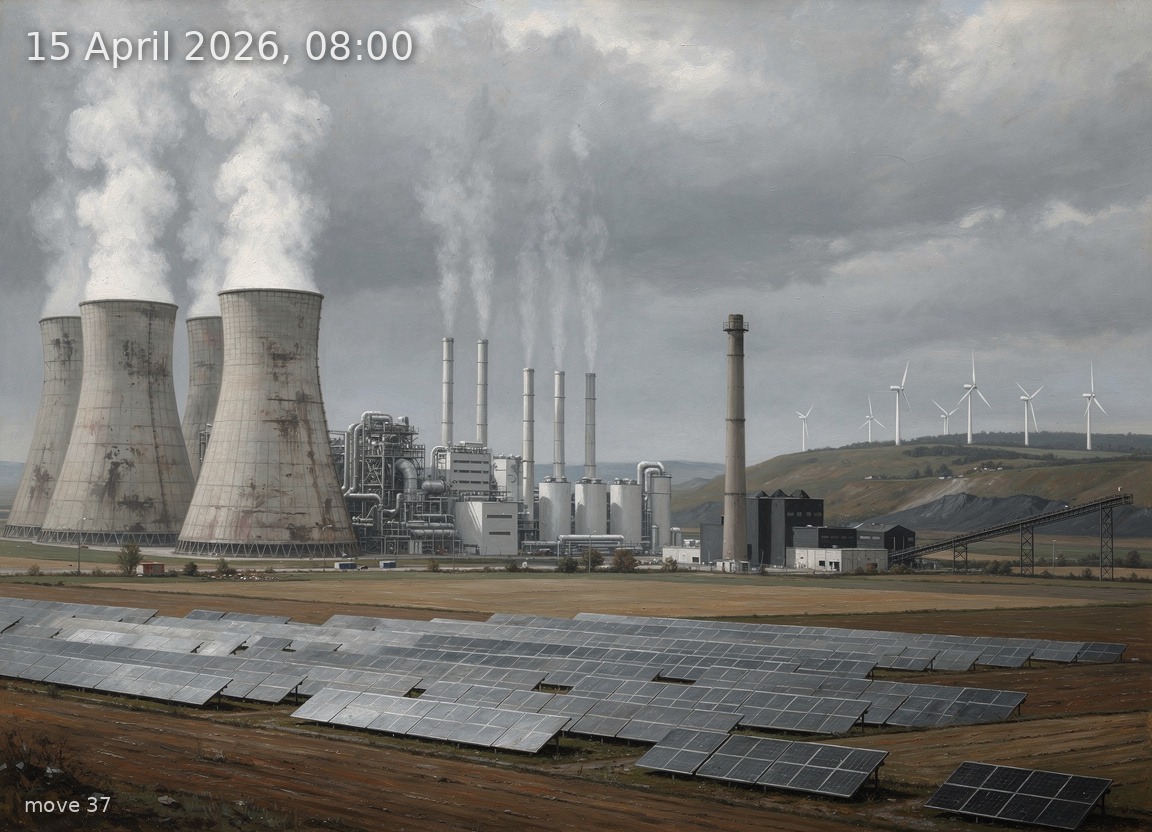
Cold overcast morning: gas, brown coal, and hard coal dominate as weak wind and muted solar drive 140 EUR/MWh prices.
Back
Generation mix
Wind onshore 7%
Wind offshore 3%
Solar 28%
Biomass 9%
Hydro 3%
Natural gas 20%
Hard coal 9%
Brown coal 20%
51%
Renewable share
5.1 GW
Wind (on + offshore)
14.1 GW
Solar
49.5 GW
Total generation
-15.2 GW
Net import
140.1 €/MWh
Day-ahead price
1.0°C / 4 km/h
Temp / Wind speed
Open-Meteo, Kassel (51.3°N 9.5°E)
100.0% / 4.5 W/m²
Cloud cover / Radiation
330
gCO₂/kWh
Image prompt
Brown coal 9.8 GW dominates the left quarter of the scene as a massive lignite power station with four hyperbolic cooling towers emitting thick white steam plumes into the grey sky; natural gas 10.1 GW occupies the centre-left as a cluster of modern combined-cycle gas turbine plants with slender exhaust stacks trailing wispy vapour; hard coal 4.5 GW appears centre-right as a smaller coal plant with a single tall chimney and dark conveyor belts feeding fuel; solar 14.1 GW fills a broad middle-ground as vast fields of aluminium-framed crystalline silicon PV panels stretching across flat farmland, their surfaces dull and reflective-grey under the overcast, producing power but receiving no direct sunlight; wind onshore 3.5 GW is visible as a scattered row of three-blade turbines on low hills in the right background, rotors turning almost imperceptibly in the still air; wind offshore 1.5 GW is suggested by distant turbines on a hazy grey horizon line at far right; biomass 4.5 GW appears as a medium-sized wood-chip-fed plant with a squat industrial building and a gently smoking stack in the right foreground; hydro 1.5 GW is a small run-of-river station with a weir visible along a cold river cutting through the lower foreground. The sky is entirely overcast at 100% cloud cover—a flat, heavy, oppressive ceiling of uniform grey pressing down on the landscape, evoking expensive, tight market conditions. Time is 08:00 in April: full daylight but completely diffuse, no shadows, a cold blue-grey ambient light. Temperature is 1 °C: bare deciduous trees with no leaves, frost on brown grass, patches of lingering ice along the riverbank, breath-like steam visible near structures. Wind is nearly calm: no motion in grass, flags hang limp. Highly detailed oil painting in the tradition of 19th-century German Romantic landscape painters—Caspar David Friedrich meets industrial modernity—rich muted earth tones, visible expressive brushwork, deep atmospheric perspective through layers of haze and steam, meticulous engineering accuracy on every turbine nacelle, cooling tower, PV module frame, and smokestack. No text, no labels.