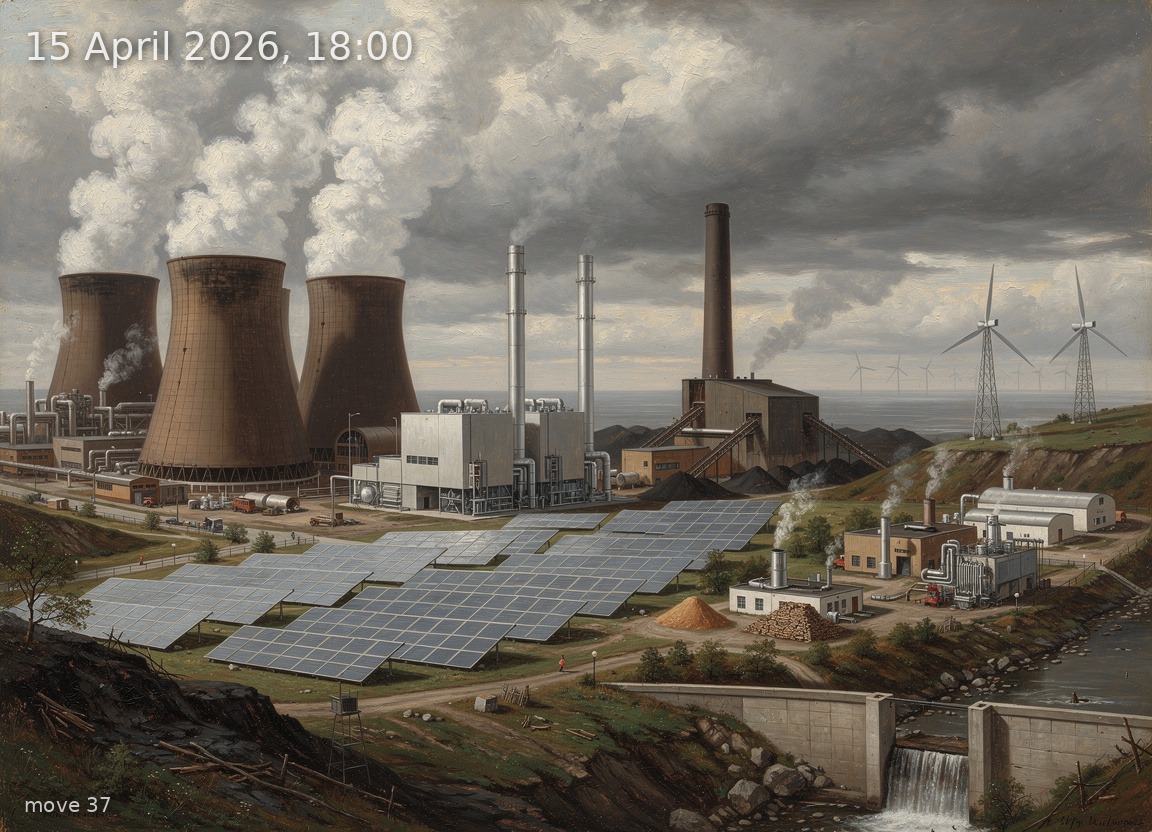
Brown coal, gas, and imports dominate as near-zero wind and overcast skies limit renewables during the evening demand peak.
Back
Generation mix
Wind onshore 3%
Wind offshore 3%
Solar 21%
Biomass 11%
Hydro 4%
Natural gas 21%
Hard coal 12%
Brown coal 26%
42%
Renewable share
2.2 GW
Wind (on + offshore)
7.8 GW
Solar
37.1 GW
Total generation
-23.5 GW
Net import
141.9 €/MWh
Day-ahead price
16.6°C / 2 km/h
Temp / Wind speed
Open-Meteo, Kassel (51.3°N 9.5°E)
100.0% / 90.8 W/m²
Cloud cover / Radiation
398
gCO₂/kWh
Image prompt
Brown coal 9.5 GW dominates the left third of the scene as a massive lignite power complex with four hyperbolic cooling towers emitting thick white steam plumes; natural gas 7.7 GW fills the centre-left as two compact CCGT units with tall single exhaust stacks venting thin heat shimmer; solar 7.8 GW appears across the centre as expansive fields of aluminium-framed crystalline silicon PV panels angled toward the dim sky, their surfaces reflecting only flat grey light; hard coal 4.3 GW occupies the centre-right as a traditional coal plant with a single large smokestack and coal conveyors; biomass 4.3 GW appears as a cluster of smaller wood-chip-fired CHP facilities with modest chimneys and steam; wind onshore 1.2 GW is represented by two three-blade turbines on lattice towers in the right background, blades perfectly still in the windless air; wind offshore 1.0 GW is suggested by faint silhouettes of offshore turbines on a distant grey sea horizon at far right; hydro 1.4 GW appears as a concrete dam with modest spillway in the right foreground. The sky is completely overcast with heavy, low, oppressive pewter-grey clouds — no blue, no sun visible — conveying the high electricity price and stifling atmosphere. Time is 18:00 in mid-April dusk: a dim orange-red glow barely visible along the lowest horizon line beneath the cloud deck, the upper sky darkening toward slate grey, the landscape lit in flat, fading, warm-cool transitional light. Temperature is mild at 16.6°C; fresh green spring vegetation — young beech leaves, bright grass — covers rolling hills between the industrial installations. The air is perfectly still, no motion in trees or turbine blades. Transmission lines with tall steel pylons stretch toward the horizon in multiple directions, suggesting heavy power flows and imports. Highly detailed oil painting in the tradition of 19th-century German Romantic landscape painters — rich colour palette of greys, ochres, muted greens, and dusky amber — visible impasto brushwork, dramatic atmospheric depth, meticulous engineering detail on every turbine nacelle, cooling tower, panel frame, and smokestack. No text, no labels.