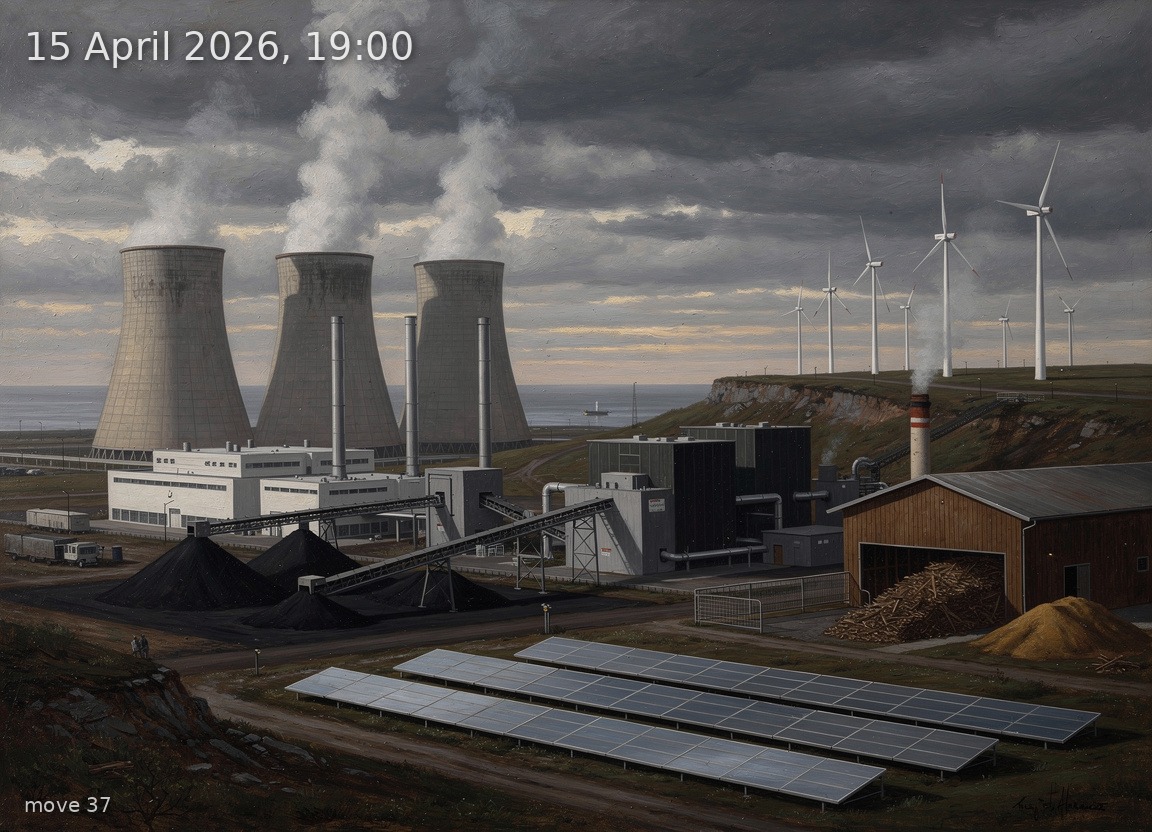
Brown coal and gas dominate at 19 GW combined as weak wind, fading solar, and high demand drive 180 EUR/MWh prices and heavy imports.
Back
Generation mix
Wind onshore 5%
Wind offshore 4%
Solar 6%
Biomass 13%
Hydro 4%
Natural gas 28%
Hard coal 13%
Brown coal 28%
31%
Renewable share
2.9 GW
Wind (on + offshore)
1.9 GW
Solar
34.0 GW
Total generation
-26.8 GW
Net import
180.1 €/MWh
Day-ahead price
16.7°C / 3 km/h
Temp / Wind speed
Open-Meteo, Kassel (51.3°N 9.5°E)
100.0% / 25.0 W/m²
Cloud cover / Radiation
463
gCO₂/kWh
Image prompt
Brown coal 9.6 GW dominates the left third of the scene as a cluster of massive hyperbolic cooling towers with thick white-grey steam plumes rising into the overcast sky; natural gas 9.4 GW fills the centre-left as a row of compact CCGT power plants with tall single exhaust stacks emitting thin heat shimmer; hard coal 4.4 GW appears centre-right as a smaller coal plant with rectangular boiler houses and conveyor belts feeding dark fuel; biomass 4.4 GW is rendered as a timber-clad industrial facility with a modest stack and woodchip storage piles beside it; solar 1.9 GW appears as a modest field of aluminium-framed crystalline silicon panels in the mid-ground reflecting only dull grey sky, no sunlight on them; wind onshore 1.7 GW shows as a few three-blade turbines on a gentle ridge, rotors nearly still in the calm air; wind offshore 1.3 GW is suggested by distant turbines barely visible on a flat grey horizon line; hydro 1.4 GW appears as a small dam structure with water cascading into a river at the far right edge. The lighting is late dusk at 19:00 in April — a rapidly fading orange-red glow barely visible along the lower horizon, the sky above dark slate-grey graduating to deep blue-grey at the zenith, cloud cover is total at 100%, oppressive and low-hanging. The atmosphere is heavy and brooding, reflecting the extreme 180 EUR/MWh price — a sense of industrial weight pressing down. Spring vegetation is present: fresh green grass and budding trees at 16.7°C, but muted in the fading light. Smoke and steam from the thermal plants drift sluggishly in the near-calm 2.9 km/h wind. Sodium streetlights along an access road are just beginning to flicker on. Style: highly detailed oil painting in the tradition of 19th-century German Romantic landscape painting — rich, dark colour palette of umber, slate, ochre, and muted green; visible impasto brushwork; deep atmospheric perspective with layers of industrial haze; meticulous engineering detail on every turbine nacelle, cooling tower, and exhaust stack. The composition evokes Caspar David Friedrich's sense of sublime scale but applied to industrial infrastructure. No text, no labels.