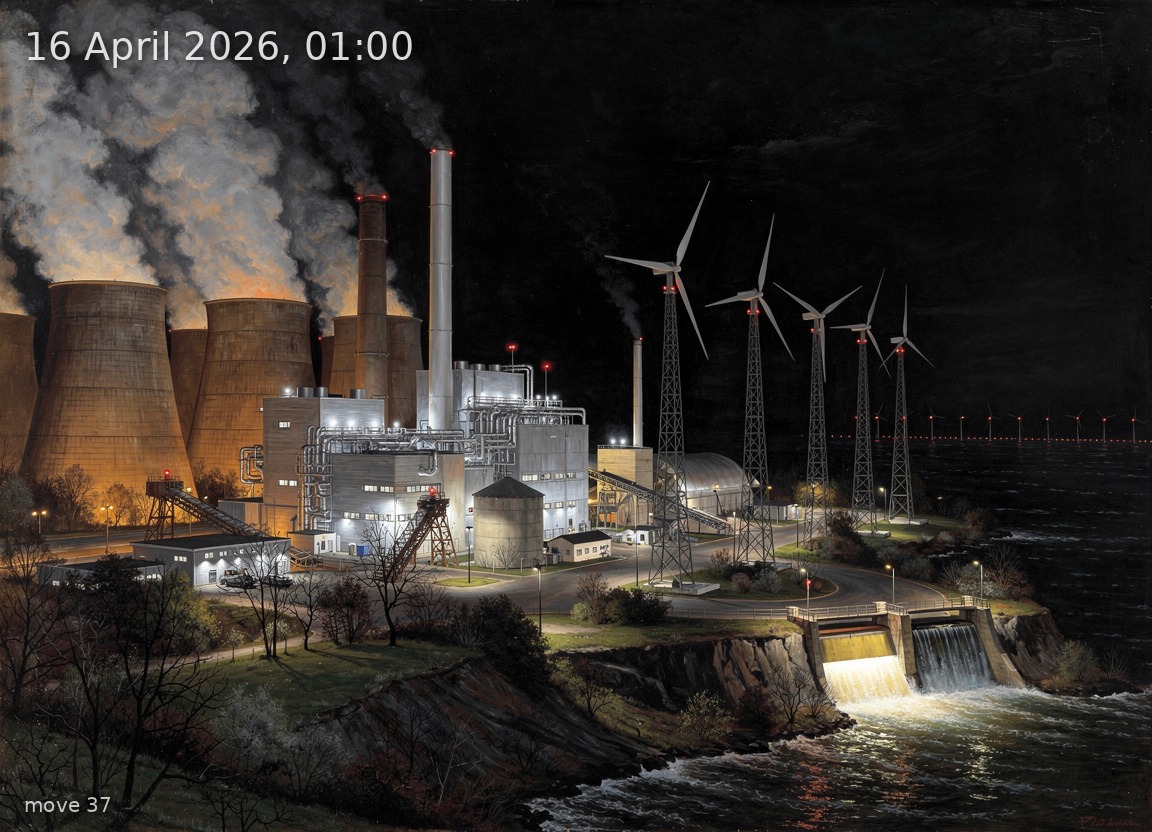
Lignite, gas, and wind dominate overnight generation as Germany imports 8.8 GW under heavy cloud cover.
Back
Generation mix
Wind onshore 18%
Wind offshore 9%
Biomass 11%
Hydro 4%
Natural gas 22%
Hard coal 12%
Brown coal 24%
42%
Renewable share
10.0 GW
Wind (on + offshore)
0.0 GW
Solar
36.7 GW
Total generation
-8.8 GW
Net import
101.4 €/MWh
Day-ahead price
8.6°C / 9 km/h
Temp / Wind speed
Open-Meteo, Kassel (51.3°N 9.5°E)
99.0% / 0.0 W/m²
Cloud cover / Radiation
393
gCO₂/kWh
Image prompt
Brown coal 8.8 GW occupies the left third of the scene as a cluster of massive hyperbolic cooling towers with thick white steam plumes rising into the darkness, their concrete shells lit by orange sodium floodlights from below; natural gas 8.0 GW fills the centre-left as two compact CCGT power stations with tall slender exhaust stacks venting thin plumes, illuminated by harsh industrial halogen lighting; wind onshore 6.7 GW spans the centre-right as a row of tall three-blade turbines on lattice and tubular towers, their red aviation warning lights blinking against the black sky, blades turning slowly in moderate wind; wind offshore 3.3 GW appears on the far right horizon as a distant line of turbines standing in dark water, their warning lights forming a dotted red line; hard coal 4.5 GW sits between the lignite and gas plants as a smaller coal-fired station with a single large smokestack and conveyor belt infrastructure, glowing under amber work lights; biomass 4.2 GW appears as a modest industrial facility with a cylindrical silo and short stack emitting a faint plume, nestled among the larger plants; hydro 1.4 GW is visible as a small concrete dam structure with illuminated spillway in the lower right foreground. The sky is completely black with 99% cloud cover — no stars, no moon, no twilight, a heavy impenetrable overcast pressing down oppressively, reflecting faintly the sodium-orange industrial glow from below. The temperature is a cool 8.6°C April night; early spring vegetation is barely visible — dark bare-branched trees and pale new grass faintly lit near the facilities. The atmosphere is heavy and oppressive, matching the elevated electricity price — the air feels thick with moisture and industrial haze. The entire scene is rendered as a highly detailed oil painting in the tradition of 19th-century German Romantic landscape painters — rich deep blues, blacks, warm oranges, and pale yellows applied with visible, textured brushwork. Each power plant is depicted with meticulous engineering accuracy: nacelle housings and pitch-controlled blades on the turbines, reinforced concrete shells on the cooling towers, aluminium cladding on the CCGT units. The composition evokes the sublime industrial night, vast and humbling. No text, no labels.