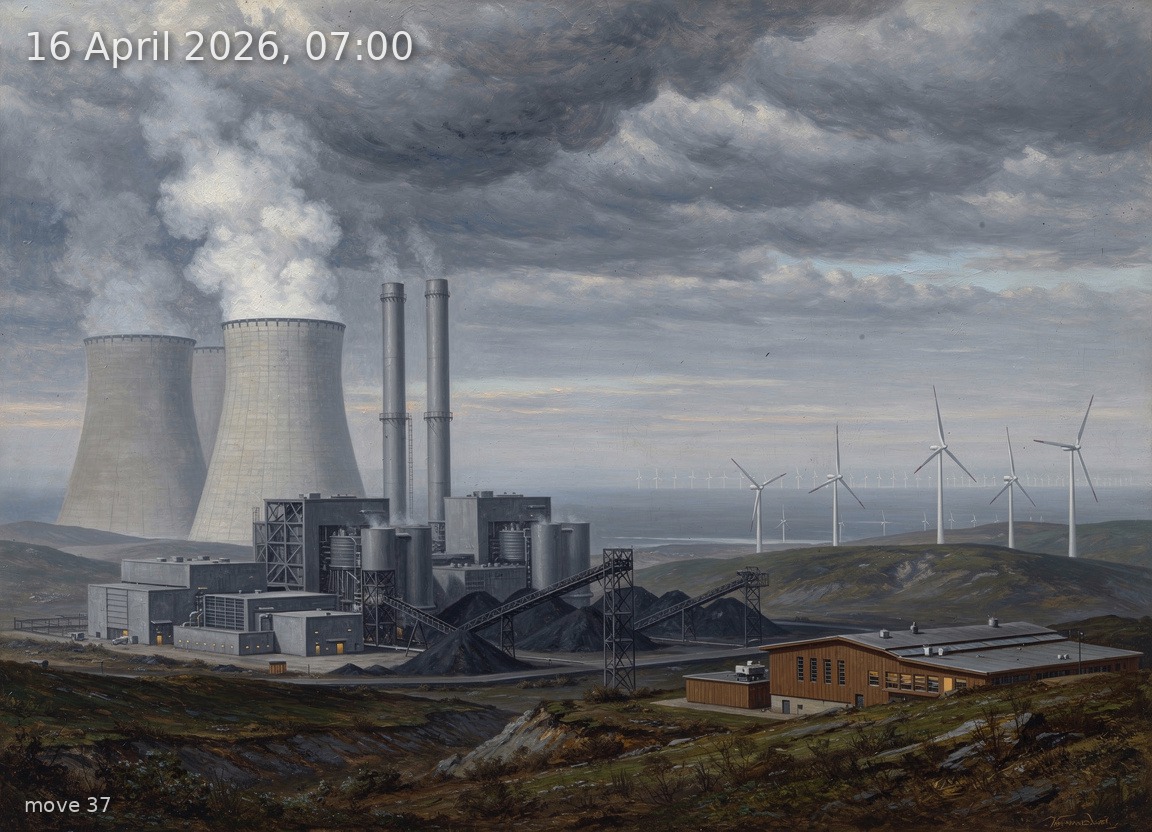
Gas, brown coal, and hard coal dominate as full overcast and light winds suppress renewables, driving 20.2 GW net imports.
Back
Generation mix
Wind onshore 14%
Wind offshore 6%
Solar 9%
Biomass 11%
Hydro 3%
Natural gas 22%
Hard coal 12%
Brown coal 22%
43%
Renewable share
7.8 GW
Wind (on + offshore)
3.8 GW
Solar
40.1 GW
Total generation
-20.2 GW
Net import
145.0 €/MWh
Day-ahead price
8.2°C / 6 km/h
Temp / Wind speed
Open-Meteo, Kassel (51.3°N 9.5°E)
100.0% / 0.0 W/m²
Cloud cover / Radiation
382
gCO₂/kWh
Image prompt
Natural gas 9.0 GW occupies the centre-left as a cluster of compact CCGT power stations with tall single exhaust stacks venting thin grey plumes; brown coal 8.8 GW fills the left background as massive hyperbolic cooling towers releasing thick white steam columns into the low sky; hard coal 5.0 GW appears as a dark industrial complex with rectangular boiler houses and conveyor belts in the centre-right middle ground; wind onshore 5.5 GW is represented by a scattered row of three-blade turbines on gentle hills in the right third, rotors turning very slowly; wind offshore 2.3 GW is suggested by distant turbines barely visible on a grey horizon line at far right; biomass 4.4 GW appears as a modest wood-clad CHP plant with a low smokestack near the right foreground; hydro 1.4 GW is a small dam and powerhouse nestled in a valley at far right; solar 3.8 GW is shown as a field of aluminium-framed crystalline PV panels in the right foreground, but they are dull and unreflective under the thick clouds, producing minimal gleam. No sunshine whatsoever — the sky is a uniform heavy 100% overcast of low stratiform cloud in tones of pewter and slate grey. The time is early morning dawn at 07:00 in April: the light is a cold, flat, pale blue-grey pre-dawn wash filtering weakly through total cloud cover, no direct sun visible, no warm tones in the sky, the horizon barely distinguishable from the clouds above. The atmosphere feels oppressive and weighty, reflecting the high electricity price — the air itself seems thick and pressing down on the landscape. Temperature is a cool 8°C spring morning: early deciduous trees show tight buds but no full leaves, grass is damp and muted green, patches of morning dew visible. Wind is nearly still at 5.7 km/h — barely any motion in the grass, smoke and steam plumes rise almost vertically before slowly drifting. Foreground shows high-voltage transmission pylons with heavy cable catenary stretching across the scene, symbolising the massive import flows. Style: highly detailed oil painting in the tradition of 19th-century German Romantic landscape painters such as Caspar David Friedrich and Carl Blechen — rich sombre colour palette of greys, slate blues, muted ochres, and industrial umber; visible layered brushwork; deep atmospheric perspective with haze softening the distant cooling towers; meticulous engineering detail on every turbine nacelle, lattice tower, PV panel frame, and cooling tower shell. The scene reads as a brooding industrial masterwork, monumental and contemplative. No text, no labels.