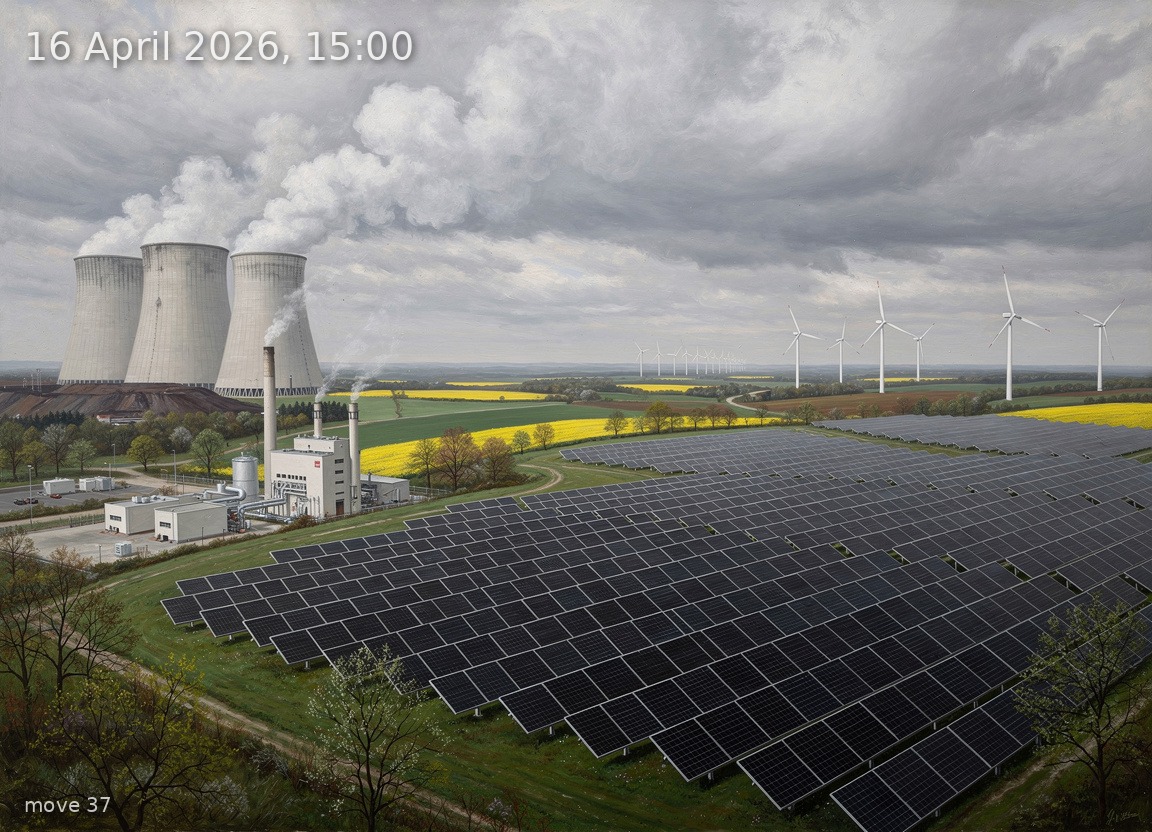
Overcast solar at 32.4 GW leads generation; brown coal and gas fill gaps as Germany net-imports 4.5 GW.
Back
Generation mix
Wind onshore 8%
Wind offshore 3%
Solar 59%
Biomass 7%
Hydro 3%
Natural gas 6%
Hard coal 4%
Brown coal 10%
81%
Renewable share
6.3 GW
Wind (on + offshore)
32.4 GW
Solar
55.0 GW
Total generation
-4.6 GW
Net import
70.9 €/MWh
Day-ahead price
16.5°C / 5 km/h
Temp / Wind speed
Open-Meteo, Kassel (51.3°N 9.5°E)
100.0% / 13.5 W/m²
Cloud cover / Radiation
138
gCO₂/kWh
Image prompt
Solar 32.4 GW dominates the scene as vast expanses of aluminium-framed crystalline silicon PV panels stretching across rolling mid-German farmland, covering roughly 60% of the composition from the centre to the right; brown coal 5.5 GW occupies the far left as a cluster of massive hyperbolic cooling towers with thick white-grey steam plumes rising into the overcast sky; wind onshore 4.6 GW appears as a line of modern three-blade turbines on low ridges behind the solar fields, rotors barely turning in the still air; natural gas 3.1 GW is rendered as two compact CCGT units with slender exhaust stacks and thin heat haze near the coal plant; hard coal 2.0 GW shows as a single large power station with rectangular boiler house and tall chimney stack emitting a wisp of pale smoke, tucked beside the brown coal towers; wind offshore 1.7 GW is visible in the far background as faint silhouettes of turbines on a hazy horizon line suggesting the North Sea; biomass 4.1 GW appears as a cluster of modest wood-clad facilities with short stacks and woodchip piles adjacent to the solar arrays; hydro 1.5 GW is suggested by a small reservoir dam glimpsed in a valley fold at the right edge. The sky is completely overcast with a thick, uniform, pale-grey cloud blanket — no blue visible — yet the scene is fully daylit in the flat, shadowless illumination of an afternoon at 15:00 in April. The light is bright but diffuse, no direct sunbeams or sun disk. Spring vegetation: fresh pale-green grass, budding deciduous trees, some yellow rapeseed in distant fields. Temperature 16.5°C gives a mild, damp atmosphere with slight haze near the horizon. The mood is moderately heavy and oppressive, reflecting the 70.9 EUR/MWh price — a leaden, pressured sky pressing down on the industrial landscape. Highly detailed oil painting in the tradition of 19th-century German Romantic landscape painters — Caspar David Friedrich meets industrial sublime — with rich layered colour, visible confident brushwork, atmospheric aerial perspective fading distant turbines into mist, but meticulous engineering accuracy on every turbine nacelle, every PV module frame, every cooling tower's concrete ribbing. No text, no labels.