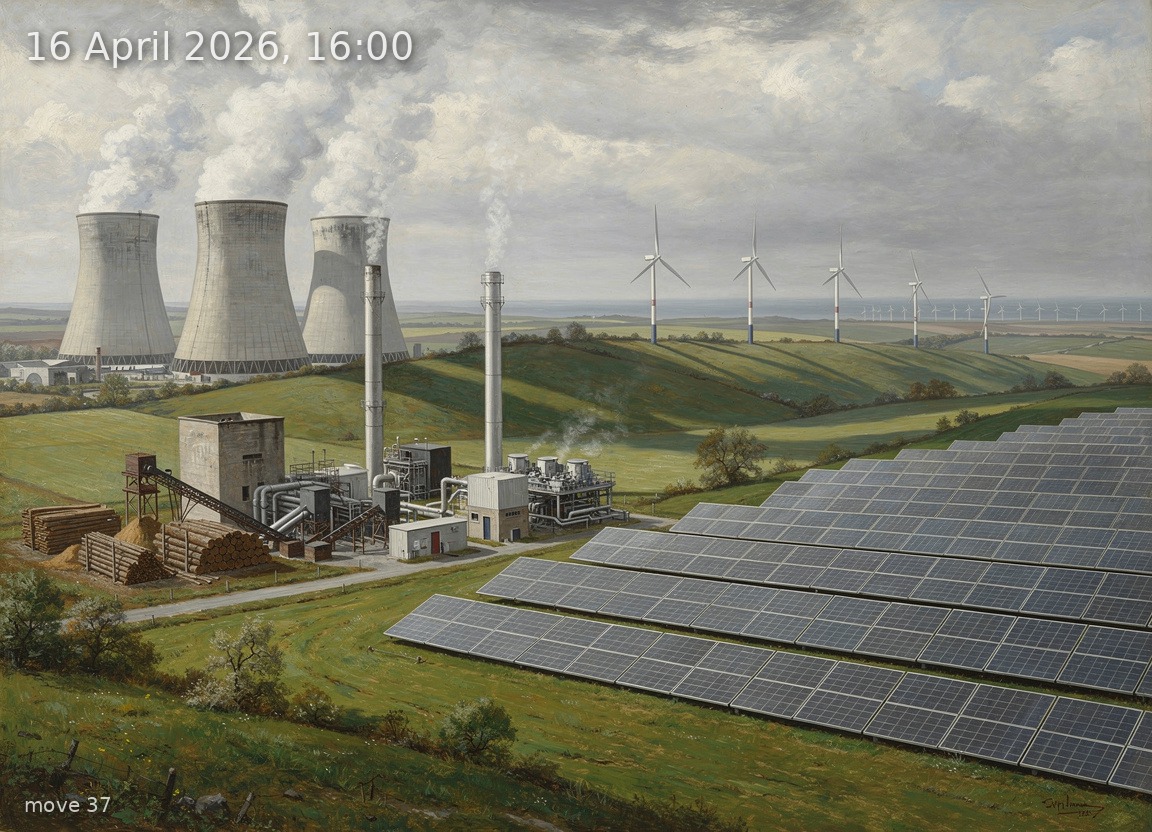
Solar leads at 26.4 GW under overcast skies, but 9.2 GW net imports needed as wind stays weak and demand peaks.
Back
Generation mix
Wind onshore 9%
Wind offshore 3%
Solar 53%
Biomass 8%
Hydro 3%
Natural gas 6%
Hard coal 4%
Brown coal 13%
77%
Renewable share
6.0 GW
Wind (on + offshore)
26.4 GW
Solar
49.3 GW
Total generation
-9.2 GW
Net import
89.8 €/MWh
Day-ahead price
17.6°C / 7 km/h
Temp / Wind speed
Open-Meteo, Kassel (51.3°N 9.5°E)
100.0% / 174.0 W/m²
Cloud cover / Radiation
165
gCO₂/kWh
Image prompt
Solar 26.4 GW dominates the right two-thirds of the scene as vast fields of aluminium-framed crystalline silicon PV panels stretching across rolling green spring farmland; brown coal 6.2 GW occupies the far left as a cluster of four massive hyperbolic cooling towers with thick white steam plumes rising heavily into the overcast sky; wind onshore 4.5 GW appears as a line of seven three-blade turbines with white lattice towers on a gentle ridge behind the solar fields, blades barely turning in the light breeze; wind offshore 1.5 GW is suggested by distant turbines on a hazy horizon line at far right; biomass 4.1 GW is rendered as a medium-sized industrial plant with a timber yard and single smokestack mid-left; natural gas 3.1 GW appears as two compact CCGT units with slender exhaust stacks and visible heat shimmer near the coal plant; hard coal 2.0 GW is a smaller power station with a single square cooling tower beside the lignite complex; hydro 1.5 GW appears as a concrete dam with spillway in a wooded valley at far right background. The sky is fully overcast with a uniform white-grey cloud layer, yet bright with diffused afternoon daylight at 16:00 in April—no direct sun disk visible but strong ambient luminosity illuminating everything evenly. The atmosphere feels heavy and oppressive, reflecting high electricity prices—air humid, slightly hazy, clouds pressing low. Spring vegetation: fresh bright-green grass, early leaf buds on deciduous trees, scattered yellow wildflowers. Style: highly detailed oil painting in the tradition of 19th-century German Romantic landscape painters such as Caspar David Friedrich and Carl Blechen—rich layered colour, visible confident brushwork, dramatic atmospheric depth, golden-green tonal palette contrasting with the industrial grey of the thermal plants. Meticulous engineering accuracy on every turbine nacelle, every PV cell grid pattern, every cooling tower's parabolic curve. No text, no labels, no people in the foreground.