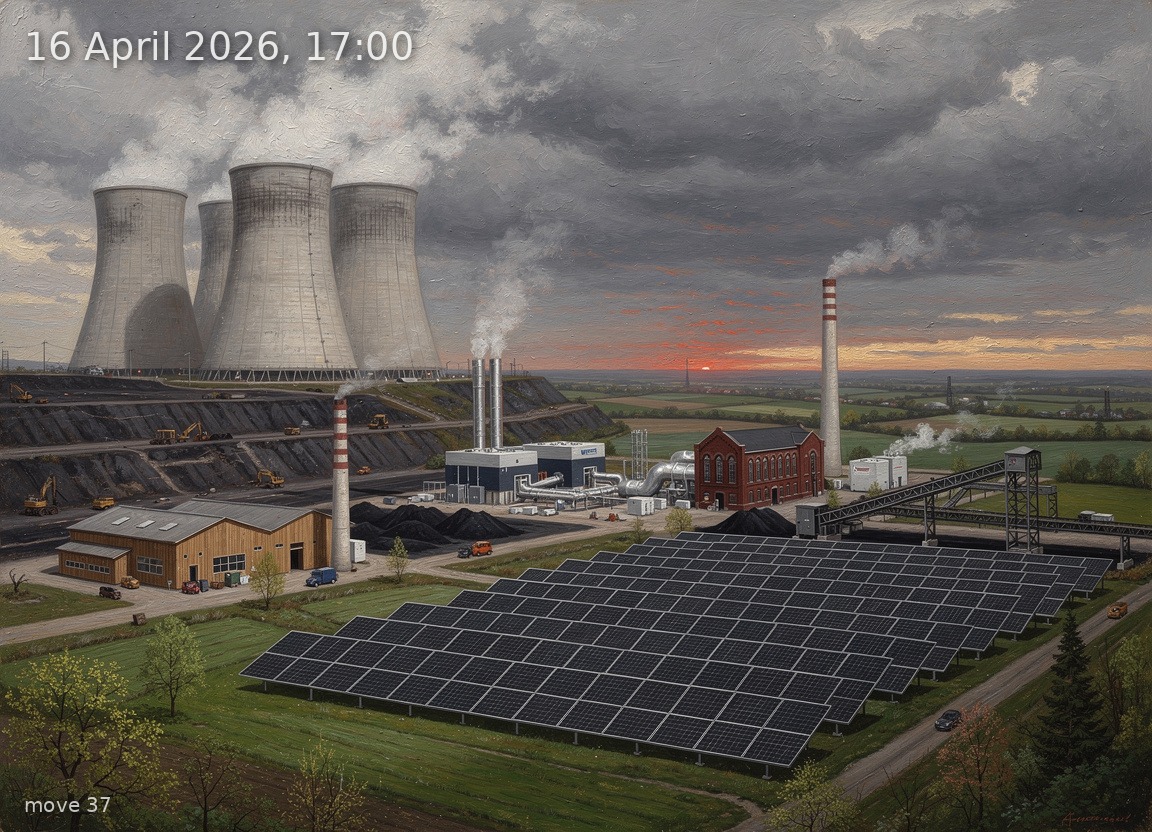
Solar leads at 18.3 GW but fading; brown coal and net imports fill a 16 GW gap at elevated prices.
Back
Generation mix
Wind onshore 9%
Wind offshore 3%
Solar 43%
Biomass 10%
Hydro 4%
Natural gas 8%
Hard coal 7%
Brown coal 17%
68%
Renewable share
5.1 GW
Wind (on + offshore)
18.3 GW
Solar
42.7 GW
Total generation
-16.2 GW
Net import
111.6 €/MWh
Day-ahead price
18.1°C / 8 km/h
Temp / Wind speed
Open-Meteo, Kassel (51.3°N 9.5°E)
100.0% / 164.2 W/m²
Cloud cover / Radiation
229
gCO₂/kWh
Image prompt
Solar 18.3 GW dominates the centre-right as vast fields of aluminium-framed crystalline silicon PV panels stretching across gently rolling farmland, angled toward a veiled sky; brown coal 7.1 GW occupies the left quarter as a cluster of massive hyperbolic cooling towers with thick white steam plumes rising into overcast air, beside open-pit terraces of dark lignite earth; wind onshore 3.8 GW appears as a line of tall three-blade turbines on a distant ridge, rotors turning slowly; wind offshore 1.2 GW is suggested by smaller turbines on a hazy far horizon; biomass 4.2 GW sits in the mid-left as a timber-clad industrial plant with a single tall chimney and woodchip storage silos; natural gas 3.6 GW is rendered as two compact CCGT units with slim exhaust stacks and modest heat shimmer, positioned between the coal plant and the solar fields; hard coal 2.9 GW appears as a dark red-brick power station with a single large smokestack and coal conveyor belts; hydro 1.5 GW is a small concrete dam with spillway visible in a wooded valley at the far right. Time of day is 17:00 in mid-April — dusk beginning, the sky entirely overcast at 100% cloud cover with a heavy, oppressive grey ceiling pressing low, but a faint orange-red glow bleeds along the western horizon where the sun is descending behind the clouds, casting a warm but muted amber light across the landscape. Temperature is a mild 18°C; fresh spring-green vegetation covers fields and trees with new leaves. The atmosphere feels dense and weighted, reflecting the high electricity price — the air almost humid and thick. Highly detailed oil painting in the tradition of 19th-century German Romantic landscape painters such as Caspar David Friedrich and Carl Blechen, with rich impasto brushwork, deep atmospheric perspective, dramatic chiaroscuro between the warm horizon glow and the cold grey overhead, meticulous engineering detail on every turbine nacelle, every cooling tower rib, every PV panel frame and inverter box. The composition balances industrial sublime with pastoral spring landscape. No text, no labels.