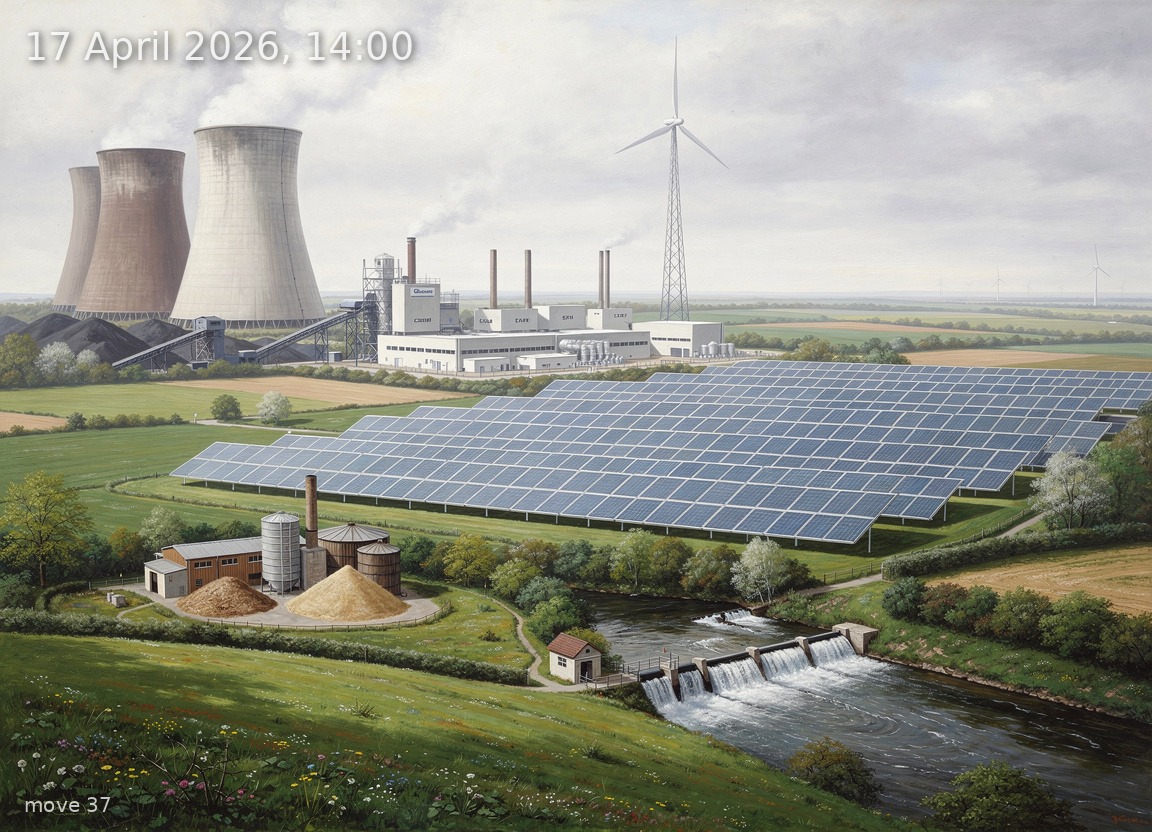
Solar provides 71% of generation at 40.1 GW under overcast skies; coal and gas cover the residual load gap.
Back
Generation mix
Wind onshore 1%
Wind offshore 1%
Solar 71%
Biomass 7%
Hydro 3%
Natural gas 5%
Hard coal 4%
Brown coal 8%
83%
Renewable share
0.9 GW
Wind (on + offshore)
40.1 GW
Solar
56.2 GW
Total generation
-3.1 GW
Net import
31.4 €/MWh
Day-ahead price
20.6°C / 6 km/h
Temp / Wind speed
Open-Meteo, Kassel (51.3°N 9.5°E)
100.0% / 418.0 W/m²
Cloud cover / Radiation
120
gCO₂/kWh
Image prompt
Solar 40.1 GW dominates the scene as vast fields of aluminium-framed crystalline silicon photovoltaic panels stretching across rolling central German farmland, occupying roughly three-quarters of the composition from the centre to the right horizon. Brown coal 4.3 GW appears at the far left as a cluster of massive hyperbolic cooling towers with thick white steam plumes rising into the overcast sky. Hard coal 2.5 GW is rendered as a smaller coal-fired power station with rectangular chimneys and conveyor belt infrastructure just beside the brown coal complex. Natural gas 2.8 GW is depicted as a compact CCGT plant with slender exhaust stacks and a modest steam plume, positioned between the coal plants and the solar fields. Biomass 4.2 GW appears as a wood-chip-fed plant with a squat smokestack and timber storage silos near the mid-left. Hydro 1.5 GW is shown as a modest run-of-river weir with turbine house along a gentle river in the mid-ground. Wind onshore 0.4 GW is a single distant three-blade turbine on a lattice tower, barely turning. Wind offshore 0.4 GW is faintly suggested on the far horizon as a lone turbine silhouette. The sky is entirely overcast with a uniform milky-white cloud layer, yet the scene is bathed in bright diffuse midday April light—it is 14:00, full daytime, so illumination is strong and even, with no direct sun disc visible but everything well-lit. The air feels mild at 20.6°C; fresh spring-green vegetation covers fields, hedgerows show new leaf, wildflowers dot the meadow edges. The atmosphere is calm and relaxed, matching a moderate electricity price—open, unhurried, pastoral despite the industrial elements. Rendered as a highly detailed oil painting in the tradition of 19th-century German Romantic landscape masters such as Caspar David Friedrich and Carl Blechen: rich layered colour, visible confident brushwork, deep atmospheric perspective, meticulous engineering detail on every turbine nacelle, every PV panel frame, every cooling tower's parabolic curve and concrete texture, every CCGT exhaust flue. The painting conveys the coexistence of technology and landscape as a grand, contemplative panorama. No text, no labels.