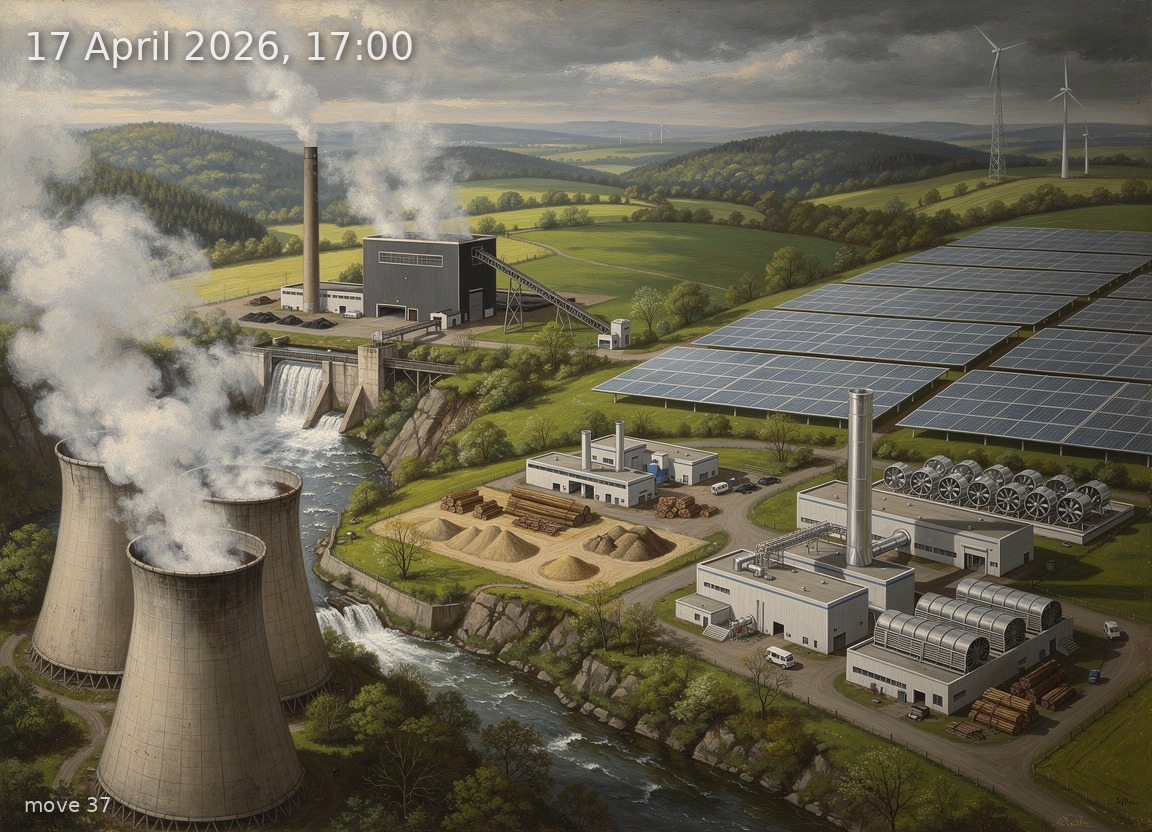
Solar leads at 18.3 GW but wind drought forces 24.9 GW net imports; coal and gas fill remaining domestic gaps.
Back
Generation mix
Wind onshore 2%
Wind offshore 1%
Solar 55%
Biomass 13%
Hydro 5%
Natural gas 5%
Hard coal 5%
Brown coal 14%
76%
Renewable share
1.0 GW
Wind (on + offshore)
18.3 GW
Solar
33.1 GW
Total generation
-24.9 GW
Net import
102.3 €/MWh
Day-ahead price
20.8°C / 6 km/h
Temp / Wind speed
Open-Meteo, Kassel (51.3°N 9.5°E)
99.0% / 177.2 W/m²
Cloud cover / Radiation
174
gCO₂/kWh
Image prompt
Solar 18.3 GW dominates the right half of the scene as vast expanses of aluminium-framed crystalline silicon photovoltaic panels stretching across flat farmland, catching dim diffuse light; brown coal 4.6 GW occupies the left foreground as three hyperbolic concrete cooling towers emitting thick white steam plumes from a lignite power station; biomass 4.2 GW appears as a cluster of mid-sized wood-chip-fed combined heat and power plants with modest chimneys and biomass fuel yards adjacent, positioned left of centre; hydro 1.8 GW is rendered as a concrete run-of-river dam with spillway cutting through a wooded gorge in the centre-left middle distance; hard coal 1.7 GW sits behind the brown coal station as a single rectangular boiler house with tall stack and coal conveyor; natural gas 1.5 GW appears as a compact CCGT plant with a single polished exhaust stack and air-cooled condenser near the centre; wind onshore 0.7 GW is shown as just two or three barely turning three-blade turbines on lattice towers far in the background, rotors nearly still in the calm air. The sky is dusk at 17:00 in April — a narrow band of orange-red glow hugs the western horizon while the rest of the sky is heavily overcast with thick grey-white stratus clouds pressing down oppressively, giving a heavy, tense atmosphere reflecting the high electricity price. The landscape is central German rolling countryside with fresh green spring vegetation, grass bright with late April growth, and scattered deciduous trees leafing out. Temperature is warm at 20.8°C — no frost, air feels heavy and humid. The overall mood is brooding and weighty. Rendered as a highly detailed oil painting in the tradition of 19th-century German Romantic landscape painters — Caspar David Friedrich meets industrial realism — with rich colour palette emphasizing amber, slate-grey, and spring green, visible impasto brushwork, dramatic atmospheric depth, and meticulous engineering accuracy on every turbine nacelle, PV module, and cooling tower. No text, no labels.