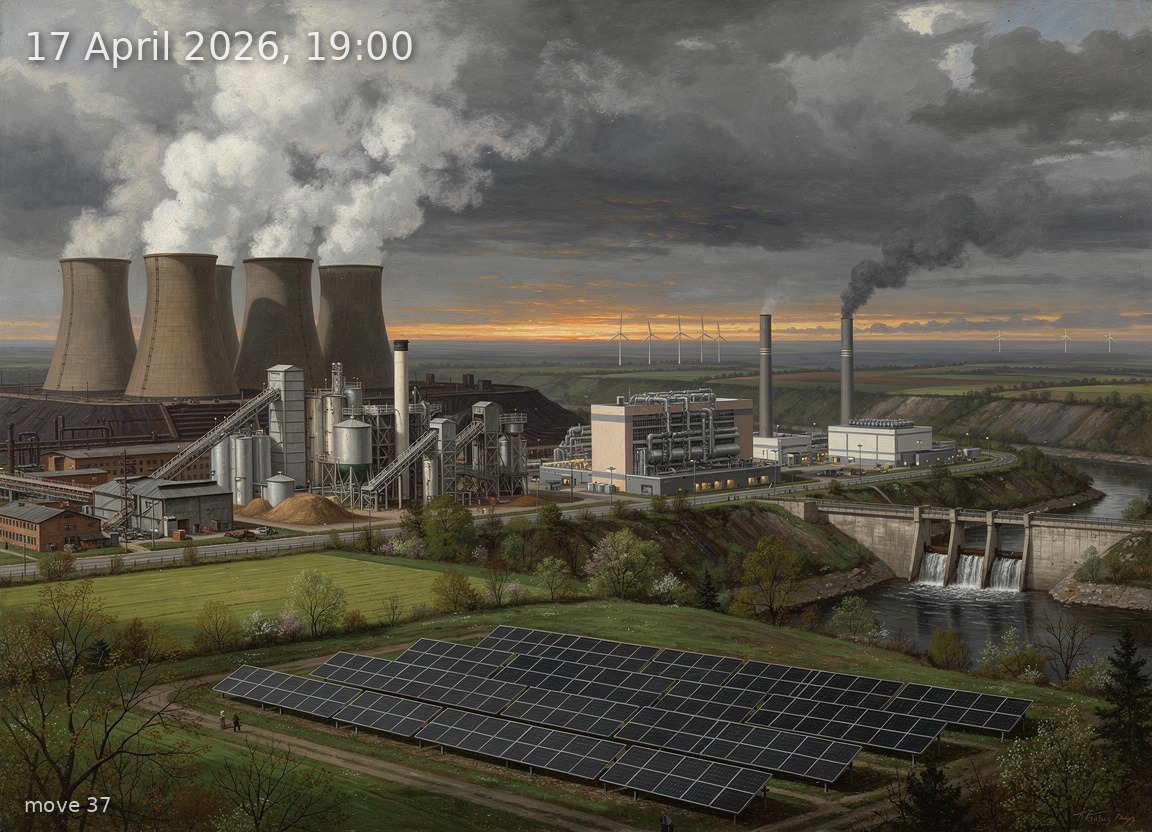
Brown coal and biomass anchor thin domestic generation as Germany imports over 33 GW under windless overcast skies.
Back
Generation mix
Wind onshore 8%
Wind offshore 2%
Solar 10%
Biomass 17%
Hydro 8%
Natural gas 9%
Hard coal 11%
Brown coal 35%
45%
Renewable share
2.5 GW
Wind (on + offshore)
2.3 GW
Solar
24.2 GW
Total generation
-33.2 GW
Net import
157.4 €/MWh
Day-ahead price
20.1°C / 2 km/h
Temp / Wind speed
Open-Meteo, Kassel (51.3°N 9.5°E)
100.0% / 1.2 W/m²
Cloud cover / Radiation
415
gCO₂/kWh
Records
#2
Import Peak
Image prompt
Brown coal 8.6 GW dominates the left third of the scene as a massive lignite power station complex with four hyperbolic cooling towers emitting thick white steam plumes; biomass 4.2 GW appears center-left as a cluster of industrial biomass plants with tall chimneys and wood-chip conveyor belts; hard coal 2.6 GW sits center-right as a single large coal-fired station with a rectangular boiler house and twin smokestacks trailing grey exhaust; solar 2.3 GW occupies a modest foreground strip as rows of aluminium-framed crystalline silicon PV panels, but they are dark and inactive under heavy clouds reflecting no light; wind onshore 2.0 GW appears as a small group of three-blade turbines on a distant ridge, rotors motionless in still air; natural gas 2.1 GW is rendered as a compact CCGT plant with a single sleek exhaust stack and visible heat shimmer; hydro 1.8 GW appears far right as a concrete dam with modest spillway flow; wind offshore 0.5 GW is a faint pair of turbines on a distant grey horizon line. The lighting is late dusk at 19:00 in April — a narrow band of muted amber-orange glow lingers on the very lowest horizon, while the sky above is fully overcast in heavy, oppressive dark grey clouds stretching to the zenith, creating a brooding, high-price atmosphere. The landscape is flat central German terrain with fresh spring-green fields and budding deciduous trees at 20°C. The air is perfectly still — no motion in grass, flags, or turbine blades. Transmission pylons with high-voltage lines recede toward the horizon in multiple directions, symbolizing the massive import flows. Sodium streetlights along a nearby road are beginning to flicker on. Painted in the style of a highly detailed 19th-century German Romantic oil painting — rich impasto brushwork, deep atmospheric perspective, dramatic chiaroscuro between the glowing industrial facilities and the darkening sky — yet every engineering detail is technically precise: turbine nacelles, lattice towers, cooling tower parabolic profiles, PV cell grid patterns. No text, no labels.