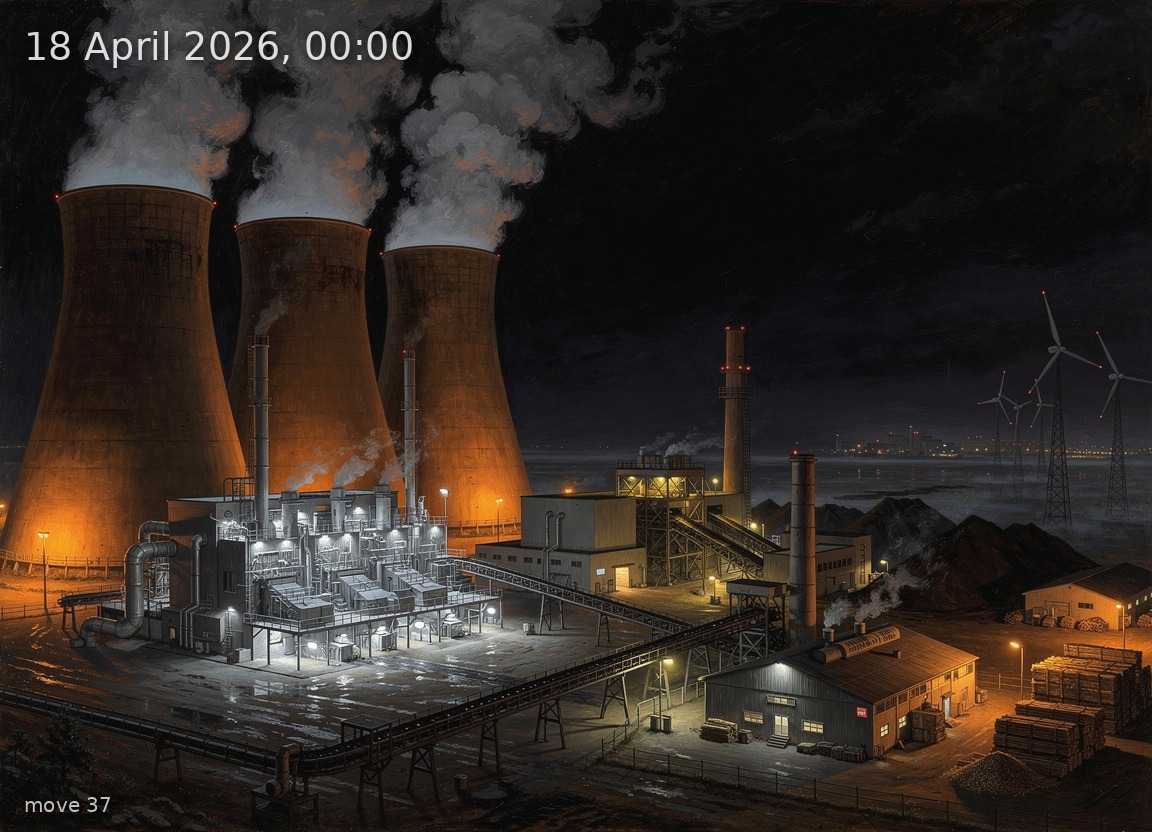
Coal, gas, and anomalous solar dominate midnight generation, driving 34 GW net exports under full cloud cover.
Back
Generation mix
Wind onshore 1%
Wind offshore 2%
Solar 62%
Biomass 5%
Hydro 2%
Natural gas 11%
Hard coal 6%
Brown coal 11%
72%
Renewable share
2.2 GW
Wind (on + offshore)
48.5 GW
Solar
78.6 GW
Total generation
+34.0 GW
Net export
116.2 €/MWh
Day-ahead price
13.6°C / 5 km/h
Temp / Wind speed
Open-Meteo, Kassel (51.3°N 9.5°E)
100.0% / 0.0 W/m²
Cloud cover / Radiation
188
gCO₂/kWh
Image prompt
Brown coal 8.8 GW dominates the left quarter as a cluster of massive hyperbolic cooling towers with thick white steam plumes rising into the black sky, lit from below by orange sodium lamps; natural gas 8.6 GW fills the centre-left as a row of compact CCGT power blocks with tall single exhaust stacks emitting thin vapour, their metallic surfaces gleaming under floodlights; hard coal 4.5 GW appears centre-right as a squat industrial complex with conveyor belts and a tall chimney stack, coal piles faintly visible under yellow worklights; biomass 4.2 GW is rendered as a modest wood-chip-fed cogeneration plant with a steaming vent and stacked timber, warmly lit; wind onshore 0.9 GW and wind offshore 1.3 GW appear as a few slowly turning three-blade turbines on lattice towers in the far right background, their red aviation warning lights blinking against the darkness; hydro 1.8 GW is suggested by a concrete dam spillway in the far distance with faint white water catching industrial light. The sky is completely black — no moon, no twilight, no sky glow — a deep navy-to-black vault with heavy overcast obscuring all stars. The atmosphere is dense and oppressive, hinting at the high electricity price: low-hanging mist clings to the ground, humidity visible in halos around every lamp. Spring vegetation — fresh green grass and budding deciduous trees — is barely discernible in the artificial light at 13.6°C. The air is nearly still, barely 5 km/h, so smoke and steam rise almost vertically. The entire composition is rendered as a highly detailed oil painting in the tradition of 19th-century German Romantic landscape art — think Caspar David Friedrich meeting industrial reality — with rich, dark colour palette, visible impasto brushwork, dramatic chiaroscuro from artificial light sources against total darkness, and meticulous engineering detail on every turbine nacelle, cooling tower, and exhaust stack. No text, no labels.