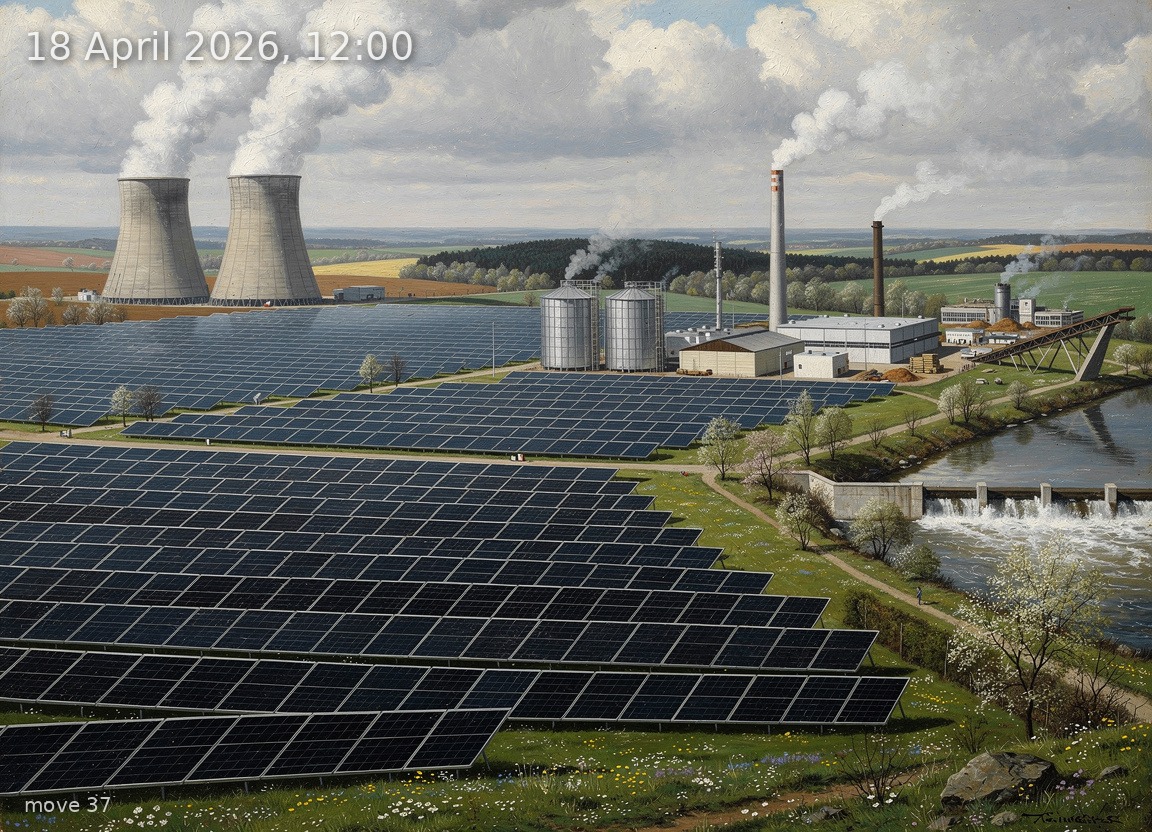
Massive 48.5 GW solar output under thin overcast drives 8.8 GW net exports and a slightly negative price.
Back
Generation mix
Wind onshore 1%
Wind offshore 2%
Solar 77%
Biomass 7%
Hydro 3%
Natural gas 3%
Hard coal 2%
Brown coal 5%
90%
Renewable share
1.8 GW
Wind (on + offshore)
48.5 GW
Solar
63.0 GW
Total generation
+8.8 GW
Net export
-3.4 €/MWh
Day-ahead price
18.2°C / 6 km/h
Temp / Wind speed
Open-Meteo, Kassel (51.3°N 9.5°E)
100.0% / 329.2 W/m²
Cloud cover / Radiation
75
gCO₂/kWh
Image prompt
Solar 48.5 GW dominates the entire scene as vast fields of aluminium-framed crystalline silicon photovoltaic panels stretching across gently rolling central German farmland, covering roughly three-quarters of the composition from foreground to mid-ground, their blue-black surfaces reflecting a bright but diffused midday sky. Brown coal 3.4 GW appears at the left horizon as two hyperbolic concrete cooling towers with thick white steam plumes rising into the overcast. Biomass 4.2 GW is rendered as a cluster of medium-scale wood-chip CHP plants with cylindrical silos and modest stacks emitting thin grey exhaust, placed just left of centre behind the solar fields. Hydro 1.8 GW shows as a concrete run-of-river weir with churning white water visible in a river cutting diagonally through the middle distance. Natural gas 1.8 GW appears as a compact CCGT plant with a single tall exhaust stack and low rectangular housing, positioned to the right of the cooling towers. Hard coal 1.4 GW is a smaller coal-fired station with a single square chimney and conveyor belt, visible behind the gas plant. Wind onshore 0.9 GW is a small group of three three-blade turbines on a far ridge, rotors barely turning. Wind offshore 1.0 GW is suggested by a distant line of turbines on a hazy horizon above a faint strip of sea at the far right edge. The sky is fully overcast—a uniform bright white-grey cloud layer—yet the light is intense and shadowless, a luminous noon in April. Temperature is mild at 18°C: fresh spring-green grass grows between panel rows, scattered wildflowers, budding deciduous trees along field edges. The atmosphere is calm, almost serene, reflecting the negative price—open, unhurried, no tension. Painted in the style of a highly detailed 19th-century German Romantic oil painting with rich visible brushwork, atmospheric aerial perspective, meticulous engineering detail on every turbine nacelle, every PV cell grid line, every cooling tower's parabolic concrete texture, yet suffused with the luminous grandeur of Caspar David Friedrich's landscapes. No text, no labels.