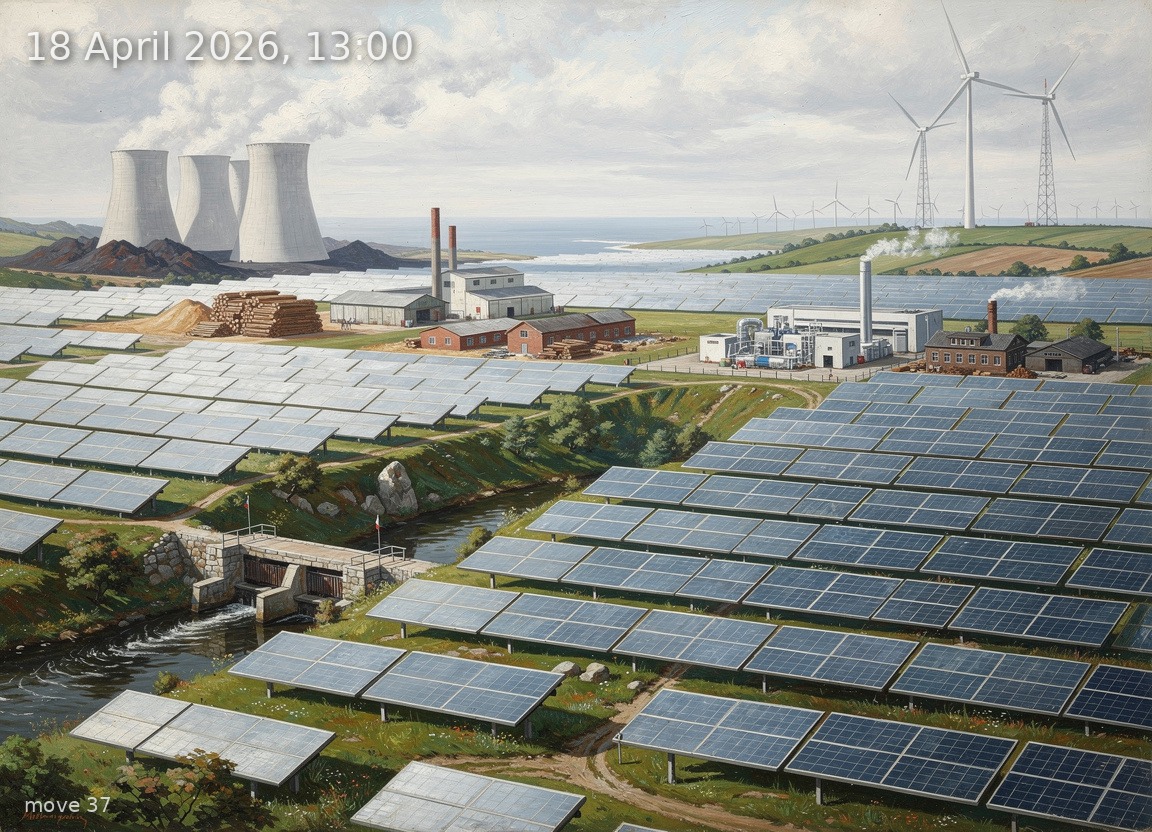
Solar at 48.5 GW drives a 10.0 GW net export and negative prices on a mild, overcast spring midday.
Back
Generation mix
Wind onshore 1%
Wind offshore 2%
Solar 78%
Biomass 7%
Hydro 3%
Natural gas 3%
Hard coal 2%
Brown coal 5%
90%
Renewable share
1.8 GW
Wind (on + offshore)
48.5 GW
Solar
62.4 GW
Total generation
+10.0 GW
Net export
-4.1 €/MWh
Day-ahead price
18.4°C / 9 km/h
Temp / Wind speed
Open-Meteo, Kassel (51.3°N 9.5°E)
100.0% / 181.0 W/m²
Cloud cover / Radiation
69
gCO₂/kWh
Image prompt
Solar 48.5 GW dominates the scene as an enormous expanse of crystalline silicon PV panels stretching across rolling spring fields and village rooftops covering roughly three-quarters of the composition; brown coal 3.2 GW appears as a cluster of hyperbolic cooling towers with lazy steam plumes on the far left horizon; biomass 4.2 GW is rendered as several mid-sized wood-chip power plants with modest chimneys and small timber yards beside them in the left-center; hydro 1.8 GW shows as a stone-faced run-of-river dam with spillway in a green valley at center-left; natural gas 1.7 GW is a compact modern CCGT facility with a single slender exhaust stack and low vapor plume at center-right; hard coal 1.1 GW appears as a smaller conventional power station with a single squat chimney in the right-center background; wind onshore 0.9 GW is two or three nearly motionless three-blade turbines on lattice towers on a distant ridge at far right; wind offshore 1.0 GW is a faint line of turbines on the horizon suggesting a North Sea coast. Full daylight at 1 PM but the entire sky is a luminous, uniform overcast — bright white-grey cloud layer from horizon to horizon, no direct sun visible, yet the landscape is flooded with strong diffuse light that gleams off every aluminium PV frame. The atmosphere feels calm, open, and quietly abundant — no oppressive weight, reflecting the negative price. Spring vegetation: fresh bright-green grass, blossoming apple trees, rapeseed beginning to yellow. Temperature is pleasant at 18°C — no haze, gentle air. Style: highly detailed oil painting in the tradition of 19th-century German Romantic landscape painters — Caspar David Friedrich meets industrial modernity — rich layered colour, visible confident brushwork, atmospheric depth with delicate gradations in the overcast sky. Each technology is rendered with meticulous engineering accuracy: three-blade rotor nacelles, aluminium-framed polycrystalline panels with visible cell grids, hyperbolic concrete cooling tower textures, CCGT exhaust geometries. No text, no labels.