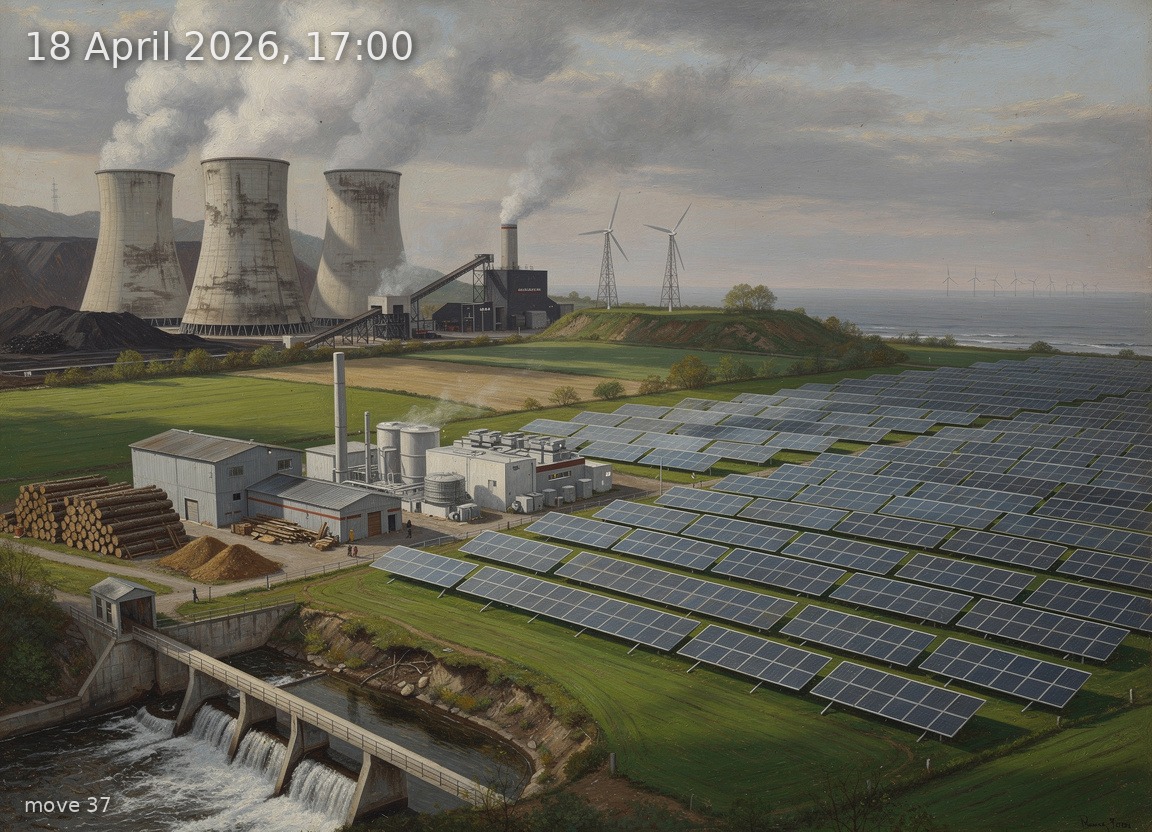
Solar at 48.5 GW dominates under full overcast; 14.5 GW net export with brown coal and biomass providing residual baseload.
Back
Generation mix
Wind onshore 1%
Wind offshore 2%
Solar 75%
Biomass 7%
Hydro 3%
Natural gas 2%
Hard coal 2%
Brown coal 8%
88%
Renewable share
2.1 GW
Wind (on + offshore)
48.5 GW
Solar
64.6 GW
Total generation
+14.5 GW
Net export
90.8 €/MWh
Day-ahead price
19.3°C / 12 km/h
Temp / Wind speed
Open-Meteo, Kassel (51.3°N 9.5°E)
100.0% / 47.5 W/m²
Cloud cover / Radiation
93
gCO₂/kWh
Image prompt
Solar 48.5 GW dominates the entire right two-thirds of the scene as vast rolling fields of aluminium-framed crystalline silicon PV panels stretching to the horizon across gentle green April farmland; brown coal 5.4 GW occupies the left background as a cluster of massive hyperbolic cooling towers with thick white-grey steam plumes rising into the overcast; biomass 4.2 GW appears as a mid-sized industrial plant with a timber-yard and a single tall stack emitting faint smoke, positioned left of centre; wind onshore 0.9 GW shown as two distant three-blade turbines on a ridge, rotors turning slowly; wind offshore 1.2 GW represented by a handful of turbines glimpsed on a far grey coastal horizon line; natural gas 1.3 GW as a compact CCGT plant with a single exhaust stack and modest heat shimmer; hard coal 1.2 GW as a small conventional power station with conveyor belt and single cooling tower near the lignite complex; hydro 1.8 GW as a concrete dam with spillway visible in a valley at far left. Time is 17:00 Berlin dusk: the sky is entirely overcast at 100% cloud cover, a heavy uniform blanket of pewter-grey stratus, with a band of warm orange-red light glowing faintly along the lowest horizon beneath the cloud deck as the sun begins to set — upper sky darkening toward slate blue. The atmosphere feels heavy and oppressive reflecting the high 90.8 EUR/MWh price. Temperature is a mild 19.3°C; spring vegetation is lush bright green, wildflowers dotting field edges, birch and beech trees in fresh leaf. Light wind barely stirs the grass. Rendered as a highly detailed oil painting in the tradition of 19th-century German Romantic landscape painters — rich layered colour, visible confident brushwork, atmospheric depth and chiaroscuro — but with meticulous engineering accuracy on every technology: turbine nacelles with three-blade rotors on lattice towers, PV panel grid patterns, hyperbolic cooling tower concrete texture, CCGT exhaust geometry. The composition evokes Caspar David Friedrich's sense of sublime scale, human industry dwarfed beneath an immense brooding sky. No text, no labels.