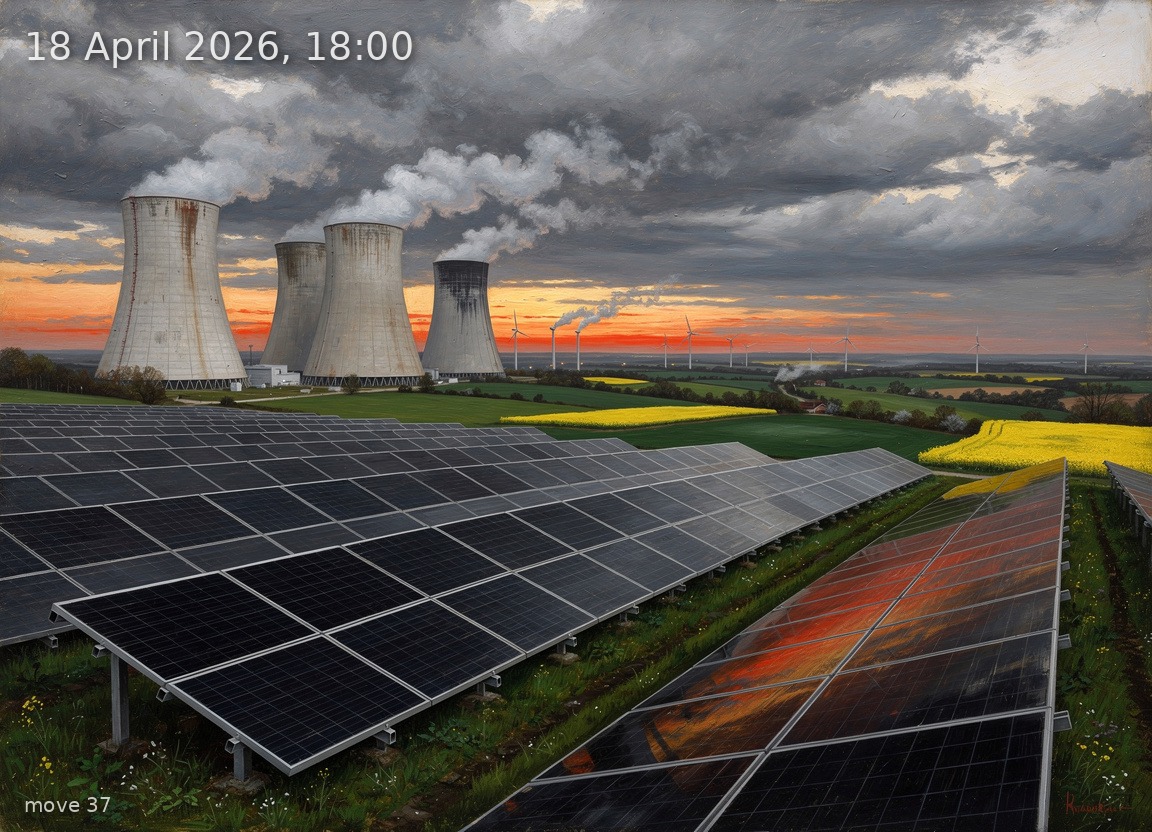
Solar at 48.5 GW drives 86% renewables and 14.3 GW net export, yet coupled-market demand holds prices above 119 EUR/MWh.
Back
Generation mix
Wind onshore 1%
Wind offshore 2%
Solar 74%
Biomass 6%
Hydro 3%
Natural gas 3%
Hard coal 2%
Brown coal 9%
86%
Renewable share
2.2 GW
Wind (on + offshore)
48.5 GW
Solar
66.0 GW
Total generation
+14.3 GW
Net export
119.6 €/MWh
Day-ahead price
18.8°C / 12 km/h
Temp / Wind speed
Open-Meteo, Kassel (51.3°N 9.5°E)
80.0% / 80.8 W/m²
Cloud cover / Radiation
104
gCO₂/kWh
Image prompt
Solar 48.5 GW dominates the entire scene as vast fields of aluminium-framed crystalline silicon PV panels stretching across rolling central German farmland, covering roughly three-quarters of the composition. Brown coal 5.9 GW appears at the far left as a cluster of massive hyperbolic cooling towers with lazy white-grey steam plumes drifting eastward. Biomass 4.2 GW occupies the left-centre as a wood-chip-fed power station with a tall exhaust stack and a steaming dome amid timber stacks. Hydro 1.8 GW is visible as a concrete dam and small reservoir nestled in a wooded valley at the centre-left. Natural gas 1.7 GW appears as a compact CCGT plant with a single slender exhaust stack and modest heat shimmer, placed behind the solar fields. Hard coal 1.6 GW shows as a smaller conventional coal plant with a single square cooling tower, partially screened by trees, near the gas plant. Wind offshore 1.4 GW is suggested on the far-right horizon as distant turbines in a hazy North Sea backdrop. Wind onshore 0.9 GW appears as a few three-blade turbines with lattice towers on a gentle ridge, their blades turning slowly in light breeze. Time of day is 18:00 in mid-April: dusk light with a rapidly fading orange-red glow on the lower western horizon, sky above transitioning from warm amber to steel grey, heavy cloud cover at 80% creating an oppressive, layered overcast ceiling pressing down on the landscape. The atmosphere is thick and weighty despite the warmth of 18.8°C — hazy, humid spring air. Spring vegetation is lush green, rapeseed fields showing early yellow blooms, deciduous trees in fresh leaf. The overall mood is heavy and brooding despite abundant generation, reflecting the high 119.6 EUR/MWh price. Style: highly detailed oil painting in the tradition of 19th-century German Romantic landscape painters — Caspar David Friedrich meets industrial sublime — rich saturated colour, visible impasto brushwork, dramatic atmospheric depth, meticulous engineering detail on every turbine nacelle, every PV cell edge, every cooling tower's reinforced-concrete ribbing. No text, no labels.