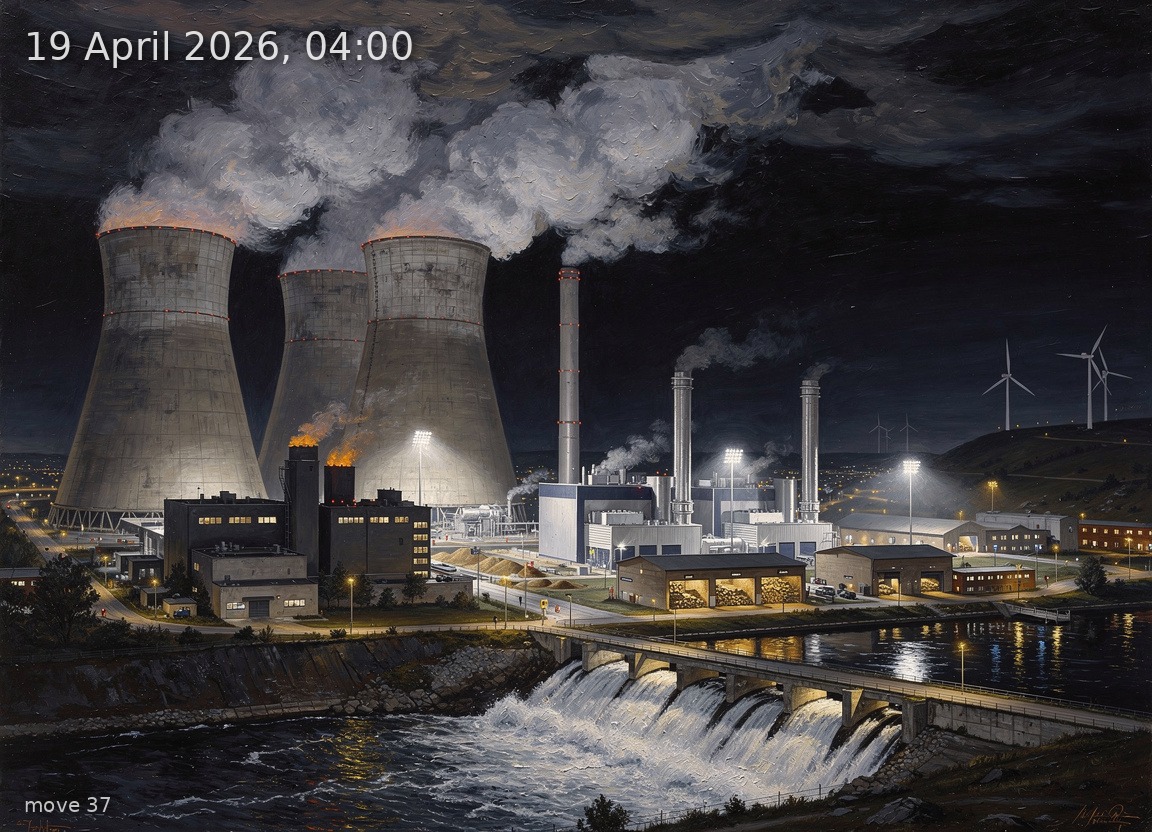
Pre-dawn baseload dominated by brown coal, hard coal, and gas; reported solar figure is a data anomaly.
Back
Generation mix
Wind onshore 1%
Wind offshore 2%
Solar 68%
Biomass 6%
Hydro 3%
Natural gas 7%
Hard coal 5%
Brown coal 9%
79%
Renewable share
2.0 GW
Wind (on + offshore)
48.5 GW
Solar
71.2 GW
Total generation
+71.2 GW
Net export
105.4 €/MWh
Day-ahead price
11.5°C / 6 km/h
Temp / Wind speed
Open-Meteo, Kassel (51.3°N 9.5°E)
100.0% / 0.0 W/m²
Cloud cover / Radiation
143
gCO₂/kWh
Image prompt
Brown coal 6.1 GW dominates the left third of the scene as a massive lignite power station with three hyperbolic cooling towers billowing thick white-grey steam into the black night sky; hard coal 3.7 GW appears just left of centre as a gritty coal-fired plant with tall rectangular boiler houses and a single large chimney emitting a faint orange-lit plume; natural gas 4.9 GW fills the centre as two compact CCGT units with slim silver exhaust stacks and visible heat shimmer under floodlights; biomass 4.2 GW stands right of centre as a cluster of industrial wood-chip-fuelled CHP buildings with modest stacks and warm amber light spilling from loading bays; hydro 1.8 GW appears as a concrete run-of-river dam in the right middle ground with floodlit spillway water; wind onshore 0.9 GW and wind offshore 1.1 GW together appear as a sparse line of three-blade turbines on a distant ridge at far right, red aviation warning lights blinking. The time is 04:00 — the sky is completely black, no twilight, no moon, a deep navy-to-black firmament; the only illumination comes from sodium-yellow and white industrial floodlights casting harsh pools of light on the infrastructure. Overcast ceiling at 100% means no stars are visible. Temperature is mild spring at 11.5 °C: fresh green grass and budding deciduous trees faintly visible at ground level where floodlight spills. The atmosphere is heavy and oppressive, reflecting the high 105.4 EUR/MWh electricity price — low haze clings between the plants, steam and exhaust plumes press downward in the still air with only 6.4 km/h wind. A river runs through the middle ground reflecting the industrial glow. Style: highly detailed oil painting in the tradition of 19th-century German Romantic landscape painters such as Caspar David Friedrich crossed with industrial realism — rich impasto brushwork, dramatic chiaroscuro between deep shadow and warm artificial light, atmospheric depth achieved through layered haze, meticulous engineering detail on every turbine nacelle, cooling tower, and exhaust stack. No text, no labels.