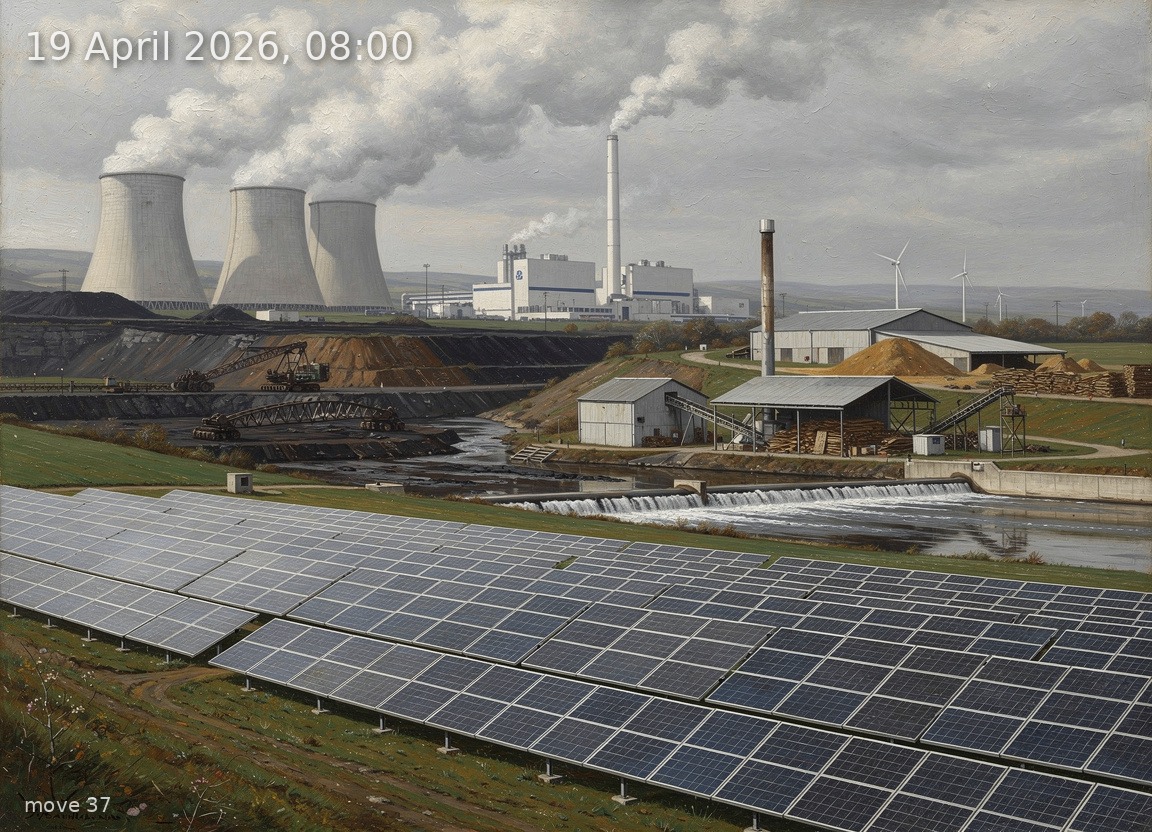
Diffuse solar leads at 48.5 GW under full overcast; coal and gas provide 13.5 GW of thermal backup with wind nearly absent.
Back
Generation mix
Wind onshore 1%
Wind offshore 2%
Solar 69%
Biomass 6%
Hydro 3%
Natural gas 6%
Hard coal 5%
Brown coal 8%
81%
Renewable share
2.6 GW
Wind (on + offshore)
48.5 GW
Solar
70.6 GW
Total generation
+70.6 GW
Net export
96.6 €/MWh
Day-ahead price
9.7°C / 12 km/h
Temp / Wind speed
Open-Meteo, Kassel (51.3°N 9.5°E)
100.0% / 0.0 W/m²
Cloud cover / Radiation
134
gCO₂/kWh
Image prompt
Solar 48.5 GW dominates the scene as vast fields of aluminium-framed crystalline silicon PV panels stretching across rolling central German farmland, occupying roughly two-thirds of the composition. Brown coal 5.9 GW appears at the left as a cluster of massive hyperbolic cooling towers with thick white-grey steam plumes merging into the overcast sky, adjacent to open-pit lignite excavations. Natural gas 4.0 GW is rendered as a pair of compact CCGT power plants with tall single exhaust stacks and thinner steam columns in the centre-left. Hard coal 3.6 GW sits behind the gas plants as a traditional coal-fired station with rectangular boiler houses and a tall chimney. Biomass 4.2 GW appears as a mid-sized wood-chip facility with a modest stack and stored timber piles, positioned centre-right. Hydro 1.8 GW is a concrete run-of-river weir with water spilling over in the middle distance. Wind onshore 0.9 GW and wind offshore 1.7 GW appear as a sparse handful of three-blade turbines on distant hills and a few offshore turbines barely visible on the far horizon, their blades turning sluggishly. The time is 08:00 on an April morning: full diffuse daylight but no sun visible; the entire sky is a uniform, heavy, pale-grey overcast at 100% cloud cover casting flat shadowless light. Early spring vegetation — bare-branching trees beginning to bud, fresh green grass — at 9.7 °C with a cool damp atmosphere. The mood is oppressive and weighty, reflecting the 96.6 EUR/MWh price: the air feels thick, the clouds press low, steam and haze blend into one dense canopy. Highly detailed oil painting in the tradition of 19th-century German Romantic landscape painters — Caspar David Friedrich meets industrial realism — rich muted earth tones, visible textured brushwork, atmospheric depth and aerial perspective. Meticulous engineering accuracy on every technology: turbine nacelles, lattice towers, PV cell grid patterns, cooling tower parabolic curves, CCGT exhaust geometry. No text, no labels.