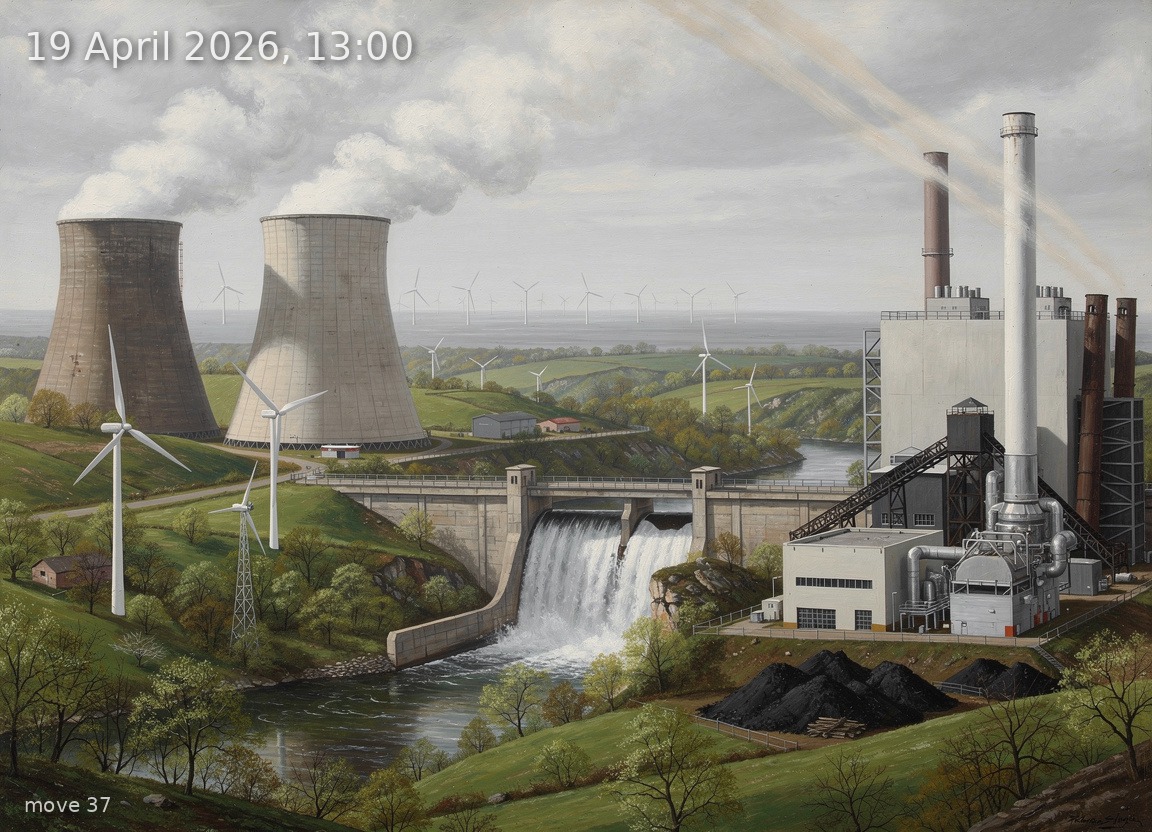
Biomass, offshore wind, and brown coal dominate as full overcast and oversupply push prices slightly negative.
Back
Generation mix
Wind onshore 6%
Wind offshore 19%
Biomass 28%
Hydro 12%
Natural gas 8%
Hard coal 9%
Brown coal 18%
65%
Renewable share
3.7 GW
Wind (on + offshore)
0.0 GW
Solar
15.0 GW
Total generation
+15.0 GW
Net export
-0.8 €/MWh
Day-ahead price
9.6°C / 19 km/h
Temp / Wind speed
Open-Meteo, Kassel (51.3°N 9.5°E)
100.0% / 7.2 W/m²
Cloud cover / Radiation
256
gCO₂/kWh
Image prompt
Biomass 4.2 GW occupies the right foreground as a cluster of large wood-chip-fired power stations with tall rectangular stacks trailing pale exhaust; offshore wind 2.9 GW appears in the distant background as a line of three-blade turbines rising from a grey North Sea horizon; brown coal 2.7 GW fills the left third as two massive hyperbolic cooling towers with thick white steam plumes; hydro 1.8 GW is rendered as a concrete dam with spillway in the middle distance; hard coal 1.4 GW sits behind the lignite plant as a smaller station with conveyor belts and a dark coal heap; natural gas 1.2 GW appears as a compact CCGT unit with a single slender exhaust stack near centre; onshore wind 0.9 GW shows as a few scattered turbines on rolling green hills. The scene is set at 1:00 PM under a completely overcast, flat, pearl-grey sky with no sun visible and no shadows on the ground, diffuse daylight illuminating everything evenly. The landscape is early spring central Germany — fresh pale-green budding trees, cool-toned grass, patches of bare brown earth, temperature around 10 °C suggested by figures in light jackets. A moderate breeze bends the grass and stirs the steam plumes sideways. The atmosphere is calm and open, reflecting the near-zero electricity price — no oppressive weight, just quiet grey expansiveness. Rendered as a highly detailed oil painting in the tradition of 19th-century German Romantic landscape painters such as Caspar David Friedrich and Carl Blechen, with rich layered colour, visible confident brushwork, atmospheric depth and aerial perspective, dramatic compositional balance between industrial structures and nature. Each technology is painted with meticulous engineering accuracy: three-blade rotor nacelles, aluminium lattice towers, hyperbolic concrete cooling tower geometry, CCGT exhaust details, dam spillway architecture. No text, no labels, no human-made signage.