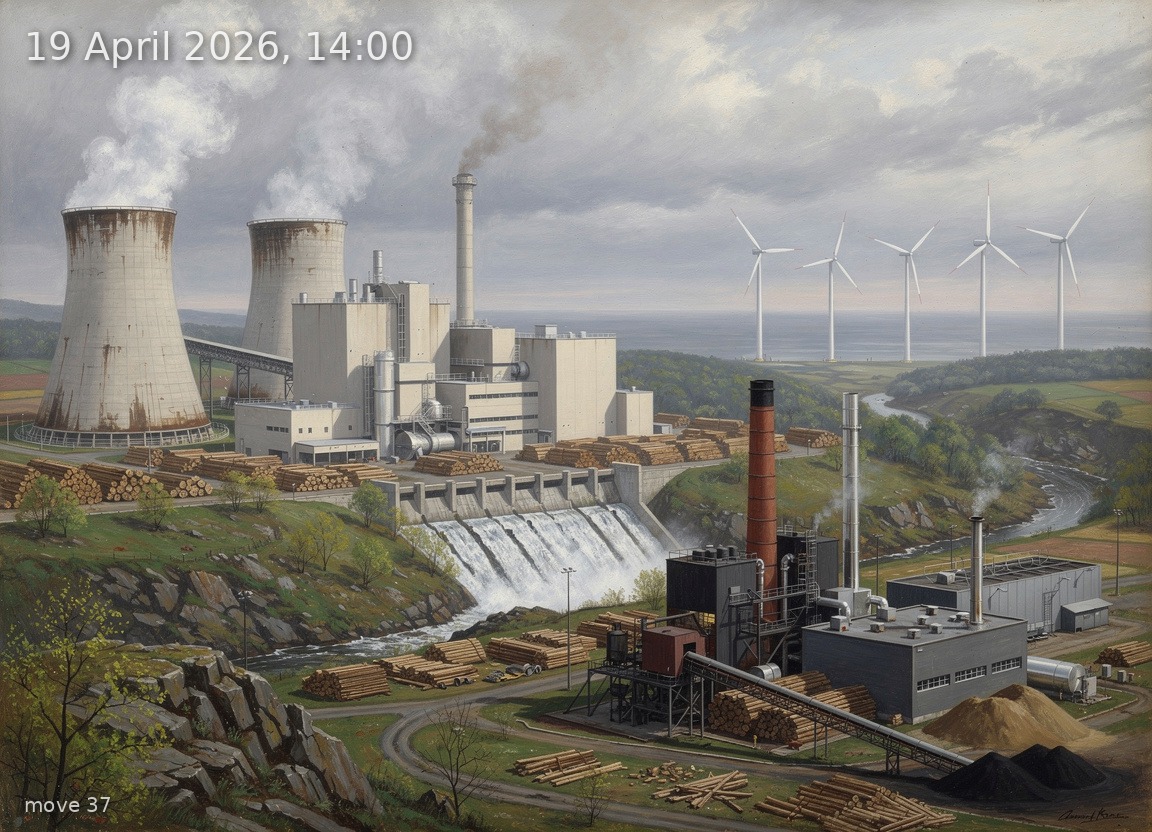
Biomass and offshore wind lead a 14 GW oversupplied grid under full overcast, pushing prices negative.
Back
Generation mix
Wind offshore 21%
Biomass 30%
Hydro 13%
Natural gas 8%
Hard coal 8%
Brown coal 19%
64%
Renewable share
3.0 GW
Wind (on + offshore)
0.0 GW
Solar
14.0 GW
Total generation
+14.0 GW
Net export
-3.0 €/MWh
Day-ahead price
10.9°C / 16 km/h
Temp / Wind speed
Open-Meteo, Kassel (51.3°N 9.5°E)
100.0% / 30.5 W/m²
Cloud cover / Radiation
260
gCO₂/kWh
Image prompt
Biomass 4.2 GW dominates the centre-left as a cluster of large industrial biomass plants with tall chimneys emitting pale wood-smoke plumes and stacked timber yards; offshore wind 3.0 GW appears in the far right background as a row of tall three-blade turbines rising from a grey North Sea horizon; brown coal 2.7 GW occupies the left foreground as two massive hyperbolic cooling towers with thick white steam columns; hydro 1.8 GW is rendered as a concrete dam with spillway in the middle distance nestled in a green valley; hard coal 1.2 GW appears as a single smaller coal plant with a red-brick stack and conveyor belts centre-right; natural gas 1.1 GW is a compact CCGT unit with a single polished exhaust stack near the hard coal plant. The time is 14:00 in mid-April — full daylight but entirely diffused and flat under 100% cloud cover, a uniform pale-grey sky with no blue visible, no shadows on the ground. The landscape is early spring central German rolling hills with fresh pale-green budding trees and damp meadows at about 11°C, a moderate breeze bending grass and ruffling puddles. No solar panels anywhere — the overcast is total. The atmosphere is calm and slightly melancholic, reflecting the mildly negative electricity price — open, unoppressive air but drained of colour. Style: highly detailed oil painting in the tradition of 19th-century German Romantic landscape painters such as Caspar David Friedrich and Carl Blechen — rich muted earth tones, visible confident brushwork, luminous atmospheric depth, meticulous engineering detail on every turbine nacelle, cooling tower reinforcement ring, and smokestack. The scene reads as a masterwork industrial landscape painting. No text, no labels.