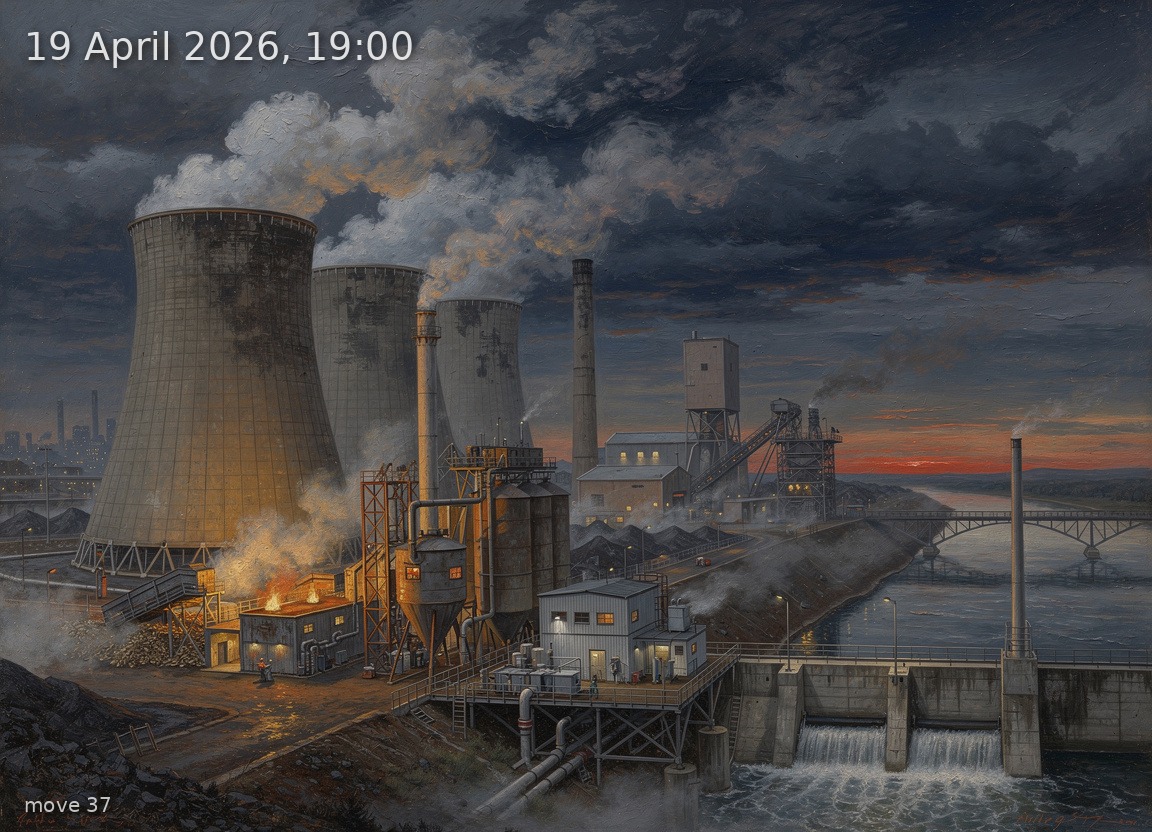
Brown coal and biomass lead evening generation as solar drops to zero and onshore wind is absent.
Back
Generation mix
Wind offshore 21%
Biomass 25%
Hydro 11%
Natural gas 6%
Hard coal 7%
Brown coal 31%
56%
Renewable share
3.5 GW
Wind (on + offshore)
0.0 GW
Solar
17.0 GW
Total generation
+17.0 GW
Net export
117.4 €/MWh
Day-ahead price
10.6°C / 19 km/h
Temp / Wind speed
Open-Meteo, Kassel (51.3°N 9.5°E)
88.0% / 67.2 W/m²
Cloud cover / Radiation
335
gCO₂/kWh
Image prompt
Brown coal 5.3 GW dominates the left third of the scene as a cluster of massive hyperbolic cooling towers with thick white-grey steam plumes rising into a darkening sky; biomass 4.2 GW occupies the centre-left as a wood-chip-fed industrial plant with a tall stack and warm amber glow from furnace openings; offshore wind 3.5 GW appears in the far right background as a row of tall three-blade turbines standing in a distant grey sea, barely visible through haze; hydro 1.8 GW is rendered centre-right as a concrete dam with water spilling over a weir, lit by a few sodium floodlights; natural gas 1.1 GW appears as a compact CCGT unit with a single slender exhaust stack emitting a thin heat shimmer, placed near the centre; hard coal 1.1 GW sits beside the brown coal complex as a smaller power station with a conveyor belt and single square chimney. TIME AND LIGHT: late dusk at 19:00 in April — the sky is a deep gradient from muted orange-red at the very lowest horizon line to dark steel-blue overhead, rapidly losing light, with 88% cloud cover creating heavy overcast layers that absorb the last glow. No direct sunlight, no solar panels anywhere. The atmosphere feels heavy and oppressive reflecting the high electricity price. Spring vegetation is pale green but muted in the fading light; birch and willow trees along a river show early leaves. Wind at moderate speed bends grasses and sends coal-plant steam plumes drifting sideways. Sodium streetlights along an access road cast pools of amber light on wet asphalt. Highly detailed oil painting in the tradition of 19th-century German Romantic landscape painters — rich colour palette of deep indigos, warm ambers, cool greys — visible thick brushwork, atmospheric depth and aerial perspective, meticulous engineering detail on every facility including turbine nacelles, lattice towers, cooling tower fluting, aluminium walkways, and pipe networks. No text, no labels.