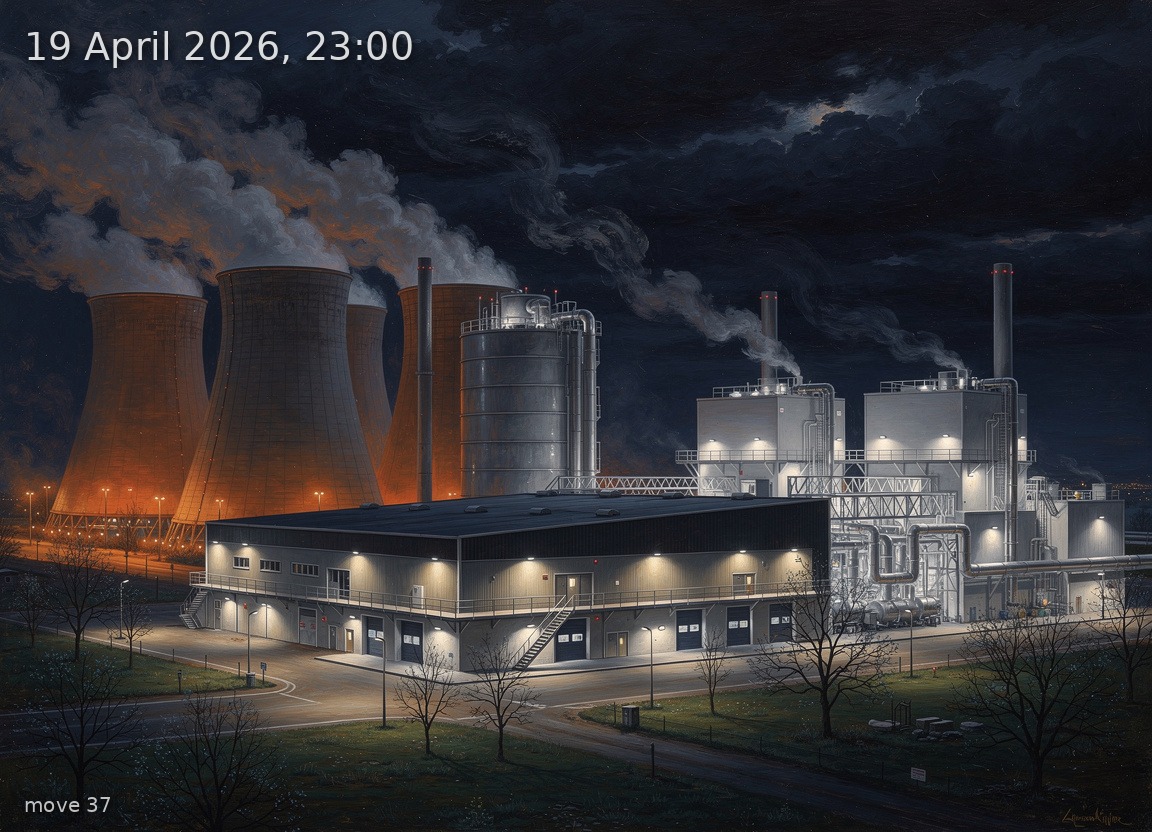
Brown coal, hard coal, gas, and biomass dominate overnight generation as onshore wind and solar are absent.
Back
Generation mix
Wind offshore 15%
Biomass 18%
Hydro 8%
Natural gas 16%
Hard coal 16%
Brown coal 28%
41%
Renewable share
3.4 GW
Wind (on + offshore)
0.0 GW
Solar
23.1 GW
Total generation
+23.1 GW
Net export
111.2 €/MWh
Day-ahead price
8.1°C / 20 km/h
Temp / Wind speed
Open-Meteo, Kassel (51.3°N 9.5°E)
73.0% / 0.0 W/m²
Cloud cover / Radiation
422
gCO₂/kWh
Image prompt
Brown coal 6.4 GW dominates the left third of the scene as a cluster of massive hyperbolic cooling towers with thick white-grey steam plumes rising into the night sky, lit from below by orange sodium lamps; biomass 4.2 GW appears center-left as a large industrial plant with a tall biomass silo and a modest chimney emitting pale vapour, warmly lit by floodlights; natural gas 3.6 GW occupies the center as two compact CCGT units with sleek single exhaust stacks venting thin heat shimmer, illuminated by bright white industrial lighting; hard coal 3.6 GW sits center-right as a traditional coal-fired power station with a single large stack and conveyor belts visible under spotlights; offshore wind 3.4 GW fills the right quarter as a row of tall three-blade turbines visible on a dark horizon line above a black North Sea, their red aviation warning lights blinking; hydro 1.8 GW appears as a small concrete dam structure in the far right background with water cascading under floodlights. The sky is completely dark, deep navy-black, no twilight, no sky glow, thick 73% cloud cover obscuring stars, creating a heavy oppressive ceiling reflecting the elevated 111.2 EUR/MWh price. The season is early spring with bare-branched trees just beginning to bud, patches of green grass faintly visible under artificial light. Wind at 20 km/h animates the steam plumes, bending them to the right, and stirs the offshore turbine blades into visible rotation. No solar panels anywhere — it is fully nighttime. The landscape is flat north-German terrain. Highly detailed oil painting in the tradition of 19th-century German Romantic landscape painters — rich, dark colour palette of deep blues, warm oranges, and industrial greys, visible impasto brushwork, atmospheric depth with haze around the cooling towers, meticulous engineering detail on turbine nacelles, lattice towers, cooling tower parabolic geometry, and CCGT exhaust systems. The mood is brooding and industrial, a nocturnal masterwork of the working grid. No text, no labels.