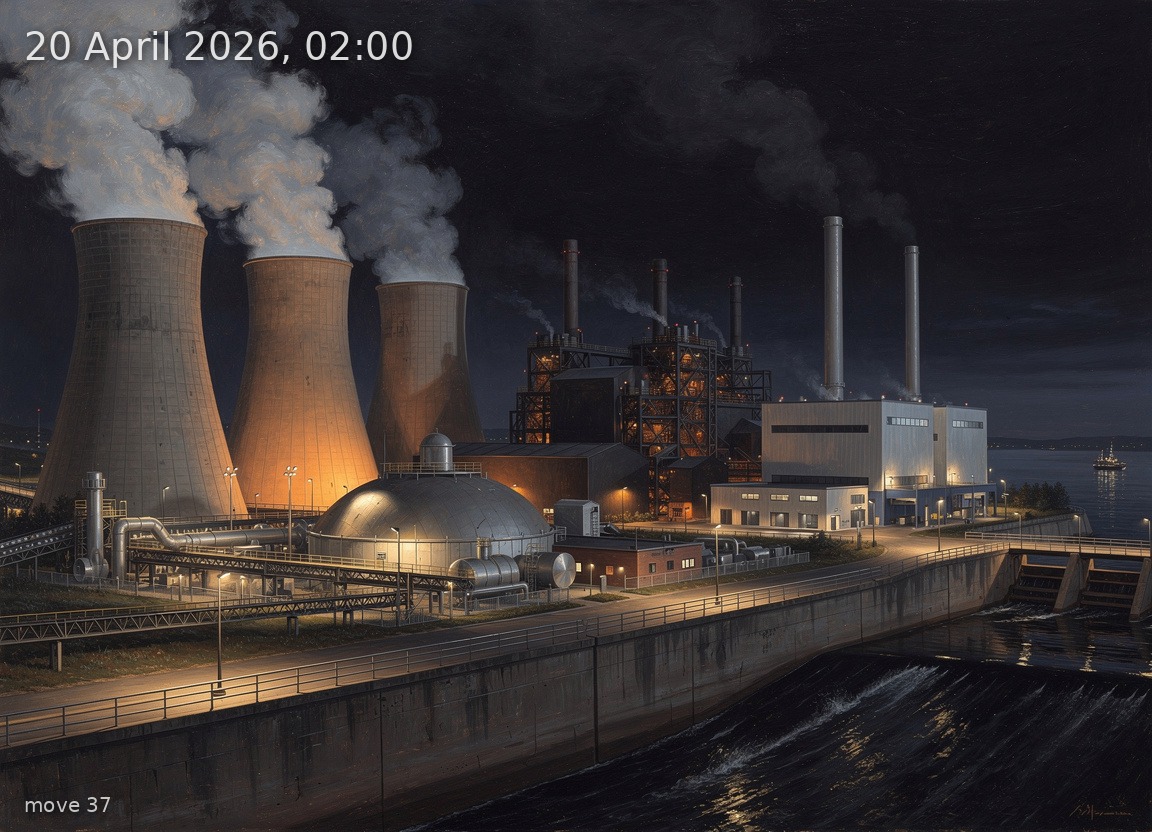
Brown coal, biomass, hard coal, and gas dominate overnight generation as onshore wind and solar contribute nothing.
Back
Generation mix
Wind offshore 13%
Biomass 19%
Hydro 8%
Natural gas 16%
Hard coal 16%
Brown coal 27%
40%
Renewable share
2.8 GW
Wind (on + offshore)
0.0 GW
Solar
21.8 GW
Total generation
+21.8 GW
Net export
99.0 €/MWh
Day-ahead price
7.3°C / 19 km/h
Temp / Wind speed
Open-Meteo, Kassel (51.3°N 9.5°E)
100.0% / 0.0 W/m²
Cloud cover / Radiation
426
gCO₂/kWh
Image prompt
Brown coal 6.0 GW dominates the left third of the scene as four massive hyperbolic cooling towers with thick white steam plumes rising into blackness; hard coal 3.6 GW appears just right of centre as a cluster of coal-fired boiler houses with tall chimneys emitting faint grey exhaust; natural gas 3.4 GW sits centre-right as two compact CCGT units with single sleek exhaust stacks and visible heat shimmer; biomass 4.2 GW occupies the centre-left as a sprawling wood-chip-fed CHP plant with a large domed silo and a modest stack trailing pale vapour; hydro 1.8 GW appears in the far right foreground as a concrete dam spillway with dark water glinting under floodlights; offshore wind 2.8 GW is suggested on the far right horizon as a distant row of turbine warning lights blinking red over an invisible sea. The sky is completely black with dense 100% overcast — no stars, no moon, no twilight — a deep navy-charcoal void pressing down oppressively, conveying the high 99 EUR/MWh price as a heavy, suffocating atmosphere. The only illumination comes from sodium-orange industrial floodlights casting pools of amber on wet tarmac, red aviation warning lights atop stacks and towers, and the faint incandescent glow from furnace openings. Early spring vegetation is barely visible — sparse budding trees along a canal in the mid-ground, grass still winter-brown, temperature around 7°C suggested by a light ground mist drifting between structures. Moderate wind is shown by steam plumes bending rightward and a tattered windsock on a pole. Highly detailed oil painting in the tradition of 19th-century German Romantic landscape painters — Caspar David Friedrich's brooding darkness combined with Adolph Menzel's industrial precision — rich impasto brushwork, dramatic chiaroscuro between amber light pools and surrounding blackness, atmospheric depth receding into haze, meticulous engineering detail on every turbine nacelle, cooling tower ribbing, and pipe array. No text, no labels.