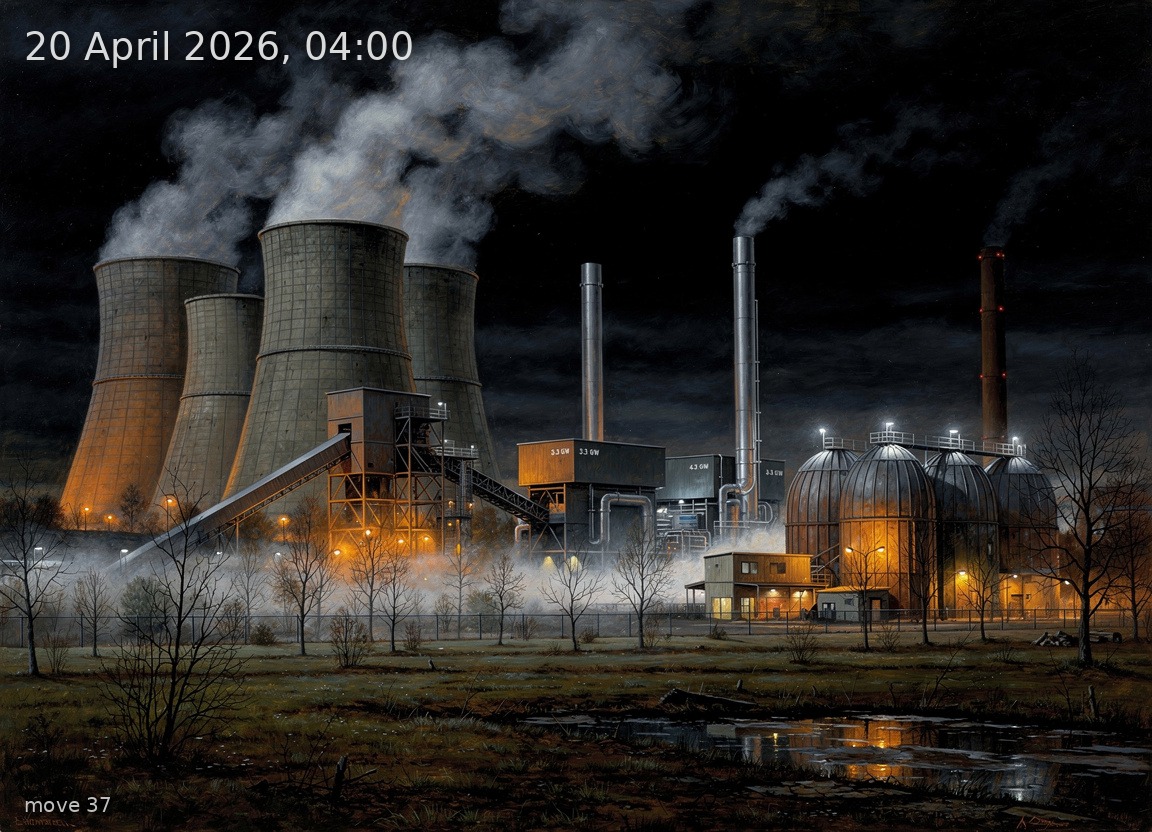
Brown coal leads overnight generation at 6.1 GW; biomass, gas, hard coal, and offshore wind fill the pre-dawn baseload.
Back
Generation mix
Wind offshore 12%
Biomass 20%
Hydro 8%
Natural gas 15%
Hard coal 16%
Brown coal 29%
40%
Renewable share
2.7 GW
Wind (on + offshore)
0.0 GW
Solar
21.5 GW
Total generation
+21.5 GW
Net export
102.3 €/MWh
Day-ahead price
6.7°C / 18 km/h
Temp / Wind speed
Open-Meteo, Kassel (51.3°N 9.5°E)
100.0% / 0.0 W/m²
Cloud cover / Radiation
426
gCO₂/kWh
Image prompt
Brown coal 6.1 GW dominates the left third of the scene as a cluster of massive hyperbolic cooling towers with thick white steam plumes rising into blackness; hard coal 3.3 GW appears center-left as a gritty coal-fired plant with tall stacks and conveyor belts, lit by orange sodium lights; natural gas 3.3 GW occupies the center as compact CCGT units with single polished exhaust stacks emitting thin vapor, illuminated by harsh industrial floodlights; biomass 4.2 GW fills the center-right as a large wood-chip-fed power station with dome-shaped storage silos and a modest chimney, warmly lit from within; offshore wind 2.7 GW appears in the far right background as a row of tall three-blade turbines standing in dark waters, their red aviation warning lights blinking; hydro 1.8 GW is rendered as a concrete dam facility nestled in a valley in the distant right, with a few lit windows. Time is 04:00 — complete darkness, deep black sky with 100% overcast, absolutely no twilight or sky glow, no stars visible, no moon. The landscape is early spring central Germany: bare trees beginning to bud, damp fields, temperature near 7°C suggesting mist clinging low to the ground. A moderate wind animates the steam plumes, bending them eastward. The atmosphere feels heavy and oppressive, reflecting a high electricity price — thick cloud pressing down, industrial haze mixing with fog. All facilities glow with artificial sodium-orange and cool-white industrial lighting, reflections gleaming off wet roads and puddles. No solar panels anywhere. Rendered as a highly detailed oil painting in the tradition of 19th-century German Romantic landscape painters — Caspar David Friedrich meets industrial realism — rich dark palette of blacks, deep blues, warm oranges, and sulfurous yellows, visible confident brushwork, atmospheric depth receding into murky distance, meticulous engineering detail on every turbine nacelle, cooling tower reinforcement rib, and exhaust stack. No text, no labels.