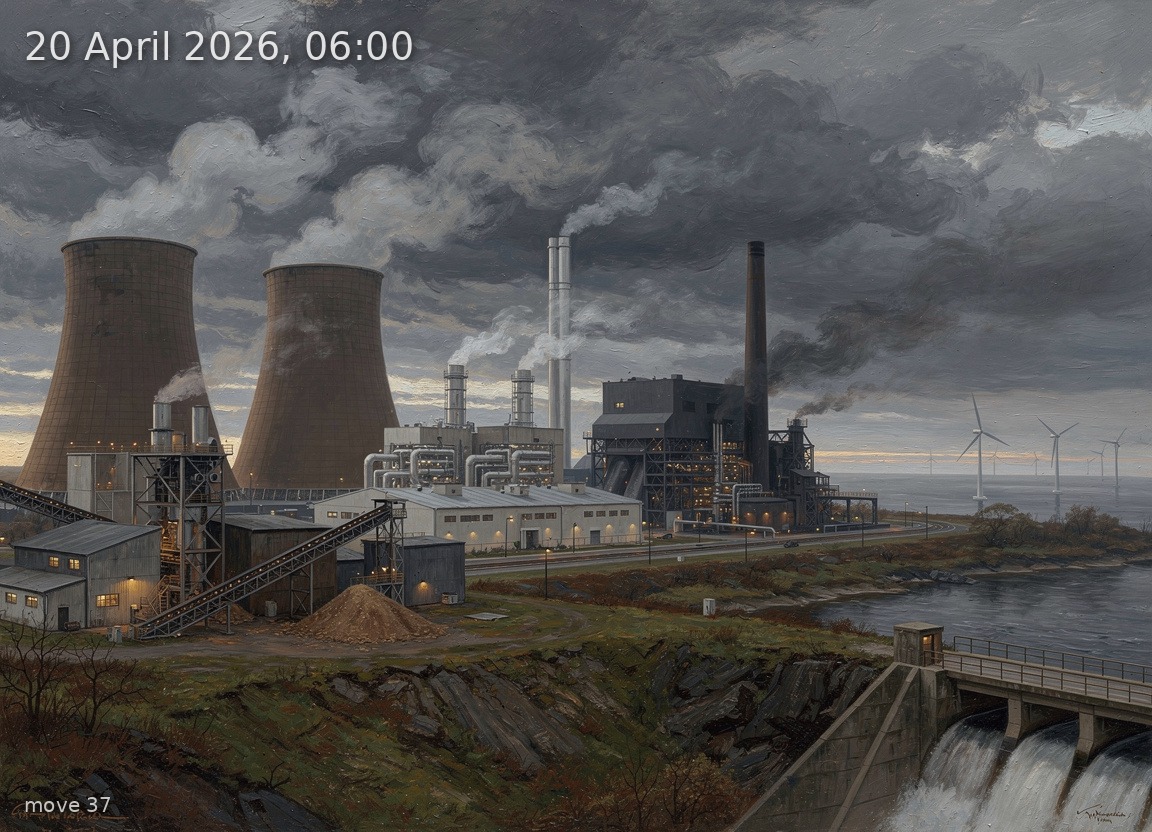
Brown coal and thermal plants dominate at dawn as full overcast eliminates solar and onshore wind sits idle.
Back
Generation mix
Wind offshore 13%
Biomass 19%
Hydro 8%
Natural gas 15%
Hard coal 14%
Brown coal 30%
40%
Renewable share
2.7 GW
Wind (on + offshore)
0.0 GW
Solar
21.6 GW
Total generation
+21.6 GW
Net export
129.4 €/MWh
Day-ahead price
6.1°C / 20 km/h
Temp / Wind speed
Open-Meteo, Kassel (51.3°N 9.5°E)
100.0% / 0.0 W/m²
Cloud cover / Radiation
428
gCO₂/kWh
Image prompt
Brown coal 6.5 GW dominates the left third of the scene as three massive hyperbolic cooling towers with thick white-grey steam plumes rising into heavy clouds; biomass 4.2 GW appears as a cluster of mid-sized industrial boiler buildings with low stacks and wood-chip conveyors in the left-centre; natural gas 3.3 GW fills the centre as two compact CCGT units with tall single exhaust stacks emitting thin vapour trails; hard coal 3.1 GW occupies the right-centre as a large power station with a prominent rectangular boiler house and a tapered chimney; offshore wind 2.7 GW is visible in the far right distance as a row of three-blade turbines standing in a grey sea on the horizon, nacelles barely discernible; hydro 1.8 GW appears as a concrete dam structure with spillway at the far right foreground edge. Time is 06:00 in April — pre-dawn with only the faintest pale blue-grey light along the eastern horizon, the sky otherwise deep slate-grey and fully overcast at 100% cloud cover, no direct sunlight, no solar panels anywhere. Temperature is 6°C: early spring vegetation is sparse, bare branches with the first tiny buds, damp brown-green grass, patches of frost on the ground. Wind speed 20.5 km/h drives visible motion in steam plumes bending sideways and in bare treetops swaying. The atmosphere is heavy, oppressive, and dense, reflecting the high 129.4 EUR/MWh price — low-hanging clouds pressing down on the industrial skyline, a brooding quality. Sodium-orange streetlights and warm industrial lighting glow from plant windows and access roads, casting amber reflections on wet pavement. Highly detailed oil painting in the tradition of 19th-century German Romantic landscape painters — rich dark tonal palette of slate, ochre, umber, and cold blue-grey, visible impasto brushwork, atmospheric depth with receding layers of industrial silhouettes, meticulous engineering detail on each turbine nacelle, cooling tower curvature, CCGT exhaust geometry, and coal plant architecture. No text, no labels.