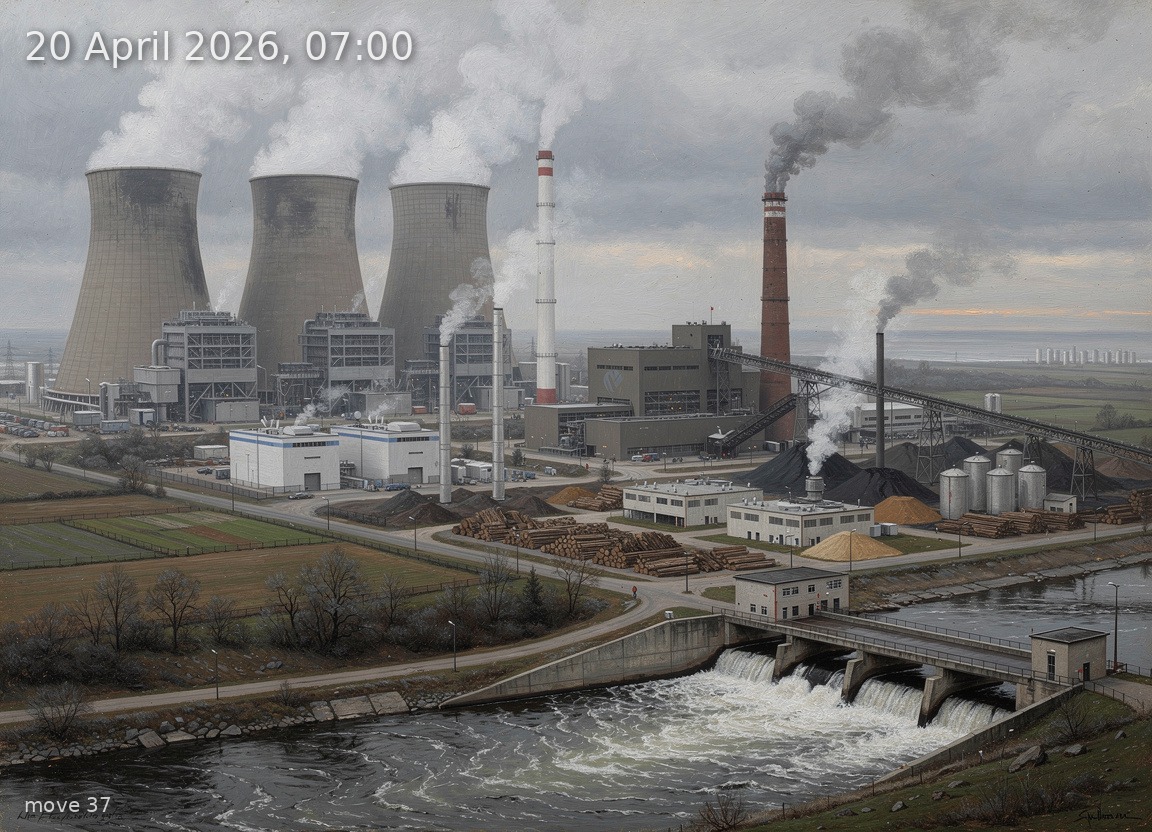
Brown coal, gas, and hard coal dominate as overcast skies and calm inland winds suppress renewable output.
Back
Generation mix
Wind offshore 12%
Biomass 18%
Hydro 8%
Natural gas 19%
Hard coal 15%
Brown coal 29%
38%
Renewable share
2.8 GW
Wind (on + offshore)
0.0 GW
Solar
23.5 GW
Total generation
+23.5 GW
Net export
142.2 €/MWh
Day-ahead price
5.7°C / 22 km/h
Temp / Wind speed
Open-Meteo, Kassel (51.3°N 9.5°E)
98.0% / 0.2 W/m²
Cloud cover / Radiation
440
gCO₂/kWh
Image prompt
Brown coal 6.7 GW dominates the left third of the scene as a massive lignite power station with three hyperbolic cooling towers emitting thick white steam plumes into the grey sky; natural gas 4.4 GW occupies the centre-left as two compact CCGT units with tall single exhaust stacks releasing thin transparent heat shimmer; hard coal 3.6 GW appears centre-right as a traditional coal plant with a large rectangular boiler house, conveyor belts, and a tall brick chimney trailing darker smoke; biomass 4.2 GW is rendered as a cluster of medium-scale wood-chip power plants with cylindrical silos and modest stacks amid stacked timber in the mid-ground right; hydro 1.8 GW appears as a concrete run-of-river dam with spillway in the right foreground beside a cold river; wind offshore 2.8 GW is visible in the far background as a distant line of three-blade turbines on the grey North Sea horizon, their rotors turning slowly. No solar panels anywhere — the sky is completely overcast at 98% cloud cover, a flat uniform blanket of heavy grey stratus. The lighting is early dawn at 07:00 in April: a pale blue-grey pre-dawn glow diffusing evenly through the thick clouds, no direct sunlight, no warm tones, the landscape illuminated by a cold flat light. The temperature is 5.7°C — early spring with bare branches on scattered trees, patches of frost on brown grass, no green leaves yet. The atmosphere feels heavy and oppressive, reflecting the 142.2 EUR/MWh price — the air is dense with moisture and industrial exhaust, visibility limited, a brooding weight pressing down. The terrain is a broad German lowland river valley. Style: highly detailed oil painting in the tradition of 19th-century German Romantic landscape painters such as Caspar David Friedrich and Carl Blechen — rich tonal depth in greys and muted earth tones, visible confident brushwork, atmospheric perspective with haze softening distant cooling towers, meticulous engineering accuracy in every turbine nacelle, every lattice tower, every conveyor mechanism. The painting conveys industrial sublime — the vast scale of human energy infrastructure under a vast indifferent sky. No text, no labels.