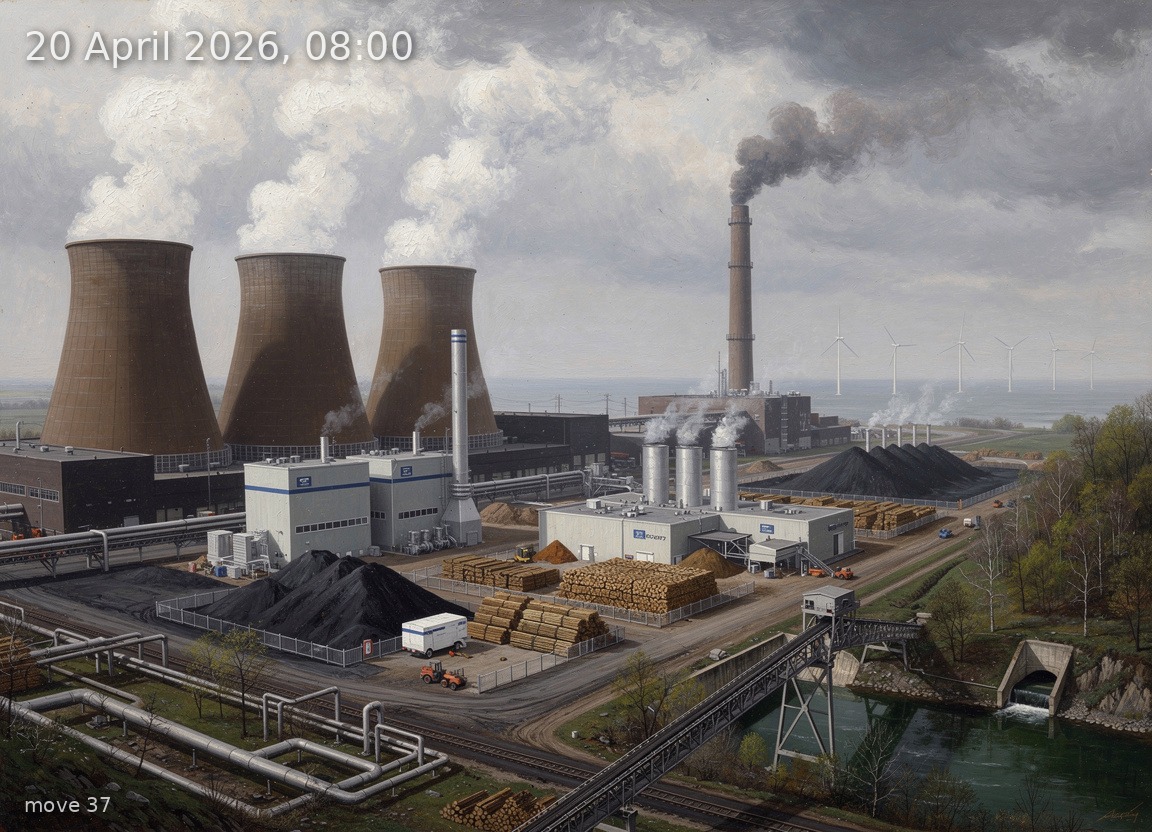
Brown coal, gas, and hard coal dominate at 19 GW as onshore wind stalls and overcast skies suppress solar.
Back
Generation mix
Wind offshore 12%
Biomass 18%
Hydro 8%
Natural gas 19%
Hard coal 15%
Brown coal 29%
38%
Renewable share
2.9 GW
Wind (on + offshore)
0.0 GW
Solar
23.7 GW
Total generation
+23.7 GW
Net export
134.3 €/MWh
Day-ahead price
6.0°C / 23 km/h
Temp / Wind speed
Open-Meteo, Kassel (51.3°N 9.5°E)
67.0% / 25.8 W/m²
Cloud cover / Radiation
440
gCO₂/kWh
Image prompt
Brown coal 6.8 GW occupies the left third of the scene as a massive lignite power station with four hyperbolic cooling towers emitting thick white steam plumes into a grey overcast sky; natural gas 4.4 GW fills the centre-left as two compact CCGT units with tall single exhaust stacks releasing thin heat shimmer; biomass 4.2 GW appears centre-right as a cluster of medium-scale wood-fired CHP plants with squat chimneys and stacked timber yards; hard coal 3.6 GW sits right of centre as a traditional coal plant with a single large smokestack and conveyor belt feeding dark coal into a bunker; wind offshore 2.9 GW is visible in the far right background as a line of three-blade turbines standing on the hazy North Sea horizon; hydro 1.8 GW appears as a small dam and reservoir nestled in a forested valley at the far right edge. The time is 08:00 on an overcast April morning: full daylight but muted, diffuse illumination with no direct sun breaking through a 67% cloud layer; the sky is uniformly grey-white with hints of pale blue attempting to break through; early spring vegetation shows budding but still mostly bare deciduous trees, some green grass emerging, temperature around 6°C suggested by a light frost on metal railings. The atmosphere feels heavy and oppressive reflecting the 134.3 EUR/MWh price—thick industrial haze hangs low, merging cooling tower steam with low clouds. No solar panels visible anywhere. Style: highly detailed oil painting in the tradition of 19th-century German Romantic landscape painters such as Caspar David Friedrich and Carl Blechen, with rich earth tones, visible impasto brushwork, dramatic atmospheric depth, and meticulous engineering detail on every turbine nacelle, lattice tower, cooling tower parabolic curve, and CCGT stack. The composition has the grandeur and melancholy of an industrial sublime landscape. No text, no labels.