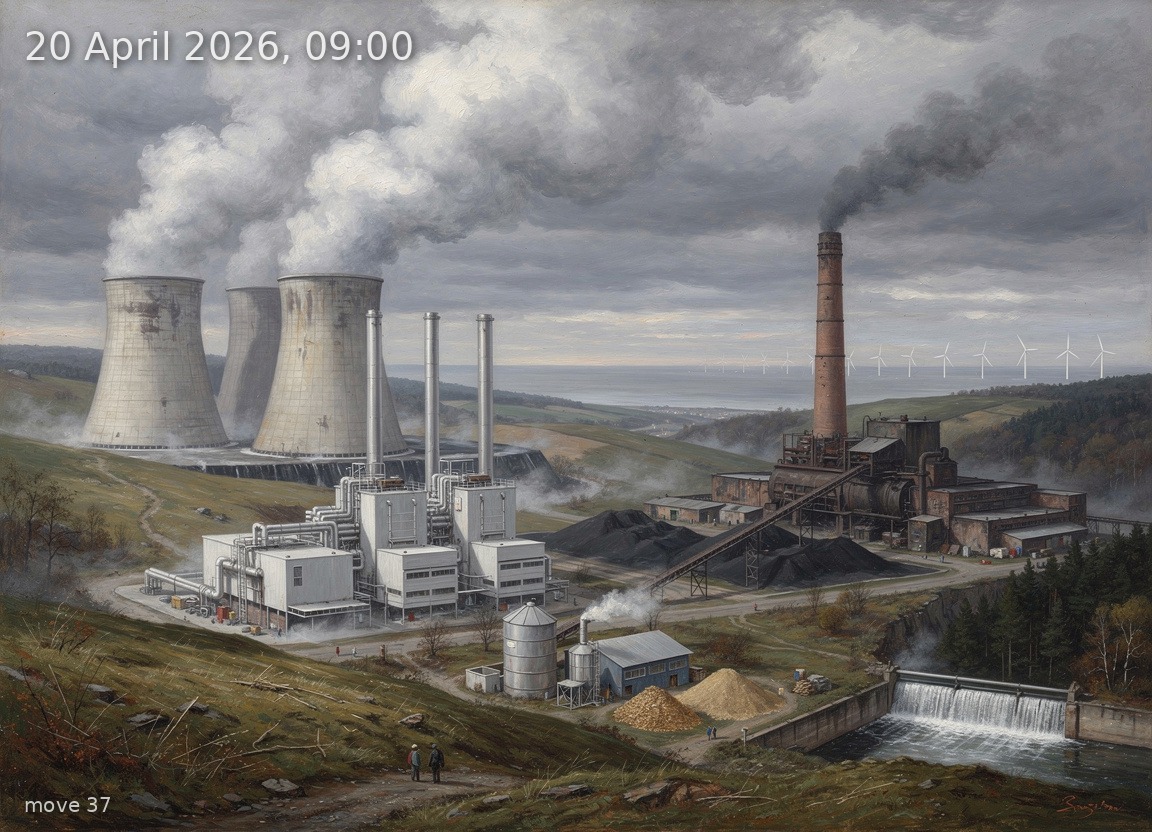
Brown coal, gas, and hard coal dominate as dense overcast eliminates solar and onshore wind stays silent.
Back
Generation mix
Wind offshore 12%
Biomass 17%
Hydro 7%
Natural gas 24%
Hard coal 17%
Brown coal 24%
36%
Renewable share
3.0 GW
Wind (on + offshore)
0.0 GW
Solar
25.3 GW
Total generation
+25.3 GW
Net export
110.0 €/MWh
Day-ahead price
6.5°C / 22 km/h
Temp / Wind speed
Open-Meteo, Kassel (51.3°N 9.5°E)
97.0% / 18.8 W/m²
Cloud cover / Radiation
437
gCO₂/kWh
Image prompt
Brown coal 6.1 GW occupies the left quarter as a cluster of massive hyperbolic cooling towers with thick white-grey steam plumes merging into the overcast sky; natural gas 6.0 GW fills the centre-left as three compact CCGT power blocks with tall slender exhaust stacks emitting thin heat shimmer; hard coal 4.2 GW appears centre-right as a gritty coal-fired station with conveyor belts feeding dark fuel into a large boiler building, a single wide chimney trailing grey smoke; biomass 4.2 GW is rendered as a mid-ground wood-chip-fed CHP plant with a conical silo and modest stack; wind offshore 3.0 GW is visible far in the background as a distant line of white three-blade turbines on the hazy northern horizon above a grey sea strip; hydro 1.8 GW appears as a small dam with spillway in a forested valley on the far right. The sky is heavily overcast at 97% cloud cover, a flat oppressive ceiling of pewter-grey stratus pressing down, no sun visible, diffuse daylight at mid-morning brightness but dull and cheerless. No solar panels anywhere—no sunshine to justify them. The landscape is early spring central German rolling hills, bare deciduous trees just beginning to bud, pale green grass, patches of brown earth, temperature near 6°C conveyed by mist clinging to low ground and figures in jackets. Moderate wind bends grass and smoke plumes slightly. The atmosphere feels heavy and costly, reflecting 110 EUR/MWh prices—industrial haze, dense air, a brooding weight. Style: highly detailed oil painting in the tradition of 19th-century German Romantic landscape masters such as Caspar David Friedrich and Carl Blechen, rich saturated earth tones and grey-blues, visible impasto brushwork, dramatic atmospheric depth and chiaroscuro, meticulous engineering detail on every turbine nacelle, cooling tower, conveyor system, and exhaust stack, monumental industrial sublime. No text, no labels.