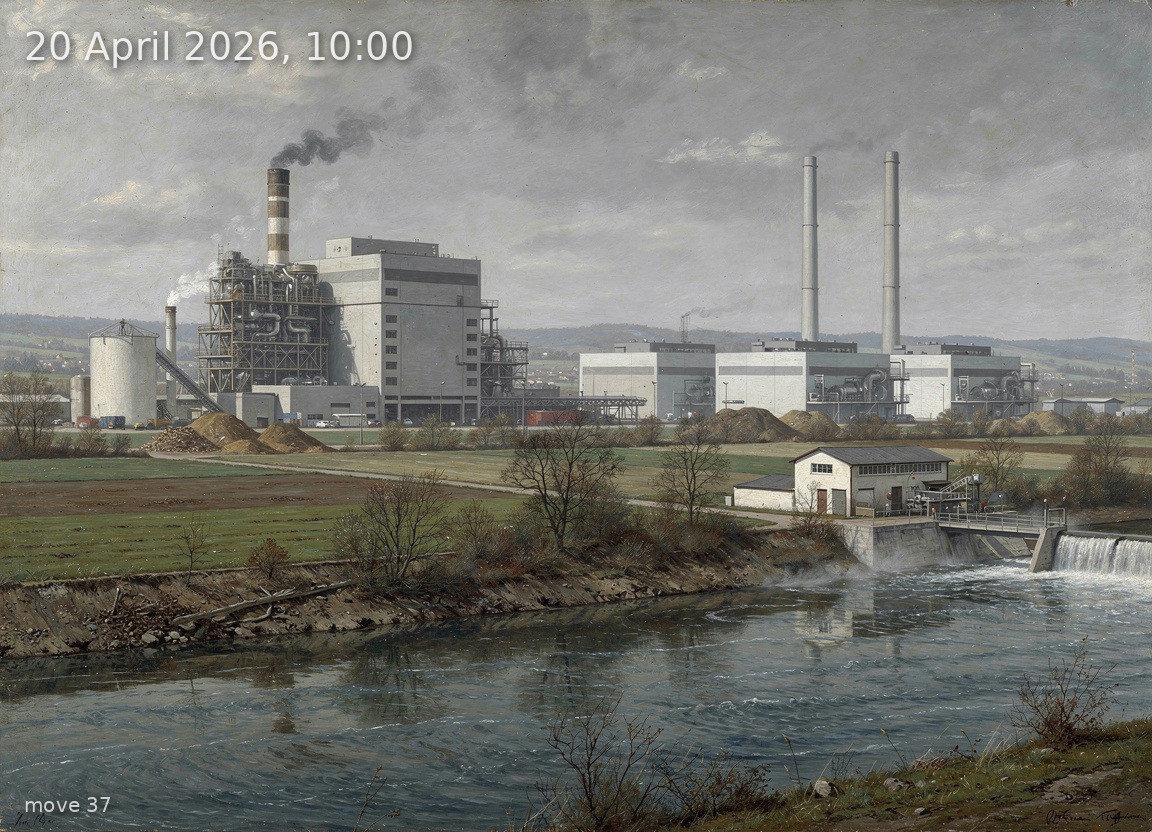
Gas, brown coal, and hard coal dominate at 15.4 GW as complete overcast eliminates solar and onshore wind stays silent.
Back
Generation mix
Wind offshore 13%
Biomass 18%
Hydro 7%
Natural gas 25%
Hard coal 17%
Brown coal 20%
38%
Renewable share
3.2 GW
Wind (on + offshore)
0.0 GW
Solar
24.9 GW
Total generation
+24.9 GW
Net export
90.2 €/MWh
Day-ahead price
7.0°C / 22 km/h
Temp / Wind speed
Open-Meteo, Kassel (51.3°N 9.5°E)
100.0% / 14.2 W/m²
Cloud cover / Radiation
415
gCO₂/kWh
Image prompt
Brown coal 5.1 GW occupies the left quarter as a cluster of four massive hyperbolic cooling towers with thick white-grey steam plumes merging into the overcast sky, flanked by conveyor belts carrying dark lignite; hard coal 4.2 GW sits left-of-centre as a large coal-fired plant with tall rectangular stacks and dark smoke wisps; natural gas 6.1 GW fills the centre-right as three modern combined-cycle gas turbine units with sleek single exhaust stacks emitting thin heat shimmer; biomass 4.5 GW appears in the right-centre as a wood-chip fired industrial facility with a rounded silo and modest chimney; offshore wind 3.2 GW is visible in the far background right as a distant row of white three-blade turbines standing in a grey North Sea barely distinguishable from the sky; hydro 1.7 GW is a small run-of-river station with a weir and low concrete powerhouse nestled at the far right edge near a swollen spring river. The sky is entirely overcast with heavy, uniform stratiform clouds in tones of slate grey and pewter, pressing down oppressively—no break in the cloud, no sunlight, diffuse flat illumination consistent with 10:00 AM daylight but deeply muted. The atmosphere feels heavy and expensive, with a brooding industrial weight. The landscape is early spring in central Germany: bare deciduous trees just beginning to bud, dull green-brown fields, patches of mud, temperature around 7°C suggested by a chill haze near the river. No solar panels anywhere—the overcast sky forbids them. No onshore wind turbines—they are absent from this scene. The overall composition is a wide panoramic view across a river valley industrial corridor. Style: highly detailed oil painting in the tradition of 19th-century German Romantic landscape painters such as Caspar David Friedrich and Carl Blechen—rich, sombre colour palette of iron greys, muted ochres, and cold blue-greens; visible confident brushwork; atmospheric depth with industrial haze layering the middle distance; meticulous engineering accuracy on every turbine nacelle, cooling tower shell, and exhaust stack. The painting conveys the sublime tension between nature and industry under a suffocating spring overcast. No text, no labels.