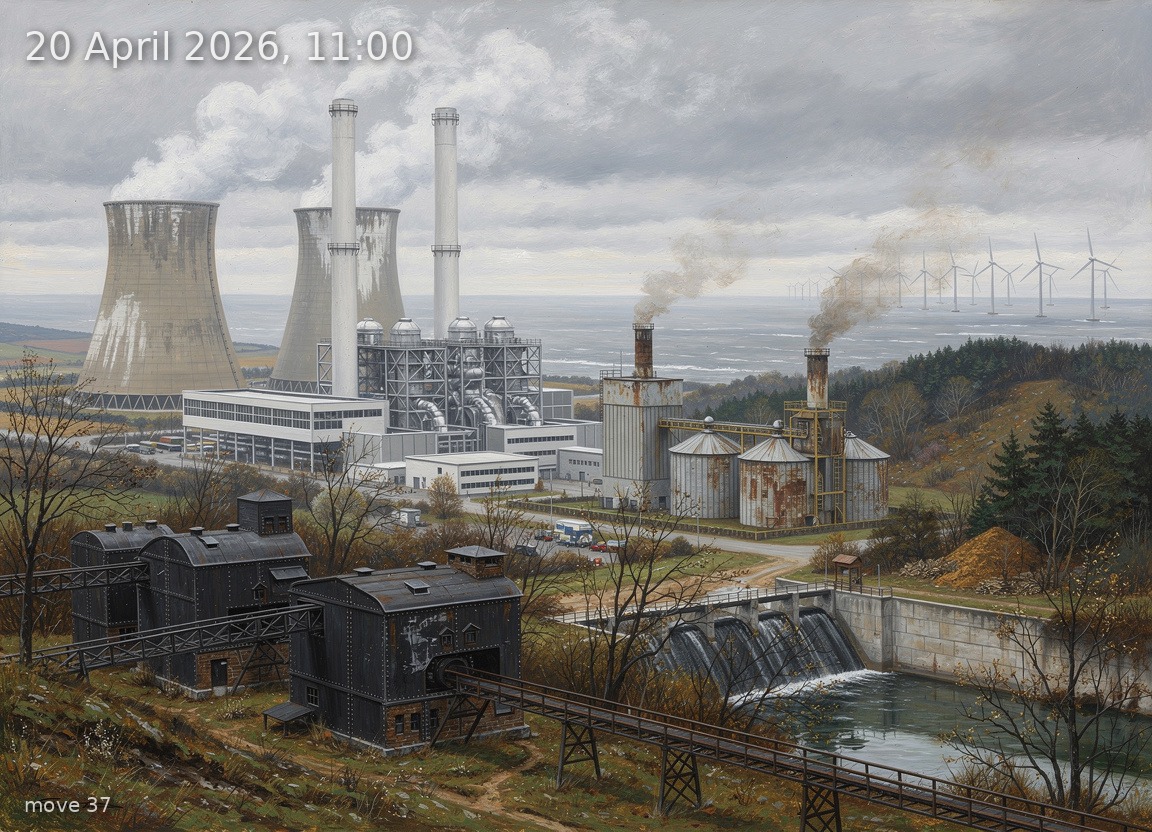
Gas, coal, and biomass carry the grid as full overcast eliminates solar and onshore wind sits idle.
Back
Generation mix
Wind offshore 14%
Biomass 19%
Hydro 7%
Natural gas 25%
Hard coal 18%
Brown coal 16%
40%
Renewable share
3.3 GW
Wind (on + offshore)
0.0 GW
Solar
23.2 GW
Total generation
+23.2 GW
Net export
75.9 €/MWh
Day-ahead price
7.4°C / 24 km/h
Temp / Wind speed
Open-Meteo, Kassel (51.3°N 9.5°E)
100.0% / 7.8 W/m²
Cloud cover / Radiation
392
gCO₂/kWh
Image prompt
Natural gas 5.9 GW dominates the centre-left as a cluster of modern combined-cycle gas turbine plants with tall single exhaust stacks venting thin white plumes; biomass 4.4 GW appears centre-right as industrial wood-chip power stations with ribbed silos and short square chimneys trailing pale smoke; hard coal 4.2 GW occupies the left foreground as a pair of large coal-fired boiler houses with conveyor belts and tall rectangular stacks; brown coal 3.8 GW sits in the left background as two massive hyperbolic cooling towers releasing thick columns of condensing steam; offshore wind 3.3 GW is visible far in the distance at the right horizon as a row of slender three-blade turbines standing in a grey sea; hydro 1.6 GW appears as a small concrete dam with spillway in the right middle ground among forested hills. Time is 11:00 AM in April but the sky is entirely overcast — a flat, heavy, unbroken ceiling of grey-white stratus clouds allowing diffuse light but no direct sun and no shadows, creating an oppressively uniform brightness. The landscape is early-spring central Germany: bare deciduous trees just beginning to bud, patches of brown and pale green grass, cool 7 °C atmosphere with a damp chill conveyed through muted tones. A moderate wind bends the sparse vegetation. The elevated price of 75.9 EUR/MWh is reflected in the heavy, pressing atmosphere and industrial density. No solar panels appear anywhere. Highly detailed oil painting in the tradition of 19th-century German Romantic landscape painters — Caspar David Friedrich's atmospheric depth married with meticulous industrial-engineering accuracy: visible turbine nacelles and lattice towers, aluminium-framed details, riveted boiler casings, lattice conveyors. Rich muted colour palette of slate grey, ochre, olive, and steel blue with visible impasto brushwork. No text, no labels.