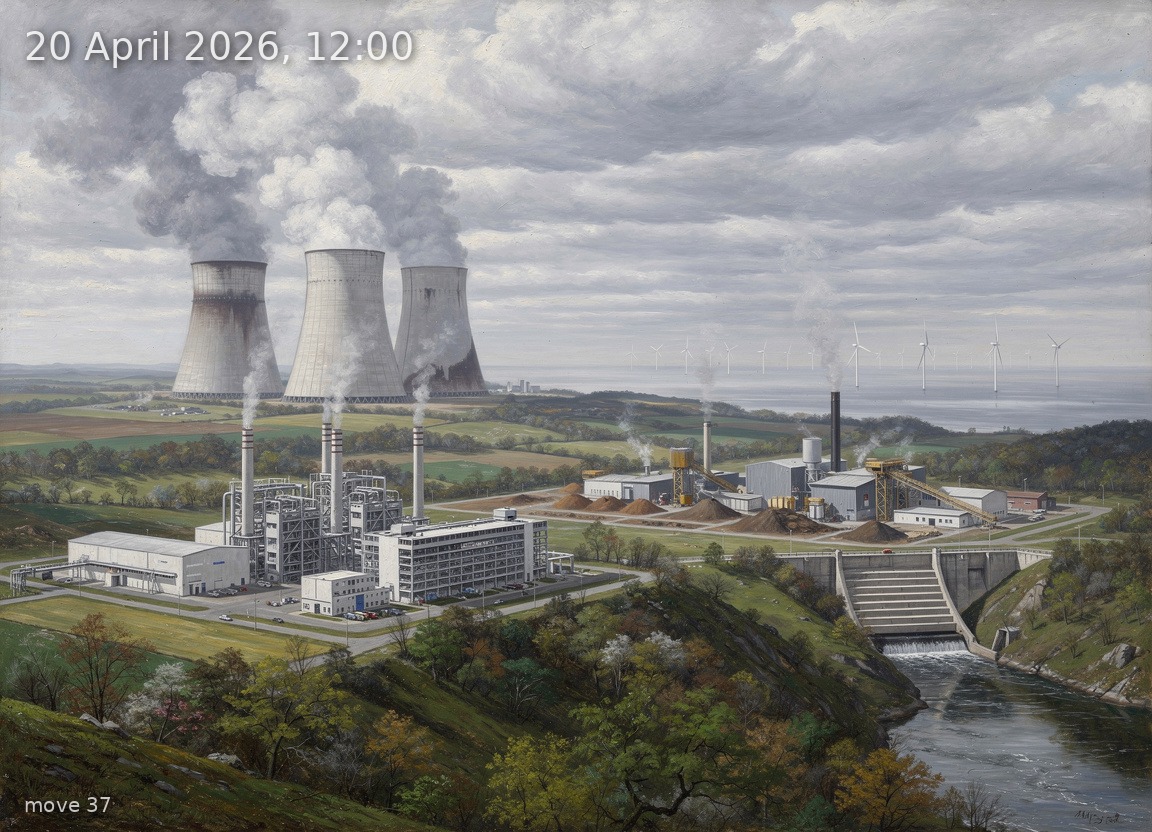
Overcast spring midday: gas, coal, and biomass dominate as onshore wind and solar contribute nothing under full cloud cover.
Back
Generation mix
Wind offshore 16%
Biomass 20%
Hydro 7%
Natural gas 22%
Hard coal 17%
Brown coal 18%
44%
Renewable share
3.4 GW
Wind (on + offshore)
0.0 GW
Solar
21.4 GW
Total generation
+21.4 GW
Net export
51.2 €/MWh
Day-ahead price
8.3°C / 24 km/h
Temp / Wind speed
Open-Meteo, Kassel (51.3°N 9.5°E)
100.0% / 33.2 W/m²
Cloud cover / Radiation
376
gCO₂/kWh
Image prompt
Natural gas 4.6 GW occupies the left-centre as a cluster of modern combined-cycle gas turbine plants with tall single exhaust stacks venting thin white plumes; brown coal 3.8 GW fills the left background as three massive hyperbolic cooling towers with voluminous grey-white steam billowing upward; hard coal 3.6 GW appears as a pair of large conventional power stations with rectangular boiler houses and twin chimneys trailing dark wisps; biomass 4.4 GW is represented in the right-centre by several mid-sized industrial plants with wood-chip conveyors and modest stacks emitting pale vapour; offshore wind 3.4 GW is visible far in the right background as a line of three-blade turbines standing on monopile foundations in a grey sea on the distant horizon; hydro 1.6 GW appears as a concrete dam and spillway nestled in a small valley at far right. The sky is an unbroken ceiling of heavy, layered stratus clouds at midday — diffuse white-grey light with no sun visible, no shadows on the ground, consistent with 100% overcast. The spring landscape shows fresh pale-green grass and budding deciduous trees at approximately 8°C — cool, damp, early-spring atmosphere. A moderate breeze bends the young grass but onshore terrain shows no spinning turbines. The mood is muted and weighty, with the industrial facilities dominating the composition under the oppressive overcast, reflecting a moderate electricity price. Highly detailed oil painting in the tradition of 19th-century German Romantic landscape painters — rich muted colour palette of greys, slate blues, mossy greens, and ivory whites, visible impasto brushwork, atmospheric aerial perspective with receding detail toward the sea horizon. Each energy technology rendered with meticulous engineering accuracy: lattice towers, nacelle housings, aluminium-framed structures, reinforced-concrete cooling towers with correct parabolic profiles, conveyor gantries. No text, no labels.