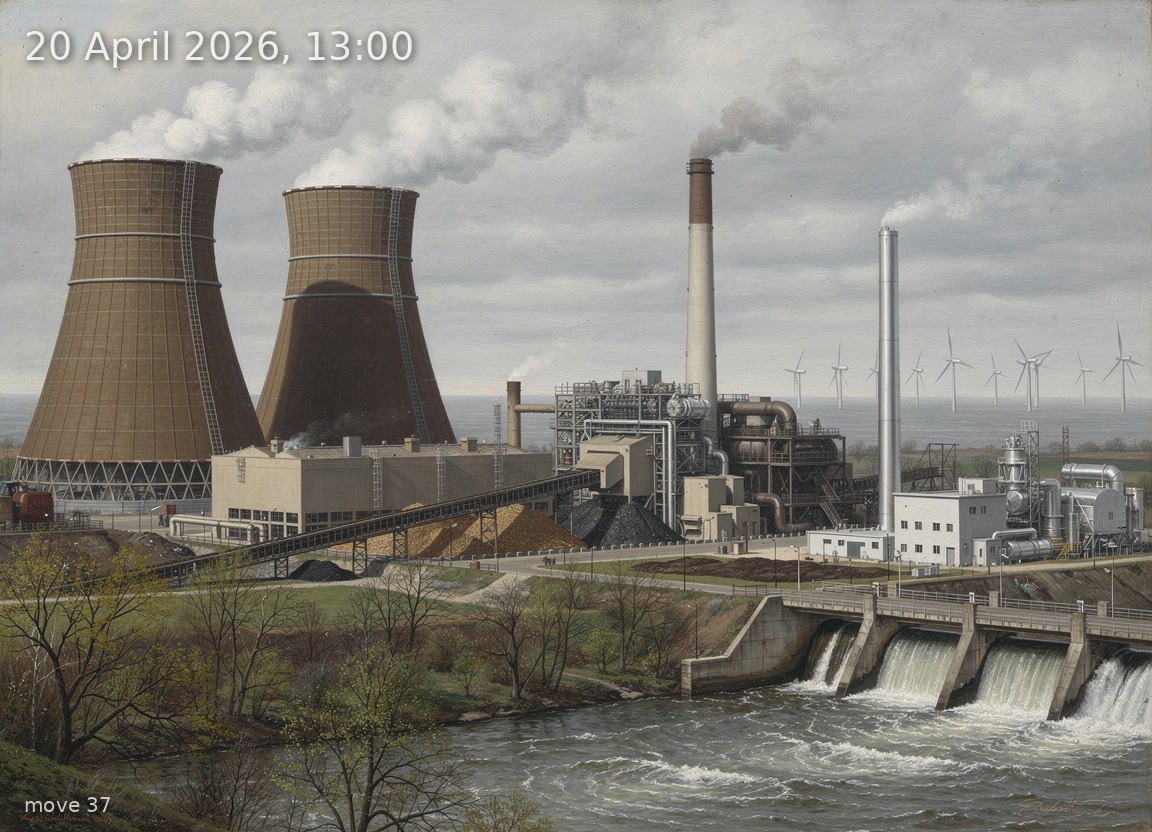
Overcast spring midday: biomass, brown coal, offshore wind, and hard coal anchor a 18.6 GW generation mix.
Back
Generation mix
Wind offshore 19%
Biomass 23%
Hydro 10%
Natural gas 12%
Hard coal 15%
Brown coal 21%
52%
Renewable share
3.6 GW
Wind (on + offshore)
0.0 GW
Solar
18.6 GW
Total generation
+18.6 GW
Net export
32.6 €/MWh
Day-ahead price
8.2°C / 25 km/h
Temp / Wind speed
Open-Meteo, Kassel (51.3°N 9.5°E)
100.0% / 28.5 W/m²
Cloud cover / Radiation
344
gCO₂/kWh
Image prompt
Brown coal 3.9 GW dominates the left quarter as a massive lignite power station with three hyperbolic cooling towers emitting thick white steam plumes into a uniformly overcast sky; biomass 4.3 GW occupies the left-centre as a sprawling wood-chip-fired plant with tall rectangular boiler buildings, conveyor belts carrying fuel, and a single wide smokestack with pale exhaust; offshore wind 3.6 GW fills the centre-right background as a distant line of three-blade turbines standing in a grey North Sea horizon, rotors turning moderately in 24.6 km/h winds; hard coal 2.8 GW appears at the right-centre as a classic coal-fired station with a pair of tall chimneys and rail-fed coal bunkers; natural gas 2.2 GW sits to the right as a compact CCGT facility with a single gleaming exhaust stack and adjacent heat-recovery unit; hydro 1.8 GW is depicted in the far right foreground as a concrete run-of-river dam with water cascading through spillways into a swollen spring river. The time is 13:00 in April: full daylight but completely diffuse, no shadows, a flat 100% cloud ceiling in pale grey tones casting even, cool illumination across the landscape. Bare deciduous trees with the first faint green buds of early spring line the riverbanks. Temperature is a cool 8°C—figures in coats walk a path near the dam. The overall atmosphere is calm and muted, reflecting a moderate 32.6 EUR/MWh price: no oppressive darkness, no bright optimism, just a quiet industrial equilibrium. No solar panels anywhere—no sun to justify them. Painted in the style of a highly detailed 19th-century German Romantic oil painting with rich, layered brushwork, atmospheric aerial perspective, meticulous engineering detail on every turbine nacelle, cooling tower rib, and boiler structure, deep tonal subtlety in the grey sky gradations, and the grandeur of Caspar David Friedrich's sense of scale applied to an industrial panorama. No text, no labels.