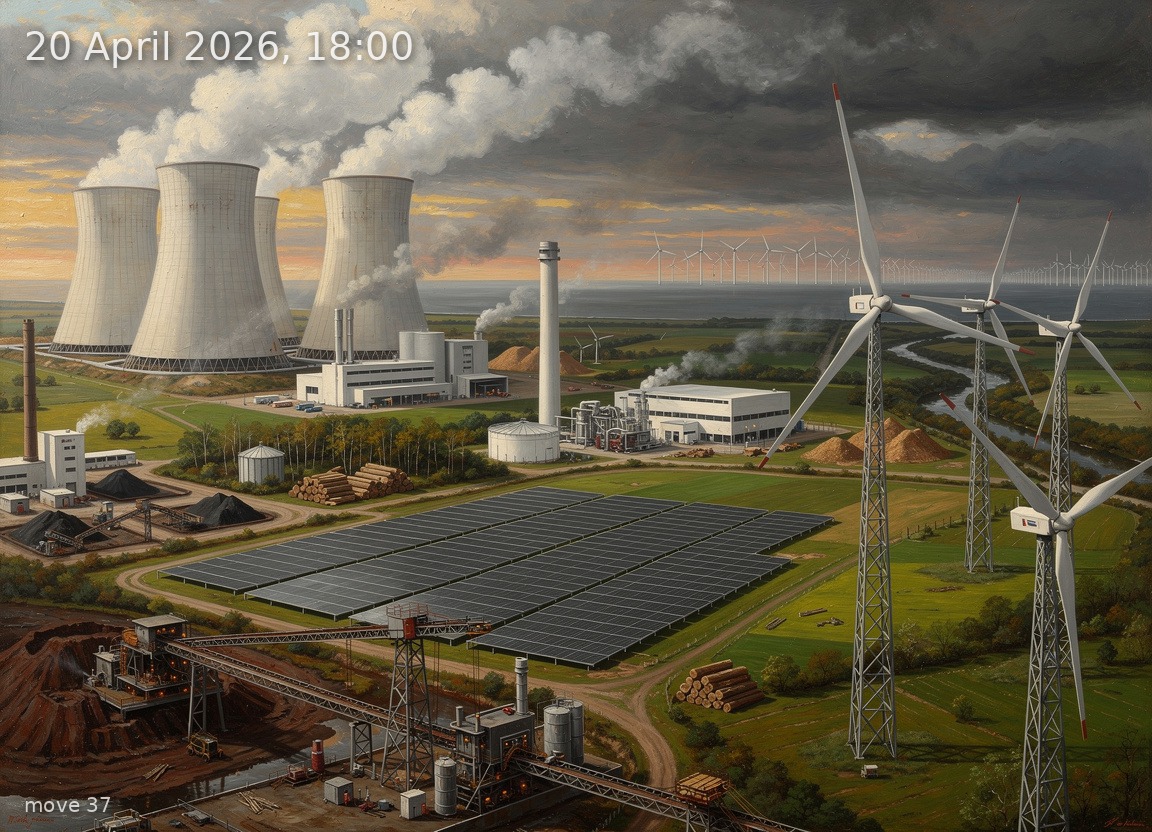
Strong wind leads generation but 14.4 GW net imports needed as solar fades under full overcast at dusk.
Back
Generation mix
Wind onshore 38%
Wind offshore 10%
Solar 17%
Biomass 10%
Hydro 4%
Natural gas 6%
Hard coal 4%
Brown coal 12%
78%
Renewable share
23.5 GW
Wind (on + offshore)
8.1 GW
Solar
48.8 GW
Total generation
-14.4 GW
Net import
112.9 €/MWh
Day-ahead price
7.8°C / 17 km/h
Temp / Wind speed
Open-Meteo, Kassel (51.3°N 9.5°E)
99.0% / 34.5 W/m²
Cloud cover / Radiation
161
gCO₂/kWh
Image prompt
Wind onshore 18.4 GW dominates the right half of the scene as dozens of large three-blade turbines on lattice and tubular steel towers stretching across rolling green spring fields, rotors spinning briskly in moderate wind; wind offshore 5.1 GW appears as a distant cluster of turbines on the far-right horizon above a grey sea glimpsed through a river valley. Brown coal 6.0 GW occupies the left foreground as a massive lignite power station with three hyperbolic cooling towers emitting thick white steam plumes drifting rightward, conveyor belts feeding dark brown fuel into the plant. Solar 8.1 GW is rendered as a broad field of aluminium-framed crystalline silicon photovoltaic panels in the centre-left middle ground, their surfaces dull and reflecting only grey sky, producing weakly. Biomass 4.7 GW appears as a mid-sized wood-chip-fired plant with a tall rectangular stack and a rounded fuel silo beside freshly coppiced woodland, positioned centre-left behind the solar field. Natural gas 2.8 GW is a compact modern CCGT facility with a single tall exhaust stack and a smaller heat-recovery steam generator, placed in the centre background. Hard coal 2.1 GW is a smaller conventional coal plant with a single rectangular chimney and a modest coal yard, visible to the far left behind the lignite station. Hydro 1.7 GW appears as a small concrete run-of-river dam on a stream in the lower-left corner. The sky is 99% overcast at dusk — 18:00 in Berlin in late April — with a narrow band of deep orange-red glow along the lowest horizon fading rapidly into heavy slate-grey and purple clouds above, creating a brooding, oppressive atmosphere reflecting the high electricity price. Temperature is a cool 7.8 °C; spring vegetation is fresh but pale, with bare-branching oaks beginning to leaf out, grass vivid green, patches of mud. The entire scene is rendered as a highly detailed oil painting in the tradition of 19th-century German Romantic landscape painters — rich, saturated colour, visible impasto brushwork, dramatic chiaroscuro between the fading horizon light and the darkening sky, atmospheric aerial perspective giving depth. Every technology is rendered with meticulous engineering accuracy: turbine nacelles, three-blade rotors, cooling tower parabolic profiles, PV panel grid lines, CCGT exhaust geometry. No text, no labels.