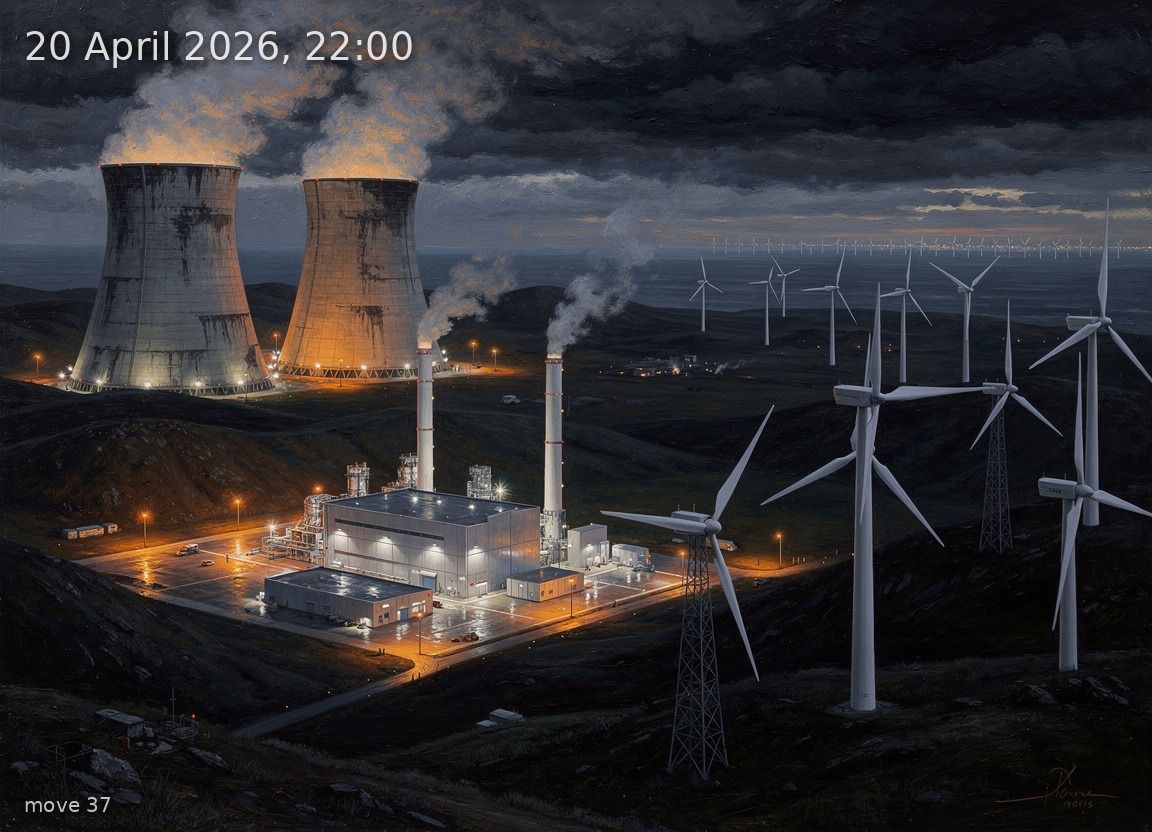
Wind leads at 24.9 GW but 7.6 GW net imports are needed as fossil plants and cool spring demand push prices to 116 EUR/MWh.
Back
Generation mix
Wind onshore 37%
Wind offshore 13%
Biomass 9%
Hydro 3%
Natural gas 17%
Hard coal 8%
Brown coal 13%
62%
Renewable share
24.9 GW
Wind (on + offshore)
0.0 GW
Solar
50.1 GW
Total generation
-7.6 GW
Net import
116.0 €/MWh
Day-ahead price
5.5°C / 7 km/h
Temp / Wind speed
Open-Meteo, Kassel (51.3°N 9.5°E)
99.0% / 0.0 W/m²
Cloud cover / Radiation
255
gCO₂/kWh
Image prompt
Wind onshore 18.5 GW dominates the right two-fifths of the scene as dozens of tall three-blade turbines with white tubular towers and nacelles, blades slowly turning, stretching across rolling dark hills; wind offshore 6.4 GW appears in the far right background as a distant line of turbines on a barely visible North Sea horizon. Natural gas 8.3 GW occupies the centre-left as a cluster of compact CCGT power stations with slim exhaust stacks venting thin white plumes, lit by orange sodium floodlights. Brown coal 6.7 GW fills the left foreground as two massive hyperbolic cooling towers emitting thick steam columns, illuminated from below by industrial halogen lights. Hard coal 4.2 GW sits just left of centre as a smaller coal-fired station with a single tall chimney and conveyor belt infrastructure. Biomass 4.5 GW appears as a mid-ground industrial biogas facility with rounded digesters and a modest stack, warmly lit. Hydro 1.4 GW is a small dam structure nestled in a valley at far left. Time is 22:00 in April — the sky is completely dark, deep navy-black, no twilight glow, 99% cloud cover so no stars or moon visible, only the faint suggestion of low clouds reflecting industrial light. The atmosphere is heavy, oppressive, reflecting 116 EUR/MWh pricing — thick low clouds press down on the landscape, tinged amber-grey by the industrial glow. Temperature is 5.5°C on a cool spring night: bare-branched trees with only the earliest buds, patches of damp grass, a chill mist hugging low ground. The entire scene is rendered as a highly detailed oil painting in the tradition of 19th-century German Romantic landscape art — rich, dark palette of deep blues, warm oranges, grey-whites, and blacks, with visible expressive brushwork, dramatic chiaroscuro, and atmospheric depth. Each energy technology is painted with meticulous engineering accuracy: three-blade rotor geometry, lattice sub-structures on turbine towers, aluminium cladding on CCGT units, reinforced concrete texture on cooling towers. The painting evokes Caspar David Friedrich crossed with industrial realism — sublime, moody, monumental. No text, no labels.