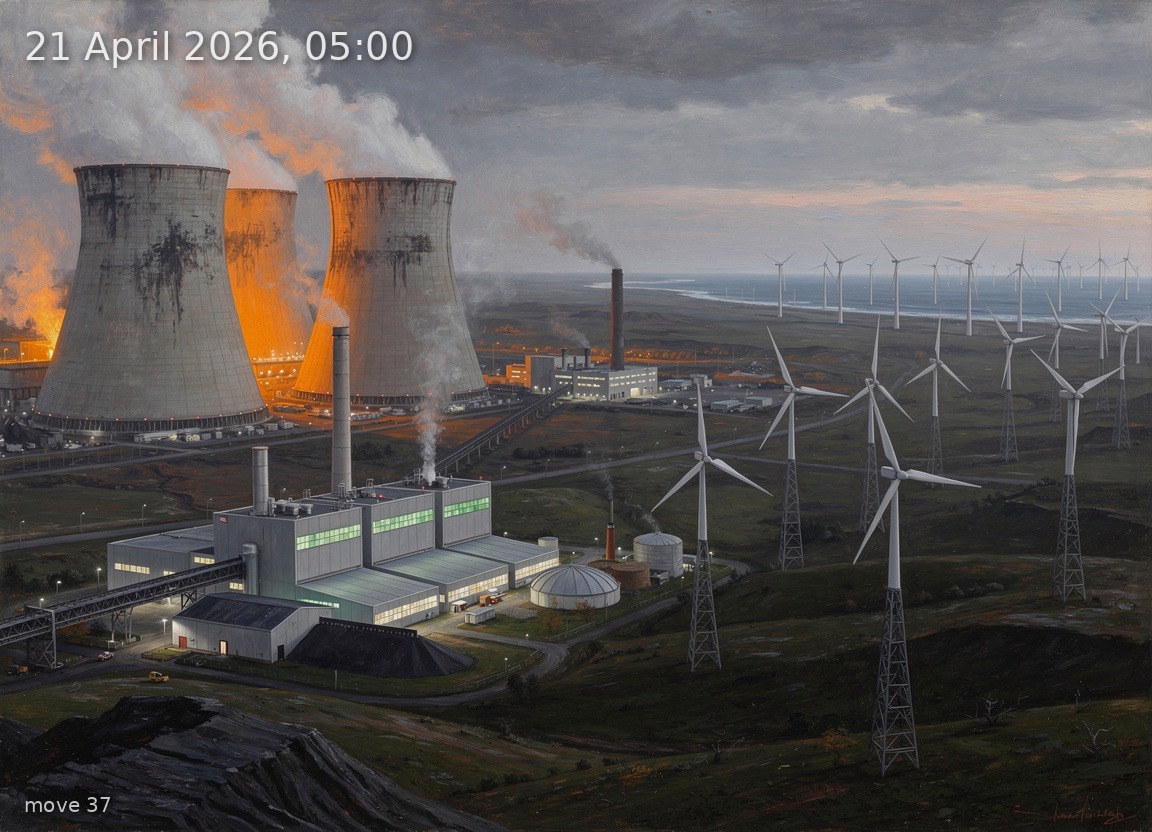
Wind leads at 17.8 GW but substantial thermal generation and net imports cover a 50.3 GW pre-dawn demand.
Back
Generation mix
Wind onshore 35%
Wind offshore 8%
Solar 0%
Biomass 10%
Hydro 3%
Natural gas 18%
Hard coal 9%
Brown coal 16%
56%
Renewable share
17.8 GW
Wind (on + offshore)
0.0 GW
Solar
41.2 GW
Total generation
-9.1 GW
Net import
108.4 €/MWh
Day-ahead price
5.4°C / 7 km/h
Temp / Wind speed
Open-Meteo, Kassel (51.3°N 9.5°E)
90.0% / 0.0 W/m²
Cloud cover / Radiation
290
gCO₂/kWh
Image prompt
Wind onshore 14.5 GW dominates the right half of the canvas as dozens of tall three-blade turbines on lattice towers stretching across a dark rolling plain, their rotors turning slowly in light wind; wind offshore 3.3 GW appears as a distant cluster of turbines on the far-right horizon above a faintly visible North Sea sliver. Brown coal 6.6 GW occupies the left foreground as a massive lignite power station with three hyperbolic cooling towers emitting thick white-grey steam plumes lit from below by sodium-orange industrial lighting. Natural gas 7.5 GW fills the centre-left as two compact CCGT units with tall single exhaust stacks releasing thin transparent heat haze, their turbine halls glowing with interior fluorescent light through high windows. Hard coal 3.8 GW sits behind the gas plant as a smaller coal station with a single large chimney and a dark conveyor belt leading to a coal heap. Biomass 4.1 GW appears as a modest wood-chip-fired plant with a short stack and a steaming dome, positioned between the gas and wind sections. Hydro 1.3 GW is suggested by a small concrete dam and spillway in a narrow valley at the far left edge. The sky is deep blue-grey pre-dawn, 05:00 in April — no direct sunlight, only the faintest pale luminance along the eastern horizon beneath a 90% overcast ceiling of heavy low stratus clouds pressing down oppressively, reflecting the high electricity price. No solar panels anywhere — the landscape is dark. Temperature is 5.4°C: bare early-spring trees with just the first tiny buds, frost on the grass, breath-like mist near ground level. Sodium streetlights cast orange pools along an access road. Transmission pylons with high-voltage lines recede into the murky distance connecting the plants. Style: highly detailed oil painting in the tradition of 19th-century German Romantic landscape painters — Caspar David Friedrich meets industrial sublime — rich chiaroscuro, visible impasto brushwork, atmospheric depth and moody grandeur, meticulous engineering detail on every turbine nacelle, cooling tower, and exhaust stack. No text, no labels.