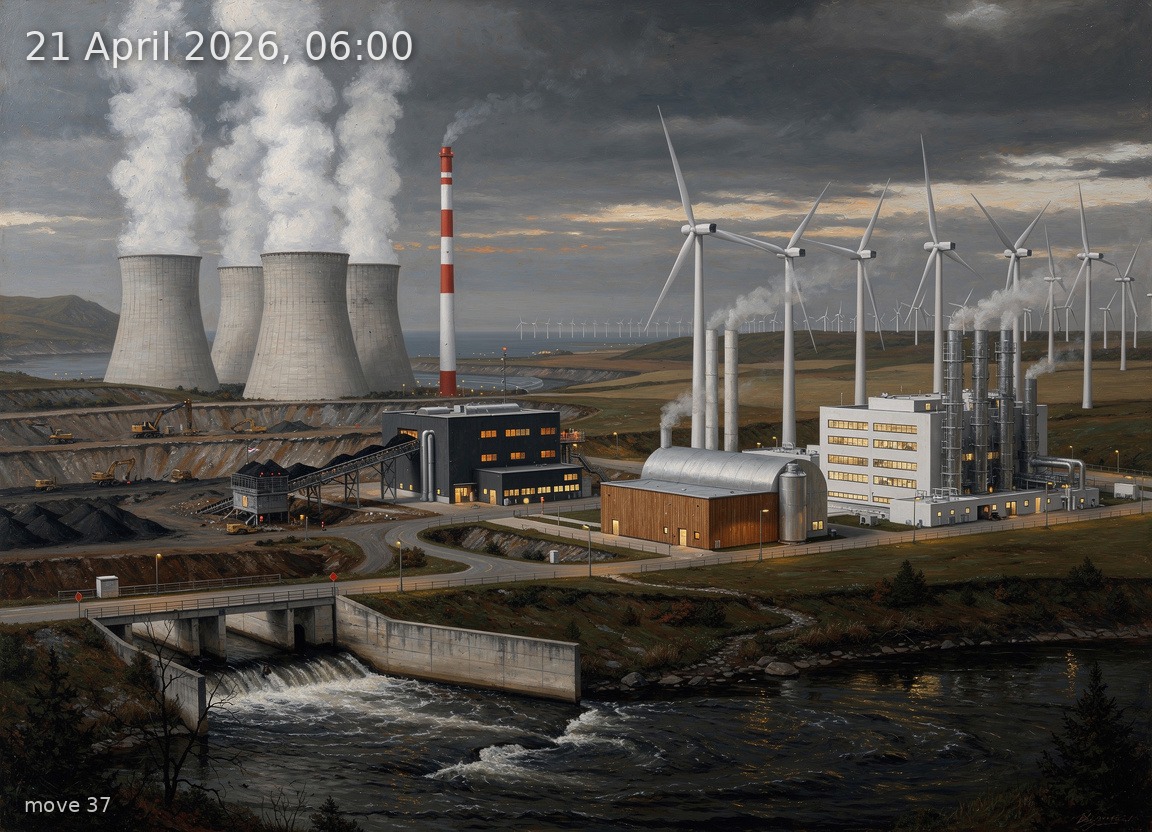
Wind leads at 17.2 GW but heavy cloud, negligible solar, and 14 GW net imports drive elevated morning prices.
Back
Generation mix
Wind onshore 34%
Wind offshore 7%
Solar 2%
Biomass 10%
Hydro 3%
Natural gas 18%
Hard coal 9%
Brown coal 16%
56%
Renewable share
17.3 GW
Wind (on + offshore)
0.9 GW
Solar
42.0 GW
Total generation
-14.0 GW
Net import
127.1 €/MWh
Day-ahead price
4.9°C / 7 km/h
Temp / Wind speed
Open-Meteo, Kassel (51.3°N 9.5°E)
88.0% / 0.0 W/m²
Cloud cover / Radiation
292
gCO₂/kWh
Image prompt
Wind onshore 14.3 GW dominates the right half of the scene as dozens of tall three-blade turbines with white tubular towers and aerodynamic nacelles stretching across rolling fields into the hazy distance; natural gas 7.7 GW appears in the centre-right as a cluster of modern combined-cycle gas turbine plants with slim exhaust stacks emitting thin pale plumes; brown coal 6.8 GW fills the left quarter as massive hyperbolic concrete cooling towers with dense white steam columns rising into the heavy sky, adjacent to a lignite open-pit mine's terraced earth; hard coal 3.8 GW sits centre-left as a blocky power station with a tall red-and-white-striped chimney and conveyor belts carrying dark fuel; biomass 4.2 GW appears as a mid-ground timber-clad industrial plant with a rounded silo and moderate white exhaust; wind offshore 2.9 GW is suggested by distant turbines on a grey horizon line beyond a sliver of the North Sea visible through a gap in the terrain; hydro 1.3 GW shows as a small concrete dam and spillway beside a dark river in the lower foreground; solar 0.9 GW is represented by a small field of aluminium-framed crystalline PV panels sitting inert and dark, reflecting no sunlight, near the foreground edge. The sky is pre-dawn deep blue-grey with 88% cloud cover — thick stratiform clouds press low, no direct sunlight, only the faintest pale luminescence along the eastern horizon hinting at sunrise still below the cloud deck. The temperature is near 5°C: early spring with bare branches on scattered birch trees, patches of frost on ploughed brown earth, dormant grass. The atmosphere feels heavy and oppressive, matching a high electricity price — the clouds seem to weigh upon the industrial landscape. Style: highly detailed oil painting in the tradition of 19th-century German Romantic landscape painters such as Caspar David Friedrich and Carl Blechen, with rich saturated earth tones, visible impasto brushwork, dramatic atmospheric depth, chiaroscuro contrast between the glowing industrial lights and the dark pre-dawn sky, meticulous engineering accuracy on every turbine blade, cooling tower, and smokestack. No text, no labels.