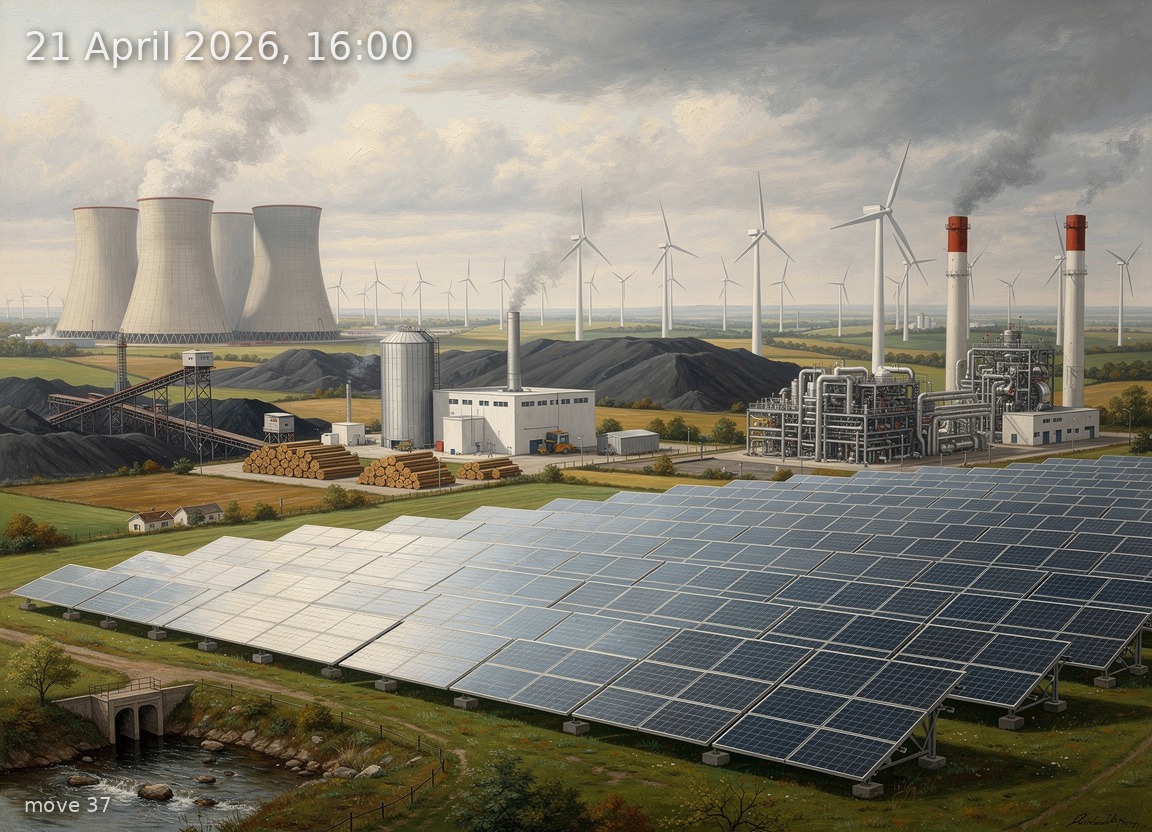
Solar at 30 GW dominates under overcast skies; onshore wind adds 12.6 GW, keeping prices low at 14.5 EUR/MWh.
Back
Generation mix
Wind onshore 22%
Wind offshore 2%
Solar 53%
Biomass 7%
Hydro 2%
Natural gas 4%
Hard coal 2%
Brown coal 7%
86%
Renewable share
13.6 GW
Wind (on + offshore)
30.0 GW
Solar
56.8 GW
Total generation
-5.5 GW
Net import
14.5 €/MWh
Day-ahead price
12.3°C / 17 km/h
Temp / Wind speed
Open-Meteo, Kassel (51.3°N 9.5°E)
99.0% / 207.8 W/m²
Cloud cover / Radiation
95
gCO₂/kWh
Image prompt
Solar 30.0 GW dominates the scene: vast expanses of aluminium-framed crystalline silicon photovoltaic panels stretch across the entire centre and right foreground, covering rolling green April farmland, their surfaces reflecting a diffuse milky-white sky. Wind onshore 12.6 GW appears as dozens of tall three-blade turbines with white tubular towers arrayed along ridgelines in the middle distance, rotors turning steadily in moderate wind. Brown coal 4.0 GW occupies the far left as a cluster of massive hyperbolic cooling towers emitting thick white steam plumes, beside conveyor belts and lignite stockpiles. Natural gas 2.5 GW sits just right of the coal plant as a compact CCGT facility with twin exhaust stacks releasing thin heat shimmer. Biomass 4.1 GW appears as a mid-sized biomass plant with a tall cylindrical silo and a modest smokestack amid stacked timber, positioned in the left-centre. Hard coal 1.2 GW is a smaller conventional power station with a single square cooling tower and coal bunker, tucked behind the biomass plant. Hydro 1.4 GW is visible as a small concrete run-of-river dam on a stream cutting through the lower-left corner. Wind offshore 1.0 GW is suggested by a faint line of turbines on the far horizon. The sky is 99% overcast—a heavy, uniform blanket of pale grey stratus clouds covering the entire dome, but with full late-afternoon daylight at 16:00 in April filtering through evenly, casting soft shadowless illumination. The atmosphere feels calm and open, reflecting the low electricity price. Spring vegetation: fresh bright-green grass, budding deciduous trees with pale new leaves, scattered yellow wildflowers. Temperature around 12°C suggests cool crispness—no heat haze. Highly detailed oil painting in the tradition of 19th-century German Romantic landscape painters—Caspar David Friedrich's atmospheric depth crossed with meticulous industrial realism. Rich layered colour, visible confident brushwork, luminous overcast sky with subtle tonal gradations from cream-white at the horizon to dove-grey at the zenith. Each technology rendered with correct engineering detail: turbine nacelles, lattice tower bases, panel junction boxes, cooling tower parabolic curves, conveyor gantries. No text, no labels.