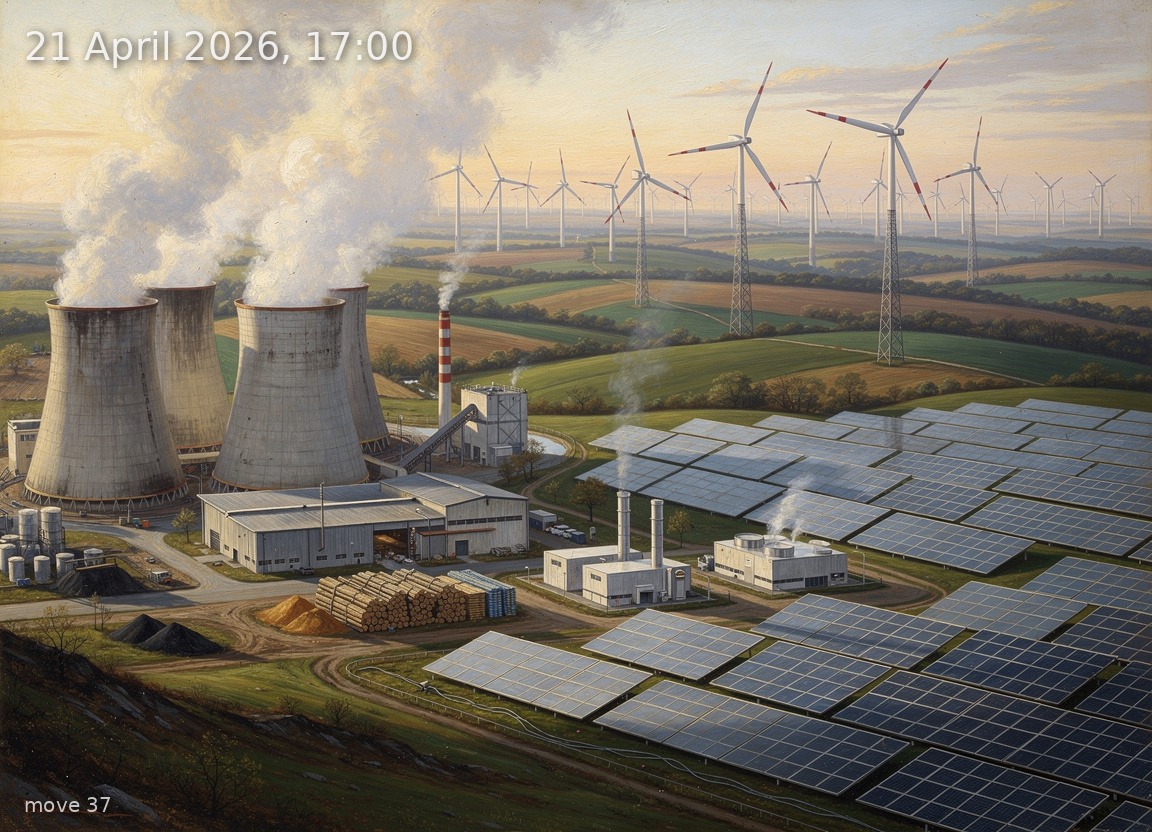
Solar at 21 GW and wind at 14.2 GW dominate, but 14.8 GW net imports bridge the gap to 63.8 GW demand.
Back
Generation mix
Wind onshore 27%
Wind offshore 2%
Solar 43%
Biomass 9%
Hydro 3%
Natural gas 5%
Hard coal 3%
Brown coal 9%
83%
Renewable share
14.2 GW
Wind (on + offshore)
21.0 GW
Solar
49.0 GW
Total generation
-14.8 GW
Net import
69.8 €/MWh
Day-ahead price
12.4°C / 17 km/h
Temp / Wind speed
Open-Meteo, Kassel (51.3°N 9.5°E)
45.0% / 183.5 W/m²
Cloud cover / Radiation
118
gCO₂/kWh
Image prompt
Solar 21.0 GW dominates the right half of the scene as vast fields of aluminium-framed crystalline silicon PV panels stretching across rolling central German farmland, angled to catch fading light; wind onshore 13.2 GW fills the upper-centre background as dozens of three-blade turbines on tall lattice and tubular towers, rotors visibly turning in moderate wind; brown coal 4.3 GW occupies the left foreground as a cluster of massive hyperbolic cooling towers with thick white-grey steam plumes rising into the sky; biomass 4.2 GW appears as a medium-sized industrial plant with a timber yard and single stack emitting thin smoke, just left of centre; natural gas 2.6 GW rendered as two compact CCGT units with slender exhaust stacks and heat-shimmer, nestled between the coal plant and biomass; hydro 1.4 GW shown as a small concrete dam with cascading water in the far left valley; hard coal 1.3 GW depicted as a smaller coal plant with a single square cooling tower and conveyor belt, behind the brown coal complex; wind offshore 1.0 GW suggested by a thin line of turbines on the far horizon. TIME AND LIGHT: 17:00 dusk in late April — the sun is very low on the western horizon, casting long golden-orange light across the landscape, the sky above transitioning from pale amber near the horizon through warm peach to a deepening blue overhead, broken cumulus clouds at 45% coverage lit from below in orange and pink, shadows stretching dramatically eastward. Spring vegetation: fresh green grass, budding deciduous trees, wildflowers in meadow edges, temperature around 12°C suggesting cool crispness. The atmosphere carries a slightly heavy, hazy quality reflecting the moderate electricity price — not oppressive but weighted. STYLE: highly detailed oil painting in the tradition of Caspar David Friedrich and Carl Blechen — rich, luminous colour with visible impasto brushwork, atmospheric depth created through layered glazes, meticulous engineering accuracy on every turbine nacelle, every PV cell reflection, every cooling tower's parabolic curvature and concrete texture. The composition balances sublime natural beauty with industrial realism, feeling like a masterwork Romantic landscape of the energy transition. No text, no labels.