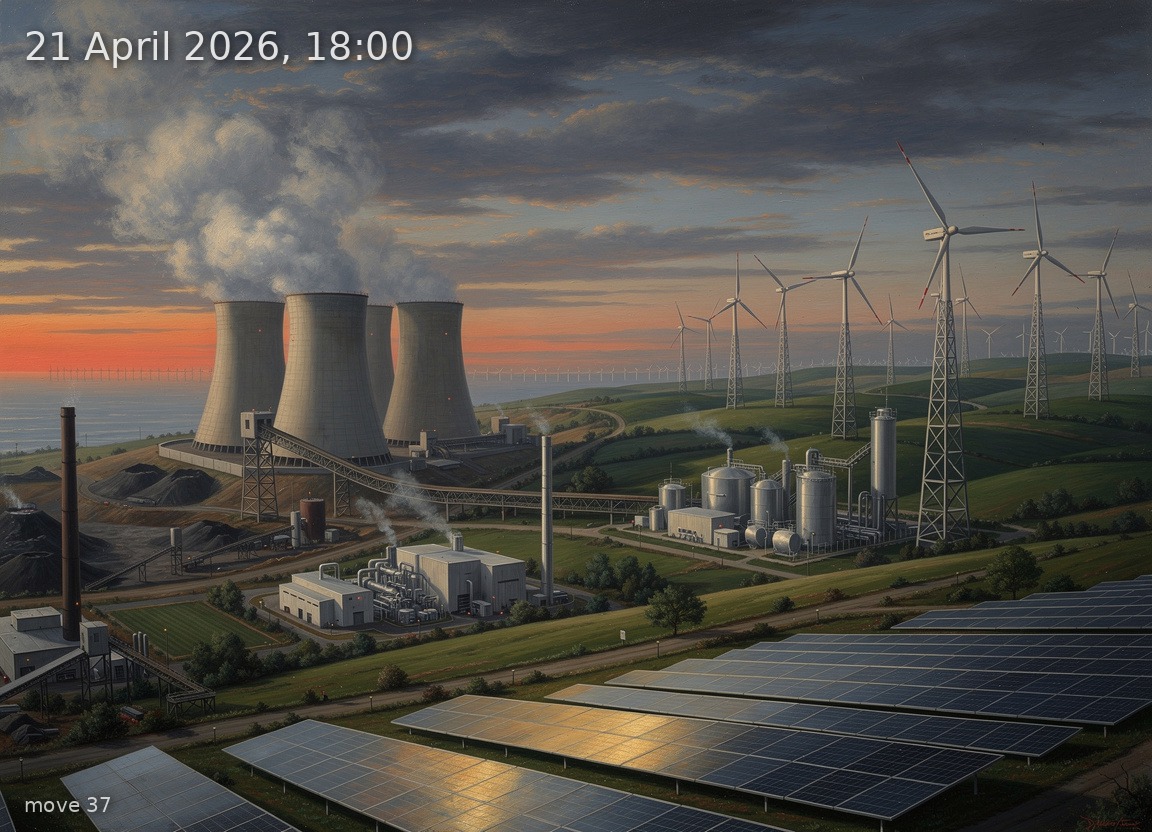
Wind and fading solar lead generation while 21 GW of net imports and thermal plants cover strong evening demand.
Back
Generation mix
Wind onshore 31%
Wind offshore 3%
Solar 26%
Biomass 10%
Hydro 3%
Natural gas 9%
Hard coal 4%
Brown coal 14%
72%
Renewable share
14.1 GW
Wind (on + offshore)
11.0 GW
Solar
42.6 GW
Total generation
-21.0 GW
Net import
102.6 €/MWh
Day-ahead price
12.0°C / 16 km/h
Temp / Wind speed
Open-Meteo, Kassel (51.3°N 9.5°E)
63.0% / 108.0 W/m²
Cloud cover / Radiation
193
gCO₂/kWh
Image prompt
Dusk scene at 18:00 in spring, rapidly fading orange-red glow on the lower horizon, darkening blue-grey sky above, scattered clouds at 63% cover. Wind onshore 13.0 GW dominates the right half of the composition as dozens of three-blade turbines on lattice towers stretching across rolling green hills, rotors turning in moderate wind. Solar 11.0 GW occupies the centre-right foreground as expansive fields of aluminium-framed crystalline silicon PV panels catching the last amber light at a low angle. Brown coal 6.0 GW fills the left quarter as a cluster of massive hyperbolic cooling towers with thick white-grey steam plumes rising against the dimming sky, adjacent conveyor belts and lignite stockpiles visible. Biomass 4.3 GW appears as a group of mid-sized industrial facilities with cylindrical digesters and modest exhaust stacks emitting thin wisps, placed left of centre. Natural gas 4.0 GW is rendered as compact CCGT units with slim silver exhaust stacks and visible heat shimmer, positioned centre-left. Hard coal 1.8 GW shows a smaller coal plant with a single tall smokestack and dark conveyor infrastructure near the far left edge. Wind offshore 1.1 GW is visible as a distant row of turbines on the far horizon line where sea meets sky. Hydro 1.4 GW appears as a concrete dam with a small reservoir glinting in the fading light in the middle distance. The atmosphere is heavy and slightly oppressive, reflecting the high electricity price—haze thickens the air, muting distant details. Spring vegetation: fresh green grass, budding deciduous trees, wildflowers in meadows. Temperature around 12°C gives a cool dampness to the air. Overhead power transmission lines and steel pylons run diagonally across the scene, emphasizing interconnection. Style: highly detailed oil painting in the tradition of 19th-century German Romantic landscape painters—rich warm-to-cool colour palette transitioning from the amber horizon to deep blue-grey zenith, visible thick brushwork, atmospheric depth with sfumato-like haze layers, meticulous engineering detail on every turbine nacelle, panel frame, cooling tower curve, and exhaust stack. No text, no labels.