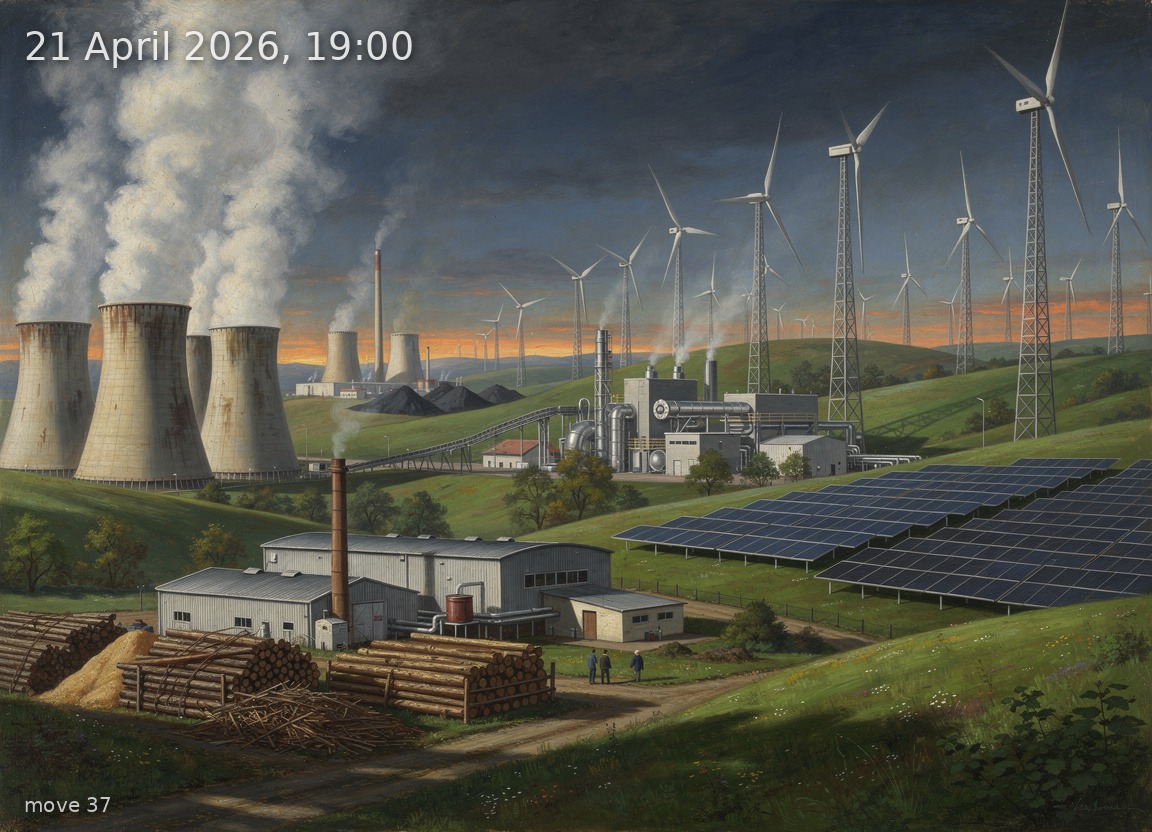
Wind leads at 12.9 GW but 24 GW net imports are needed as evening demand peaks at 63.6 GW.
Back
Generation mix
Wind onshore 33%
Wind offshore 3%
Solar 8%
Biomass 11%
Hydro 3%
Natural gas 15%
Hard coal 8%
Brown coal 19%
59%
Renewable share
14.2 GW
Wind (on + offshore)
3.1 GW
Solar
39.6 GW
Total generation
-24.0 GW
Net import
134.1 €/MWh
Day-ahead price
11.6°C / 14 km/h
Temp / Wind speed
Open-Meteo, Kassel (51.3°N 9.5°E)
27.0% / 83.0 W/m²
Cloud cover / Radiation
284
gCO₂/kWh
Image prompt
Wind onshore 12.9 GW dominates the right half of the scene as dozens of three-blade turbines on lattice and tubular towers stretching across rolling spring hills with young green grass; brown coal 7.3 GW occupies the left foreground as a cluster of massive hyperbolic cooling towers with thick white-grey steam plumes rising into the sky; natural gas 6.0 GW appears as a mid-ground complex of compact CCGT power blocks with tall single exhaust stacks emitting thin heat haze; biomass 4.5 GW is rendered as a medium-sized industrial plant with a timber storage yard and a single squat smokestack; solar 3.1 GW is shown as a modest field of aluminium-framed crystalline silicon panels in the mid-distance, their surfaces catching the last orange light; hard coal 3.1 GW appears as a coal-fired station with conveyor belts and a pair of rectangular cooling towers; wind offshore 1.3 GW is barely visible on the far horizon as a few turbines standing in a hazy sea; hydro 1.4 GW is represented by a small dam with cascading water on the far left. TIME AND LIGHTING: 19:00 in late April dusk — the sky above transitions from deep steel-blue at the zenith to a narrow band of warm amber and burnt orange along the lower horizon; the sun has just set, no direct sunlight remains, landscape lit by residual horizon glow and the first sodium-orange streetlights flickering on at the industrial facilities. ATMOSPHERE: the sky feels heavy and slightly oppressive, reflecting a high electricity price — low haze clings to the industrial structures, steam plumes catch the last amber light from below while their tops dissolve into the darkening blue. Partly cloudy sky at 27% cover, a few cumulus clouds edged gold underneath. Temperature 11.6°C — cool spring evening, figures in jackets near the biomass plant. Moderate wind animates the turbine blades mid-rotation. STYLE: highly detailed oil painting in the tradition of 19th-century German Romantic landscape painters such as Caspar David Friedrich and Carl Blechen — rich saturated colour, visible expressive brushwork, atmospheric depth with sfumato haze around distant towers, meticulous engineering detail on every nacelle, rotor blade, cooling tower, and PV panel frame. The composition balances sublime industrial grandeur with pastoral spring landscape. No text, no labels, no human-readable writing.