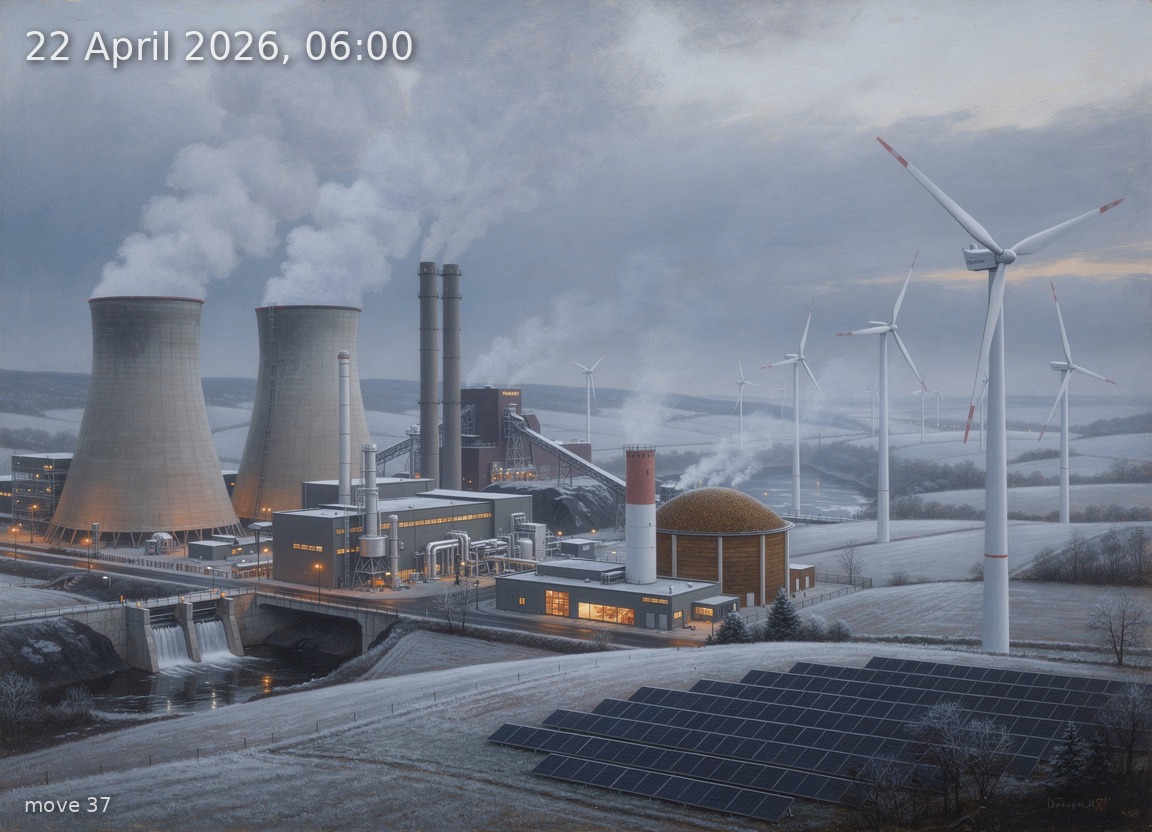
Cold, overcast dawn with high thermal dispatch and wind providing bulk renewables against a 20 GW import gap.
Back
Generation mix
Wind onshore 26%
Wind offshore 1%
Solar 3%
Biomass 12%
Hydro 4%
Natural gas 21%
Hard coal 13%
Brown coal 19%
47%
Renewable share
9.7 GW
Wind (on + offshore)
1.2 GW
Solar
35.2 GW
Total generation
-20.1 GW
Net import
139.8 €/MWh
Day-ahead price
-0.2°C / 5 km/h
Temp / Wind speed
Open-Meteo, Kassel (51.3°N 9.5°E)
91.0% / 0.0 W/m²
Cloud cover / Radiation
356
gCO₂/kWh
Image prompt
Wind onshore 9.2 GW dominates the right third of the scene as dozens of tall three-blade turbines with white tubular towers and nacelles stretching across rolling frost-covered farmland, blades turning slowly in light wind. Brown coal 6.7 GW occupies the left foreground as a massive lignite power station with three hyperbolic concrete cooling towers emitting thick white steam plumes into the cold air. Natural gas 7.5 GW fills the centre-left as a compact CCGT plant with tall slender exhaust stacks and low rectangular turbine halls, thin exhaust vapour rising. Hard coal 4.5 GW appears behind the gas plant as a coal-fired station with a single large chimney and conveyor infrastructure. Biomass 4.3 GW is rendered as a mid-sized industrial facility with a distinctive wooden-chip storage dome and moderate smokestack at centre-right. Hydro 1.3 GW appears as a small concrete dam and powerhouse nestled in a valley in the distant background. Solar 1.2 GW is barely suggested by a small field of aluminium-framed crystalline silicon panels in the mid-ground, their surfaces dark and unreflective under heavy overcast. Wind offshore 0.5 GW is hinted at by a few turbines on a grey horizon line at the far right. The sky is a deep blue-grey pre-dawn, no direct sunlight, only the faintest pale glow at the eastern horizon — heavy 91% cloud cover creates a thick, oppressive blanket of stratiform clouds pressing low. The temperature is below zero: frost coats every surface, bare deciduous trees with ice on branches, patches of old snow in furrows, breath-like mist at ground level. The atmosphere is heavy and brooding, reflecting the high electricity price. Rendered as a highly detailed oil painting in the tradition of 19th-century German Romantic landscape art — Caspar David Friedrich's atmospheric depth combined with Adolph Menzel's industrial precision. Rich, dark colour palette of steel blues, slate greys, ochre industrial lighting, and cool whites. Visible confident brushwork, atmospheric perspective with haze and mist layering the distances. Each technological element rendered with meticulous engineering accuracy: turbine nacelles, lattice transmission towers with sagging cables, cooling tower parabolic geometry, CCGT exhaust diffusers. Sodium-orange industrial lighting glows from plant windows and security lights, punctuating the cold blue pre-dawn. No text, no labels.