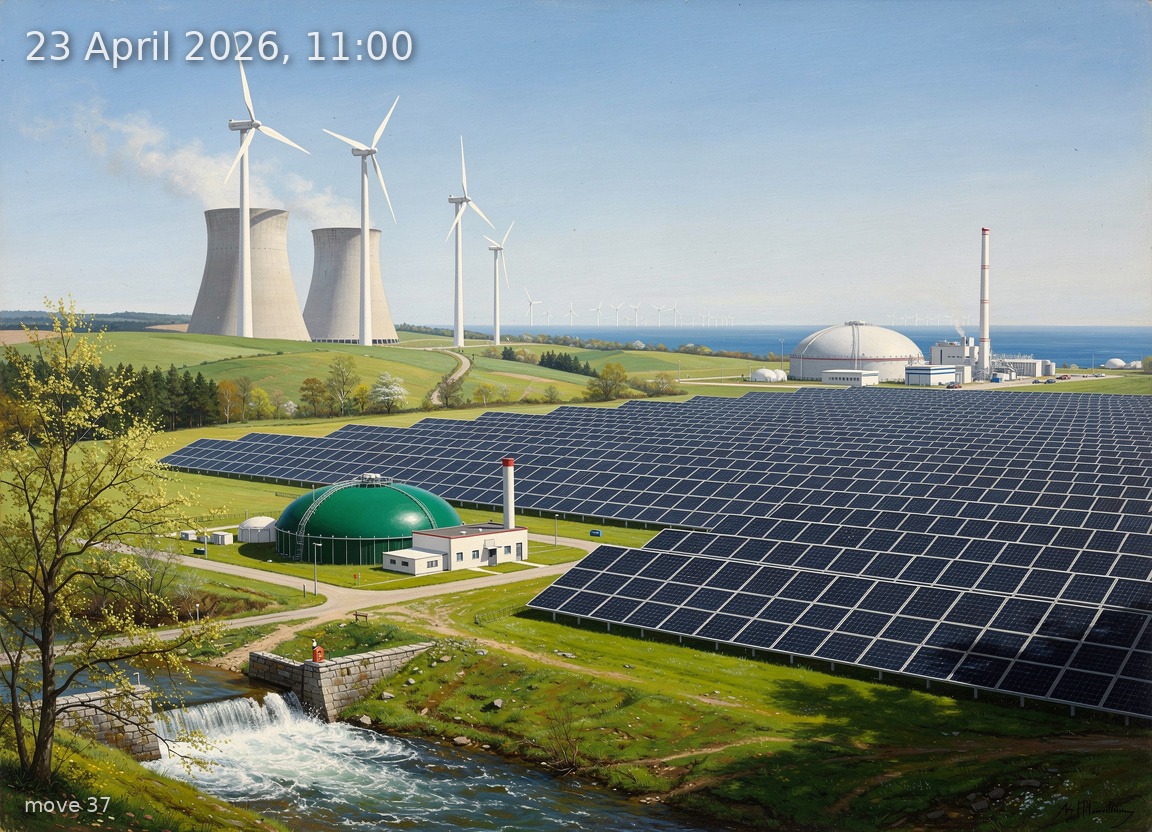
Solar at 50 GW drives 91% renewable share and 9 GW net export under clear spring skies, pushing prices negative.
Back
Generation mix
Wind onshore 12%
Wind offshore 2%
Solar 69%
Biomass 6%
Hydro 2%
Natural gas 3%
Hard coal 2%
Brown coal 4%
91%
Renewable share
10.4 GW
Wind (on + offshore)
50.0 GW
Solar
72.5 GW
Total generation
+9.0 GW
Net export
-6.2 €/MWh
Day-ahead price
12.3°C / 12 km/h
Temp / Wind speed
Open-Meteo, Kassel (51.3°N 9.5°E)
6.0% / 476.0 W/m²
Cloud cover / Radiation
64
gCO₂/kWh
Image prompt
Solar 50.0 GW dominates the scene as an immense expanse of crystalline silicon PV panels stretching across rolling green spring fields, occupying roughly two-thirds of the canvas from the centre to the right, their aluminium frames catching brilliant midday sunlight under a nearly cloudless pale-blue sky. Wind onshore 8.6 GW appears as a line of tall three-blade turbines with white tubular towers on gentle hills in the upper-left middle ground, rotors turning slowly in light wind. Wind offshore 1.7 GW is visible as a small cluster of turbines on the far horizon above a sliver of the North Sea. Biomass 4.1 GW is represented by a modest biogas plant with a rounded green fermenter dome and a low exhaust stack near the left-centre foreground. Hydro 1.2 GW shows as a small stone-walled weir with rushing water on the far left beside a tree line. Brown coal 2.8 GW occupies the far left background as two hyperbolic concrete cooling towers with thin, wispy steam plumes indicating low output. Natural gas 2.4 GW sits just right of the cooling towers as a compact CCGT facility with a single slender exhaust stack and barely visible heat shimmer. Hard coal 1.6 GW appears as a smaller coal plant with a single squat stack and conveyor belt, partially screened by budding deciduous trees. The landscape is lush early spring—fresh green grass, young leaves on trees, wildflowers beginning to bloom—under full bright daylight at 11:00 with the sun high in the southeast, casting short crisp shadows. The sky is vast and calm, almost entirely clear with only faint wisps of cirrus, conveying a serene open atmosphere consistent with negative electricity prices. Painted in the style of a highly detailed 19th-century German Romantic landscape oil painting—rich saturated colour palette, visible confident brushwork, atmospheric aerial perspective fading to a soft blue horizon, dramatic luminosity in the tradition of Caspar David Friedrich and Carl Blechen, yet with meticulous engineering accuracy in every turbine nacelle, PV cell, and cooling tower. No text, no labels.