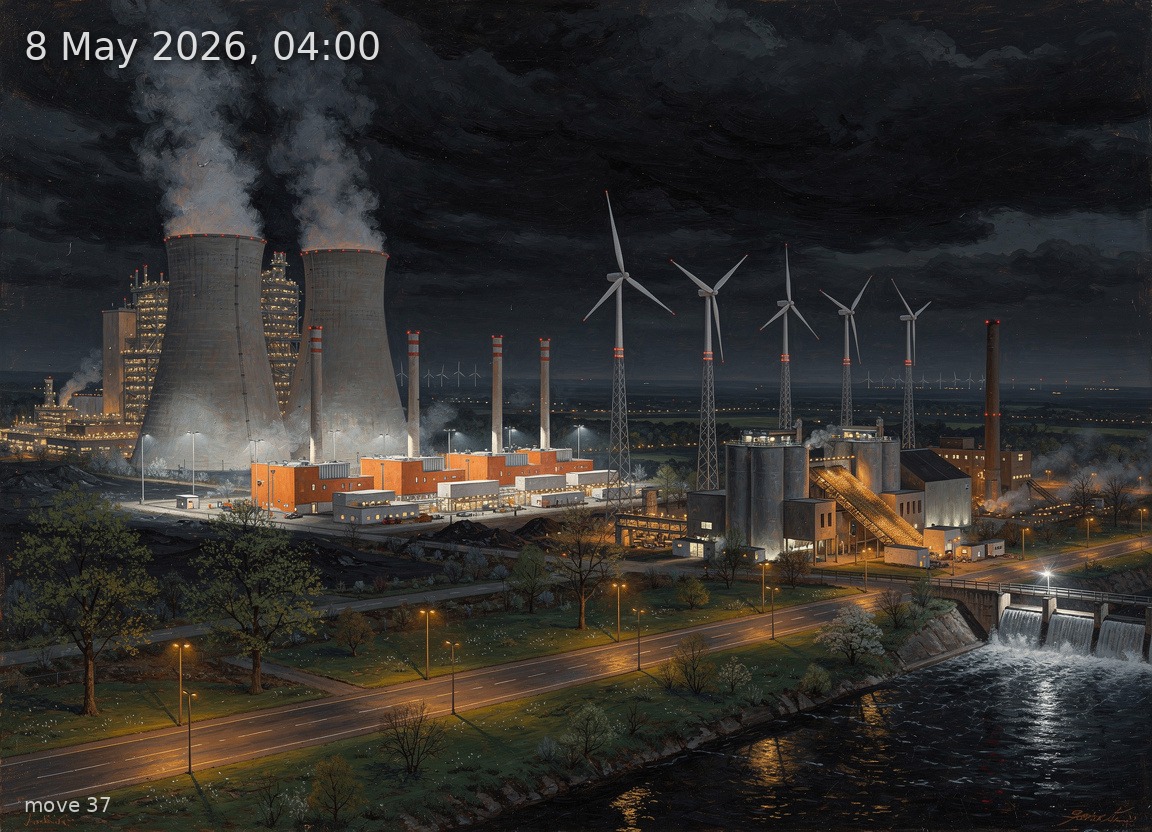
Brown coal, gas, and imports dominate at 4 AM as calm winds and zero solar leave renewables at 36%.
Back
Generation mix
Wind onshore 16%
Wind offshore 2%
Biomass 13%
Hydro 5%
Natural gas 24%
Hard coal 12%
Brown coal 28%
36%
Renewable share
5.7 GW
Wind (on + offshore)
0.0 GW
Solar
31.2 GW
Total generation
-14.6 GW
Net import
118.6 €/MWh
Day-ahead price
7.9°C / 4 km/h
Temp / Wind speed
Open-Meteo, Kassel (51.3°N 9.5°E)
99.0% / 0.0 W/m²
Cloud cover / Radiation
436
gCO₂/kWh
Image prompt
Brown coal 8.8 GW dominates the left third of the scene as a massive lignite power station with four hyperbolic cooling towers emitting thick white steam plumes into the darkness; natural gas 7.5 GW fills the center-left as a row of compact CCGT plants with tall single exhaust stacks and orange-lit turbine halls; wind onshore 5.0 GW appears across the center-right as a line of three-blade turbines on lattice towers, their rotors barely turning in the still air, red aviation warning lights blinking on nacelles; biomass 4.1 GW is rendered as a pair of industrial biomass combustion facilities with modest chimneys and warm-lit conveyor belts carrying wood pellets, positioned in the right-center; hard coal 3.7 GW appears as a coal-fired station with a single large stack and coal bunkers visible under sodium floodlights in the right portion; hydro 1.5 GW is shown as a small illuminated dam with water cascading over a spillway at the far right edge; wind offshore 0.7 GW is barely visible as distant turbine silhouettes on a dark horizon line. The sky is completely black with 99% cloud cover — no stars, no moon, no twilight glow, a heavy oppressive overcast pressing down, suggesting the high electricity price. The time is 4 AM in early May in central Germany: total darkness, the landscape visible only by artificial illumination — sodium-orange streetlights along a road in the foreground, cool white floodlights on industrial structures, and the ruddy glow of furnace interiors seen through windows. Sparse early-spring vegetation — fresh green grass and budding deciduous trees — is faintly visible in the artificial light. The air temperature is cool at 8°C, suggested by a faint mist hugging the ground. A network of high-voltage transmission lines with lattice pylons stretches across the scene, symbolizing the heavy import flows. Highly detailed oil painting in the tradition of 19th-century German Romantic landscape painters — rich deep color palette of navy, black, amber, and warm industrial orange, visible confident brushwork, atmospheric depth and chiaroscuro, with meticulous engineering accuracy for every technology depicted. The mood is somber, heavy, industrial, a nocturnal landscape where humanity's demand is answered by fire and imported current. No text, no labels.